How to Give Sadaqah Online Safely — A Complete Guide for UK Muslims
You have decided to give. Your intention is sincere, your heart is open, and you want your Sadaqah to reach someone who truly needs it. But before you click donate, a question sits at the back of your mind: is this charity actually legitimate? Is my money going where I think it is?
That question is not doubt. It is wisdom.
The Prophet Muhammad ﷺ said: “Give charity without delay, for it stands in the way of calamity.” (Tirmidhi)
He also taught us to protect our wealth and give with responsibility. In Islam, generous giving and careful giving are not opposites — they are two halves of the same act of worship.
This guide will show you exactly how to give Sadaqah online safely in the UK — what to check, what to avoid, what red flags to recognise, and how to give with full confidence that your donation is making the difference you intend.
What is Sadaqah and why does giving online matter?
Sadaqah is voluntary charity — any act of giving done sincerely for the sake of Allah (SWT), with no obligation attached. Unlike Zakat, which is a calculated annual duty, Sadaqah has no minimum amount, no fixed time, and no restriction on who can receive it. A few pounds donated online, a kind word to a neighbour, a smile to a stranger — all of these are Sadaqah.
“Sadaqah extinguishes sin as water extinguishes fire.” — Prophet Muhammad ﷺ (Tirmidhi)
Online giving has transformed the reach and speed of Sadaqah. With a few clicks, a UK Muslim can fund a water well in Pakistan, provide emergency food in Gaza, or sponsor an orphan in Yemen. Millions of lives are reached through online charity that would have been impossible to support just a generation ago.
But the same technology that makes giving easier has also made it easier for scammers to exploit generous donors. Fraudulent charities mimicking real organisations, fake social media campaigns, phishing emails disguised as donation requests — these are real, growing, and specifically targeting Muslim donors during periods of high giving such as Ramadan, Eid, and Muharram.
The Muslim Charities Forum, the Fundraising Regulator, and the Charity Commission for England and Wales have jointly urged donors to remain vigilant and be alert to the risk of fake charities, fake appeal websites, and email appeals impersonating genuine charities — particularly during periods of increased giving.
This guide gives you the knowledge to give confidently, safely, and with the maximum spiritual and practical impact.
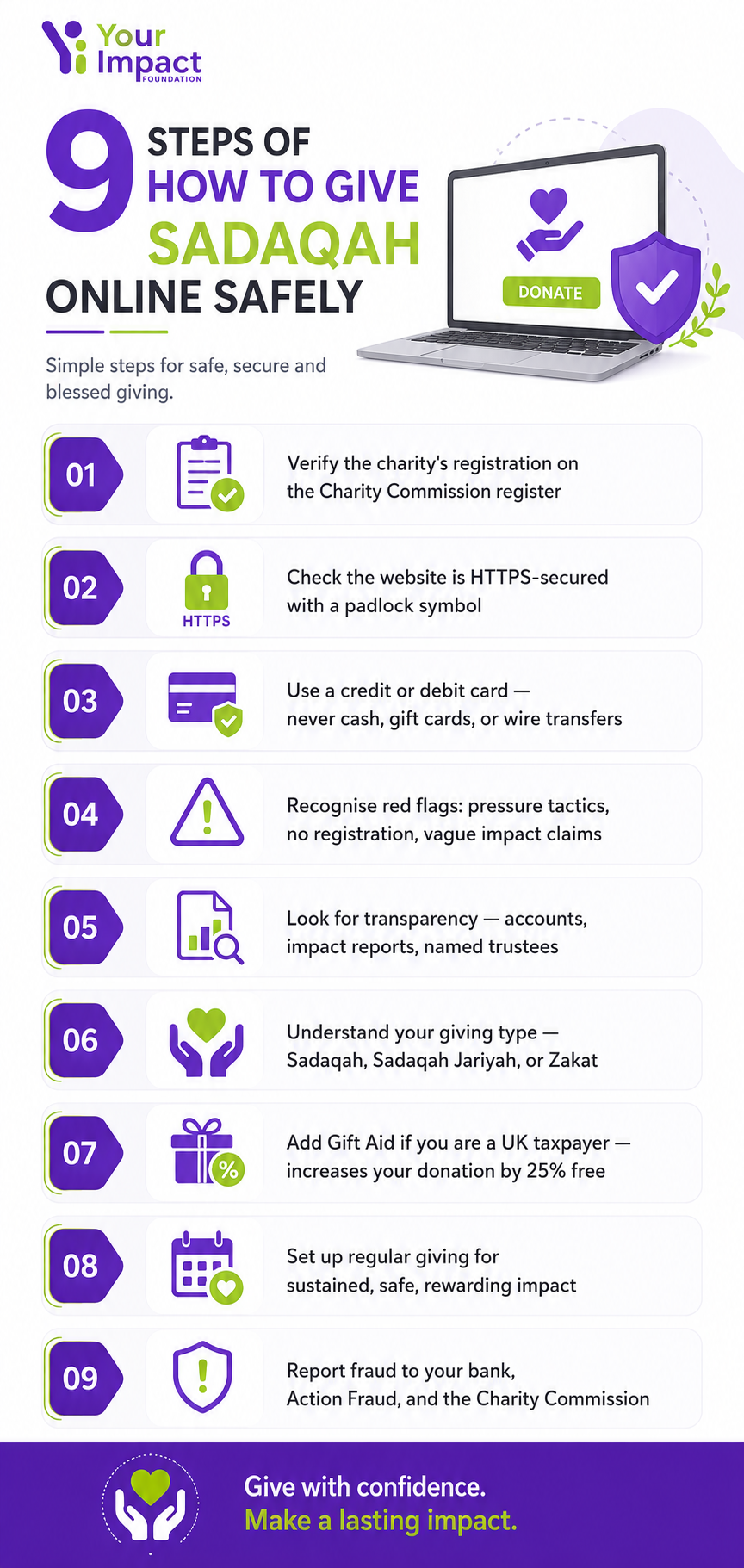
Summary: 9 steps of How to give Sadaqah online safely
Step
What to do
1
Verify the charity’s registration on the Charity Commission register
2
Check the website is HTTPS-secured with a padlock symbol
3
Use a credit or debit card — never cash, gift cards, or wire transfers
4
Recognise red flags: pressure tactics, no registration, vague impact claims
5
Look for transparency — accounts, impact reports, named trustees
6
Understand your giving type — Sadaqah, Sadaqah Jariyah, or Zakat
7
Add Gift Aid if you are a UK taxpayer — increases your donation by 25% free
8
Set up regular giving for sustained, safe, rewarding impact
9
Report fraud to your bank, Action Fraud, and the Charity Commission
Step 1: Check the charity is registered with the Charity Commission
This is the single most important step you can take before donating to any UK charity online — and it takes less than two minutes.
Every legitimate charity operating in England and Wales with an income over £5,000 is legally required to register with the Charity Commission. Registration means the organisation is subject to legal accountability, must submit annual reports and accounts, and is monitored for compliance with charity law.
How to check: Go to the official Charity Commission register at gov.uk/find-charity-information, enter the charity’s name, and verify that the registration number shown on the website matches what is on the register.
The Charity Commission’s Chief Executive has stated: “Looking up a charity on the register is one way anyone can check their money is going where they think it is. Donating to a registered charity is a good way to feel confident of that, because of the standards the law expects of them.”
Your Impact Foundation is registered with the Charity Commission for England and Wales under charity number 1192710. You can verify this directly on the Charity Commission register at any time.
If a charity you are considering has no registration number, cannot provide one, or the number does not match the register — do not donate.
Step 2: Verify the website is secure before entering any payment details
Before entering your card details or bank information on any donation page, check that the website is secure. This is a basic but critical step that many donors skip.
Look for:
HTTPS in the URL — the web address must begin with https:// not http://. The ‘S’ indicates the site is encrypted. If it is missing, your payment details are not protected.
A padlock symbol — visible in your browser’s address bar next to the URL. Click it to see the site’s security certificate.
The correct domain name — scammers frequently register domains that are one letter different from real charities (e.g. yourimpactfdn.org vs yourimpactfdn-uk.org). Always type the address directly into your browser rather than clicking a link from an email or social media post.
Fake websites mimicking authentic charities often have similar logos and web design but lack verifiable registration. They may have a website address that is slightly different to the original, and a payment portal that is not fully secure.
Practical rule: If you receive a donation link via WhatsApp, email, or social media, do not click it directly. Instead, open a new browser tab and type the charity’s known website address yourself.
Step 3: Use a secure, traceable payment method
How you pay matters as much as who you pay.
Always use:
Credit or debit card through the charity’s official payment portal
PayPal through a verified charity account
Direct bank transfer to the charity’s official account (as listed on their official website — never from a number provided in an email or social media message)
Standing order set up directly through your bank to the charity’s verified account number
Never use:
Cash sent by post
Gift cards or vouchers
Cryptocurrency (unless you are absolutely certain of the charity’s identity and have verified it through official channels)
Wire transfer to an unknown individual’s personal bank account
Payment requested urgently over the phone by someone you have not verified
Requests for payment in cash, gift cards, cryptocurrency, or wire transfers are sure-fire red flags and should never be used for charitable donations online.
Credit cards offer an additional layer of protection — if you later discover you have been defrauded, you can raise a chargeback claim with your card provider to recover the funds. This option is not available for cash or bank transfers.
Step 4: Recognise the red flags of fraudulent charity appeals
Scammers who target Muslim donors are becoming increasingly sophisticated. Fraudsters are now using artificial intelligence to create realistic images and stories to convince supporters to donate, and AI-powered chatbots to impersonate charity representatives. Knowing what to look for is your strongest protection.
Red flag 1: No charity registration number — or a number that does not verify
Any UK charity that cannot provide a Charity Commission registration number, or provides one that does not match the register, is either unregistered or fraudulent. This is a non-negotiable check.
Red flag 2: Pressure to donate immediately
Never feel pressured into making an immediate donation. A genuine charity will always give you the time to research the organisation before donating. Urgency is one of the most common manipulation tactics used by scammers — “donate in the next 24 hours or these children will not eat.” Genuine charities do not operate this way.
Red flag 3: Social media campaigns with no verifiable organisation behind them
Social media scams — fake GoFundMe campaigns, WhatsApp forwards, or Instagram posts claiming urgent need — are among the most common methods used to misdirect donations. Before sharing or donating to any social media appeal, verify the organisation behind it. If the post links to an individual’s PayPal or personal bank account rather than a charity’s secure portal, treat it with extreme caution.
Red flag 4: Vague or unverifiable impact claims
A trustworthy charity will tell you exactly where your money goes, what it funds, and how outcomes are measured. If a charity’s website is vague about how funds are used, has no annual report, no impact updates, and no evidence of completed projects — this is a significant warning sign.
Red flag 5: Requests for personal information beyond what is needed
Donating online requires your name, email, and payment details. Nothing more. Do not share personal and financial information such as your date of birth or bank account number with anyone soliciting a donation. If a charity asks for information that is not necessary to process a gift, that is a red flag.
Red flag 6: A charity name very similar to a well-known organisation
Scammers often imitate or use slight variations of the names of familiar, trusted organisations to deceive donors. Always search for the exact registered name on the Charity Commission register rather than relying on a logo or social media profile.
Red flag 7: Phishing emails with donation links
Phishing emails or links disguised as legitimate donation requests can steal bank details or credit card information. Pay attention to the email address — if it is not a verified address from the official charity, do not click any links or make any payments.
Step 5: Look for transparency — what does the charity actually show you?
Transparency is the hallmark of a trustworthy charity. Before donating, spend five minutes looking for answers to these questions on the charity’s website:
Where does the money go? A legitimate charity will clearly explain how donations are allocated — what percentage goes to programmes, what the overhead costs are, and how funds are directed to beneficiaries.
Can you see their accounts? UK-registered charities with an annual income over £25,000 must file annual accounts with the Charity Commission. These are publicly accessible. You can view Your Impact Foundation’s accounts directly on the Charity Commission register.
Do they publish impact reports? Legitimate charities show evidence of their work — photos, GPS-verified project images, beneficiary stories, and delivery updates. Your Impact Foundation provides GPS-stamped project photographs for every water well built, every food distribution carried out, and every mobile clinic deployed.
Who are the trustees? Registered charities are required to list their trustees. If a charity’s leadership is completely anonymous and unverifiable, that is a concern.
Do they have a complaints or feedback process? A legitimate charity welcomes accountability. If a charity has no contact information beyond a social media account, be cautious.
Step 6: Understand the difference between Sadaqah, Sadaqah Jariyah, and Zakat before giving
One of the most important aspects of giving safely online is giving correctly — ensuring your intention and your donation type are properly matched.
Sadaqah is any voluntary act of charity, monetary or otherwise, given sincerely for the sake of Allah. There is no minimum amount, no fixed time, and it can be given to anyone in need — Muslim or non-Muslim.
Sadaqah Jariyah is ongoing charity — a gift that continues to benefit others after it is given and continues to earn reward for the giver even after death. Water wells, schools, food kitchens, and medical clinics are all forms of Sadaqah Jariyah. The Prophet ﷺ said: “When a person dies, their deeds come to an end except three: Sadaqah Jariyah, beneficial knowledge, or a righteous child who prays for them.” (Muslim). You can read more about the best forms of Sadaqah Jariyah in our guide to Sadaqah Jariyah examples.
Zakat is the obligatory annual payment of 2.5% of eligible wealth to specific categories of recipients. It is not the same as Sadaqah, and it must be given to eligible recipients only. For a full guide to calculating your Zakat, see our 30-minute Zakat calculation guide for UK Muslims.
Understanding the difference matters for online safety — because some platforms collect Zakat without the Shariah compliance mechanisms required to distribute it correctly. Always verify that a charity handles Zakat separately from Sadaqah and distributes it in a fully Shariah-compliant manner. For a deeper explanation of these distinctions, read our article on the difference between Zakat, Sadaqah, and Lillah.
Step 7: Check if Gift Aid is offered — and use it
If you are a UK taxpayer, Gift Aid allows the charity to reclaim 25p from HMRC for every £1 you donate — at absolutely no cost to you. A legitimate UK-registered charity will always offer you the option to add Gift Aid to your donation through a simple tick box.
If a charity does not offer Gift Aid and has no explanation for why (for example, they are not UK-registered), this is worth noting. All UK-registered charities eligible for Gift Aid will have the option clearly available on their donation page.
Step 8: Set up regular giving — for consistent impact and ongoing reward
One of the most powerful ways to give Sadaqah safely online is to set up a regular monthly donation to a verified charity you trust. This approach offers several advantages:
Spiritually: A regular donation made with sincere intention carries ongoing reward. Every month that your donation reaches a family in need, a food kitchen runs, or a water well provides clean water — you receive the reward of that giving, continuously.
Practically: Regular giving provides charities with predictable income that allows them to pre-position aid, maintain partner relationships in crisis zones, and sustain programmes through the periods between major appeals. A £10 monthly gift is more valuable to a charity’s operational planning than an occasional £50 one-off.
For safety: Once you have verified a charity and set up a standing order or recurring card payment, you are protected from repeat scam attempts. You do not need to respond to urgent appeals or social media pressure — your giving is already in place.
This is why Your Impact Foundation offers a recurring giving option on our donation page. You can choose any amount, select a cause, and know that your Sadaqah is flowing continuously — month after month — to families who need it most.
Step 9: What to do if you suspect you have been scammed
Despite your best efforts, if you believe you have been deceived into donating to a fraudulent charity, act quickly:
Contact your bank or card provider immediately — report the transaction and request a chargeback if you paid by card. Speed is critical.
Report to Action Fraud — the UK’s national fraud reporting centre at actionfraud.police.uk or by calling 0300 123 2040.
Report to the Charity Commission — if the organisation was posing as a registered charity, report it at charitycommission.gov.uk.
Report to the Fundraising Regulator — if the charity was registered but you believe its fundraising was misleading or dishonest, report it at fundraisingregulator.org.uk.
Report to the platform — if the appeal was on social media, GoFundMe, or another crowdfunding platform, report it directly to the platform so they can investigate and remove it.
Be aware that fraudsters sometimes re-establish contact with previous victims claiming they can help them recover lost money — this is a secondary scam. Do not engage.
How to give Sadaqah online safely through Your Impact Foundation
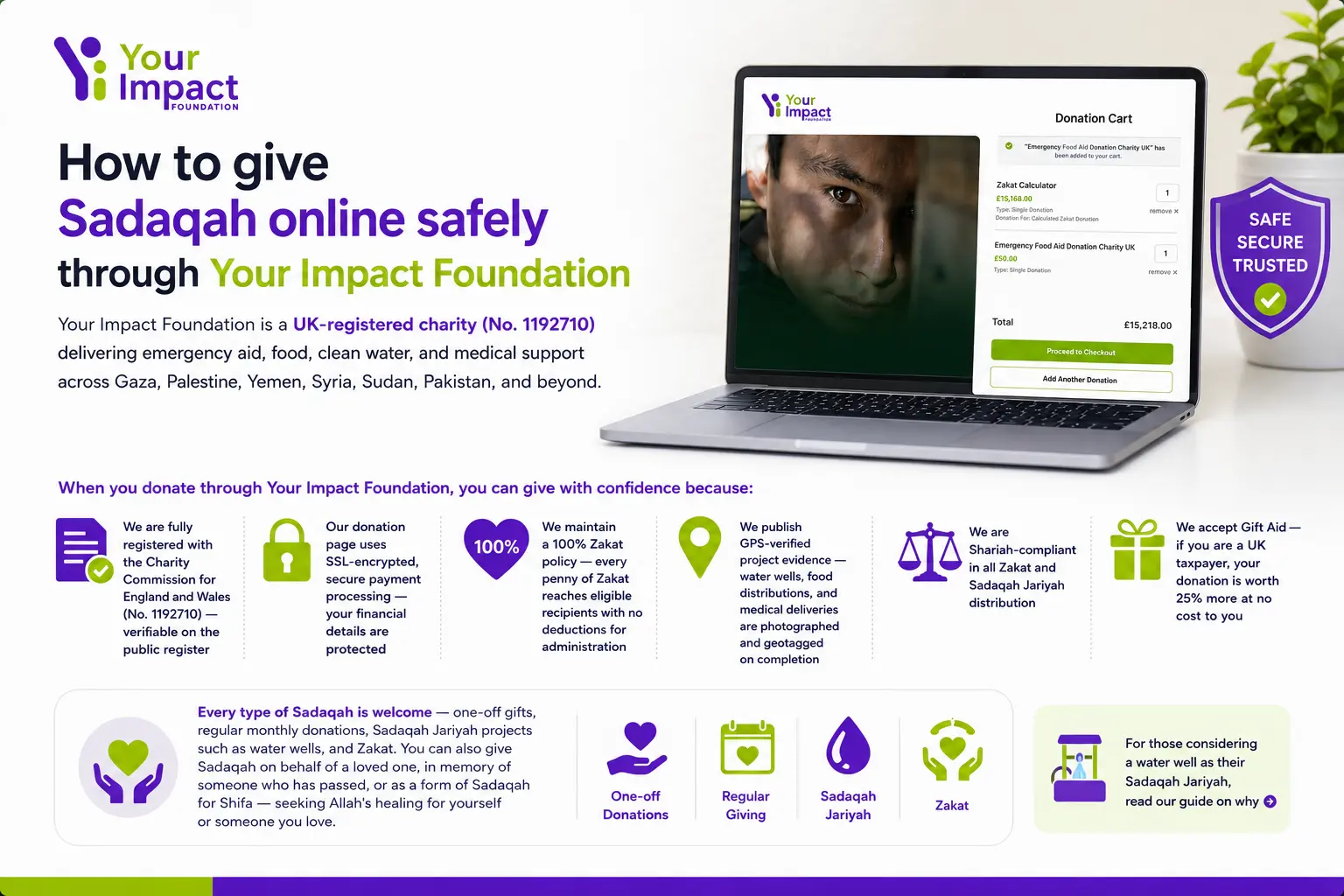
Your Impact Foundation is a UK-registered charity (No. 1192710) delivering emergency aid, food, clean water, and medical support across Gaza, Palestine, Yemen, Syria, Sudan, Pakistan, and beyond.
When you donate through Your Impact Foundation, you can give with confidence because:
We are fully registered with the Charity Commission for England and Wales (No. 1192710) — verifiable on the public register
Our donation page uses SSL-encrypted, secure payment processing — your financial details are protected
We maintain a 100% Zakat policy — every penny of Zakat reaches eligible recipients with no deductions for administration
We publish GPS-verified project evidence — water wells, food distributions, and medical deliveries are photographed and geotagged on completion
We are Shariah-compliant in all Zakat and Sadaqah Jariyah distribution
We accept Gift Aid — if you are a UK taxpayer, your donation is worth 25% more at no cost to you
Every type of Sadaqah is welcome — one-off gifts, regular monthly donations, Sadaqah Jariyah projects such as water wells, and Zakat. You can also give Sadaqah on behalf of a loved one, in memory of someone who has passed, or as a form of Sadaqah for Shifa — seeking Allah’s healing for yourself or someone you love.
Yes — provided you give through a verified, UK-registered charity with a secure (HTTPS) website and a recognised payment gateway. Always check the charity’s registration number on the Charity Commission register before donating. Giving through an unverified individual’s personal account or an unregistered organisation carries significant risk.
How do I know if an online charity is legitimate?
Check the Charity Commission register at gov.uk/find-charity-information. Every legitimate charity operating in England and Wales must be registered and will have a unique charity number. Look for HTTPS on the donation page, named trustees, published annual accounts, and evidence of completed projects. Your Impact Foundation is registered as charity number 1192710.
Can I give Sadaqah through a GoFundMe or social media campaign?
With caution. Individual crowdfunding campaigns are not regulated charities and are not subject to the same accountability requirements. Some are genuine — but many are not. If the campaign is run by an individual rather than a registered charity, you have significantly less protection if something goes wrong. Where possible, donate through a registered charity’s official website.
What is the safest way to give Sadaqah online in the UK?
Donate directly through the official website of a UK-registered charity using a credit or debit card. Type the website address manually into your browser rather than clicking links from emails or social media. Verify the charity’s registration number on the Charity Commission register, and look for a secure HTTPS connection before entering any payment details.
Can I give Sadaqah anonymously online?
Yes. Many UK charities, including Your Impact Foundation, allow you to donate without your name being published or shared. Your personal details remain private and are protected under UK data protection law. You can also donate in the name of a loved one as a gift or as Sadaqah on their behalf.
Is online Sadaqah valid in Islam?
Absolutely. The validity of Sadaqah depends on your sincere intention (niyyah) and the donation reaching those in need — not the method of delivery. Giving online through a verified charity is a fully valid and widely practised form of Sadaqah for Muslims in the UK and globally.
What should I do if I am pressured to donate immediately?
Do not give under pressure. Legitimate charities do not use high-pressure urgency tactics. If you feel pressured — through a phone call, an email, a social media post, or a WhatsApp message — stop. Take the time to research the organisation independently before making any decision to giving.
Can I give Zakat online?
Yes — but only through a charity that is verified to distribute Zakat in a Shariah-compliant manner and maintains a 100% Zakat policy. Your Impact Foundation distributes Zakat only to eligible recipients and does so in full compliance with Islamic law. See our Zakat calculation guide for full details on calculating your Zakat before giving.
Your Impact Foundation — UK Registered Charity No. 1192710 | yourimpactfdn.org
Give Sadaqah safely. Give with confidence. Give where it counts.