There is a moment most people recognise. You give something — money, time, a meal — and something shifts. Not in the recipient. In you.
Islam named that feeling fourteen centuries ago. It is the benefit of Sadaqah — and it runs far deeper than the act of giving itself.
This blog explores what are giving Sadaqah benefits for the giver, why the Prophet ﷺ called it among the most powerful acts a Muslim can perform, and why the benefits begin the moment your intention is set.
What does Sadaqah actually mean?
Sadaqah in Islam means “righteousness” and describes a voluntary charitable act towards others — whether through generosity, love, compassion, or faith. These acts are not necessarily physical or monetary. Simple good deeds such as a smile, making dua for someone, or a helping hand, are seen as acts of Sadaqah.

Unlike Zakat — which is an obligatory annual duty calculated on your wealth — Sadaqah is entirely voluntary. There is no minimum amount, no fixed time, and no restriction on who can receive it. Any sincere act of giving, done for the sake of Allah (SWT), is Sadaqah.
This distinction matters. To understand the difference between Sadaqah and Zakat in full, read our dedicated guide: The Difference Between Zakat, Sadaqah and Lillah.
What are the giving Sadaqah benefits?
1. Does Sadaqah increase your wealth?
The most common worry about giving is this: if I give away money, will I have less? The Prophet ﷺ answered this directly and unequivocally.
“Charity does not decrease wealth.” [Sahih Muslim]
This is not a metaphor. It is a promise backed by both divine revelation and the lived experience of millions of Muslims across centuries. Sadaqah purifies the giver’s wealth and blesses it, bringing barakah — divine increase — into their earnings.
Allah’s generosity is emphasised in the Quran: “The example of those who spend their wealth in the way of Allah is like a seed of grain which grows seven spikes; in each spike is a hundred grains. And Allah multiplies His reward for whom He wills.” [Quran 2:261]
One act of Sadaqah, given sincerely, does not result in less. According to Allah’s own promise, it results in more.
2. Does Sadaqah protect you from hardship?
Giving Sadaqah at a time of hardship as well as ease will help a believer in their time of need. As Anas bin Malik reported: “Give charity without delay, for it stands in the way of calamity.” [Tirmidhi]
Sadaqah is described in Islamic tradition as a shield — something that stands between the believer and harm. Through acts of charity, Muslims seek protection from life’s hardships, such as illness, financial instability, or personal tribulations. This is not superstition. It is a Prophetic teaching that places Sadaqah at the intersection of trust in Allah and practical spiritual protection.
3. Does Sadaqah forgive sins?
One of the most profound benefits of giving Sadaqah is its power to expiate sins.
“Sadaqah extinguishes sin as water extinguishes fire.” [Tirmidhi]
When done with sincere intentions, acts of charity serve as a means of repentance and can help wipe away past mistakes, earning the giver Allah’s forgiveness. The Quran emphasises this: “If you loan Allah a goodly loan, He will multiply it for you and forgive you.” [Quran 64:17]
This benefit alone makes Sadaqah one of the most accessible forms of repentance available to every Muslim — regardless of wealth, age, or circumstance.
4. Does Sadaqah provide shade on the Day of Judgement?
On the Day of Resurrection, when the sun will scorch the earth, those who gave Sadaqah in secret will find solace under the shade of Allah. The Prophet ﷺ said: “Seven people will be shaded by Allah by His Shade on the Day of Resurrection when there will be no shade except His Shade… a man who gives in charity so secretly that his left hand does not know what his right hand has given.” [Sahih Bukhari]
Sadaqah provides shade to its giver on the Day of Judgement — which is at least fifty thousand years long by our reckoning. For a single act of charity given sincerely in this life, Allah promises shelter in the most terrifying moment of the next.
5. Does Sadaqah purify the soul?
One of the primary spiritual benefits of Sadaqah is its ability to purify the soul. According to Islamic teachings, giving to those in need is considered a form of worship that can erase sins and bring blessings to the giver.
Sadaqah cleanses the soul, teaches humility, and fosters gratitude for all we have. When we give for the sake of Allah (SWT), our rewards lie with Him. It cultivates taqwa — God-consciousness — in the giver, softening the heart and bringing it closer to what Allah (SWT) loves most.
What is Sadaqah Jariyah — and why does it matter?
Sadaqah Jariyah is ongoing charity — giving that continues to benefit others and earn reward for the giver long after the initial donation.
The Prophet ﷺ said:
“When a person dies, their deeds come to an end except three: Sadaqah Jariyah, beneficial knowledge, or a righteous child who prays for them.” [Sahih Muslim]
A water well built in a drought-affected community — every cup of clean water drawn from it is a continuing act of Sadaqah on your behalf. A child’s education funded through orphan sponsorship — every lesson learned carries your reward forward. These are not one-off gifts. They are legacies.
To learn more about the most powerful forms of Sadaqah Jariyah, read: Why a Sadaqah Jariyah Water Well is the Best Sadaqah.
And if you want to understand how Sadaqah fits within the broader framework of Friday giving, read: The Benefits of Giving Sadaqah on Jummah.
Can Sadaqah be given online? And does it count?
Yes — and yes. The key is sincerity, known as niyyah. This intention turns an ordinary act into worship. The medium through which Sadaqah is given — cash, bank transfer, online donation — does not affect its validity. What matters is the sincerity of the intention and that the donation reaches a genuine recipient in need.
Giving Sadaqah online through a verified, UK-registered charity ensures your donation is delivered transparently, efficiently, and in a manner you can track. Your Impact Foundation is registered with the Charity Commission (No. 1192710) and accepts Sadaqah donations across all of our active appeals — emergency aid, food aid, water wells, and orphan sponsorship — with full financial transparency.
According to the UK Charity Commission, donating to a registered charity is one of the most reliable ways to ensure your money reaches genuine beneficiaries. All our Sadaqah donations are directed to eligible recipients and are fully accounted for.
Can Sadaqah be given on behalf of someone who has passed away?
Yes. Giving Sadaqah on behalf of someone who has died is one of the most beloved acts in Islamic tradition. The reward is passed to the deceased, and the giver also receives their own reward. Many Muslims give Sadaqah Jariyah — water wells, educational support, or ongoing food aid — in memory of a parent, spouse, or friend who has passed.
If you wish to give Sadaqah for Shifa (healing) for yourself or a loved one, read: Sadaqah for Shifa — Giving Charity for Healing.
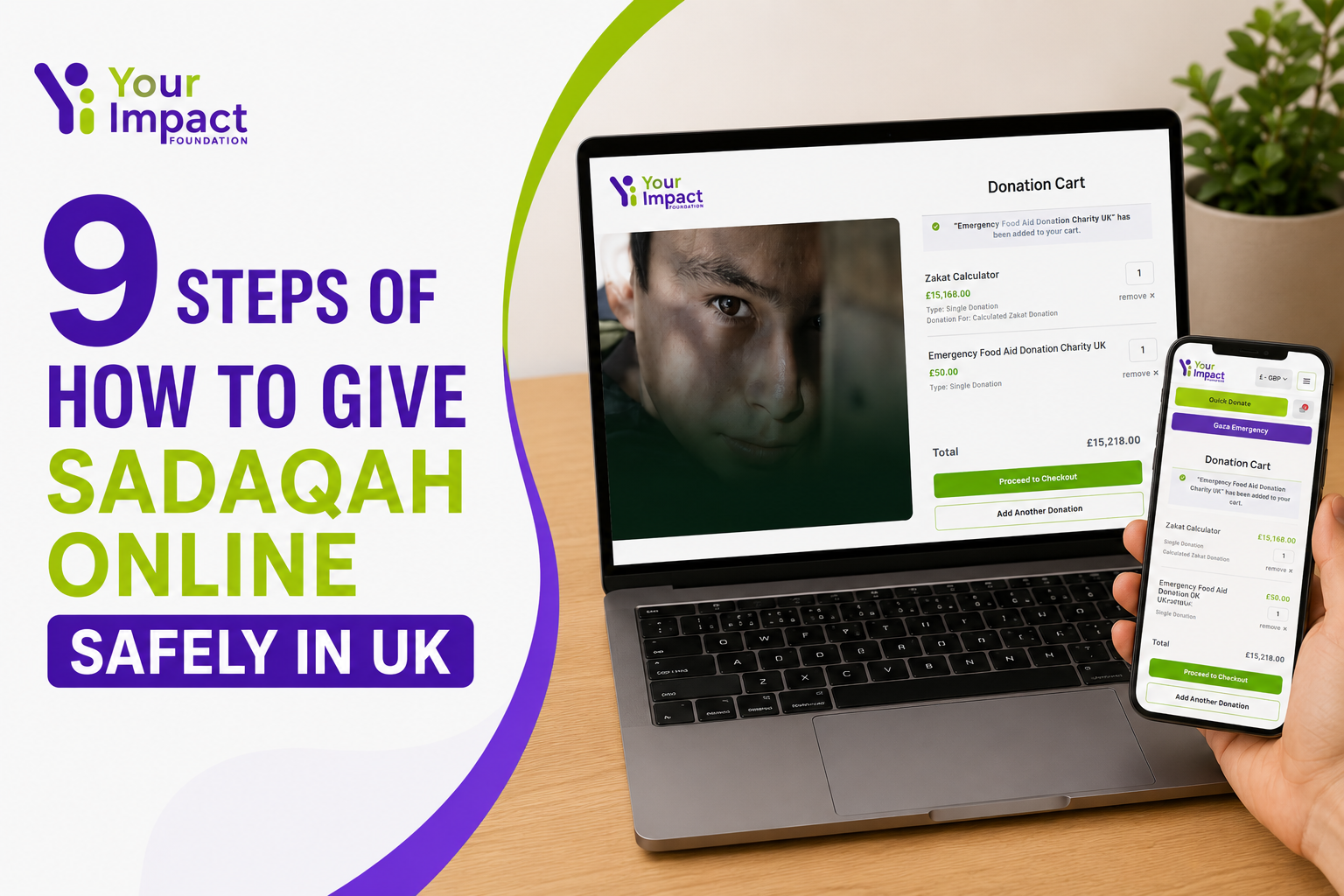
How to give Sadaqah online safely in the UK
When giving Sadaqah online, always check that the charity is registered with the UK Charity Commission, uses a secure (HTTPS) payment page, and publishes transparent impact reports. For a complete guide, read: How to Give Sadaqah Online Safely.
Your Impact Foundation accepts Sadaqah donations across multiple causes — all of them active, verified, and delivering measurable impact:
- Emergency aid — Gaza, Sudan, Yemen, Syria
- Food aid — emergency food packs and community kitchens
- Water wells — Sadaqah Jariyah projects in Pakistan and beyond
- Orphan sponsorship — monthly support for children in Gaza, Sudan, and Pakistan
Give Sadaqah today — every amount counts →
Frequently asked questions
Does Sadaqah have to be money?
No. Sadaqah includes any sincere act of giving — your time, knowledge, a smile, helping someone in need, or removing something harmful from a path. Financial giving is the most common form, but Islam recognises many forms of Sadaqah in daily life.
Is there a minimum amount for Sadaqah?
No. There is no minimum amount for Sadaqah. Even a single date given to a person in need is recorded as Sadaqah. The Prophet ﷺ was the most generous of men — and he encouraged giving whatever one is able, no matter how small.
Can Sadaqah be given to non-Muslims?
Yes. Sadaqah can be given to any person in need, regardless of faith. It is a universal act of kindness and compassion that Islam places no religious restriction on.
What is the difference between Sadaqah and Zakat?
Zakat is an obligatory annual payment of 2.5% of eligible wealth to specific categories of recipients. Sadaqah is entirely voluntary, can be any amount, given at any time, to almost anyone in need. Both purify wealth, but Sadaqah gives the believer complete freedom to give whenever and however they choose.