
Quick Answer: What is Qurbani?
What is Qurbani? Qurbani, also known as Udhiyah, is the Islamic practice of animal sacrifice performed during Eid al-Adha to commemorate Prophet Ibrahim’s willingness to sacrifice his son in obedience to Allah’s command. The word “Qurbani” comes from the Arabic root “Qurb,” meaning “nearness” or “closeness”—signifying the believer’s desire to draw closer to Allah through this act of worship. Every year, Muslims worldwide who meet the financial threshold perform Qurbani by sacrificing a sheep, goat, cow, or camel, then distributing the meat to family, friends, and the poor.
Understanding what is Eid sacrifice requires knowing its deep spiritual significance. This annual practice, performed during the four days of Eid al-Adha (26-29 May 2026 in the UK), represents complete submission to Allah’s will and embodies the Islamic principles of sacrifice, generosity, and care for the less fortunate. The Qurbani meaning extends beyond the physical act—it is a renewal of faith, a test of devotion, and a means of feeding the hungry during the blessed days of Dhul-Hijjah.
Qurbani Meaning: Complete Definition
What Does Qurbani Mean?
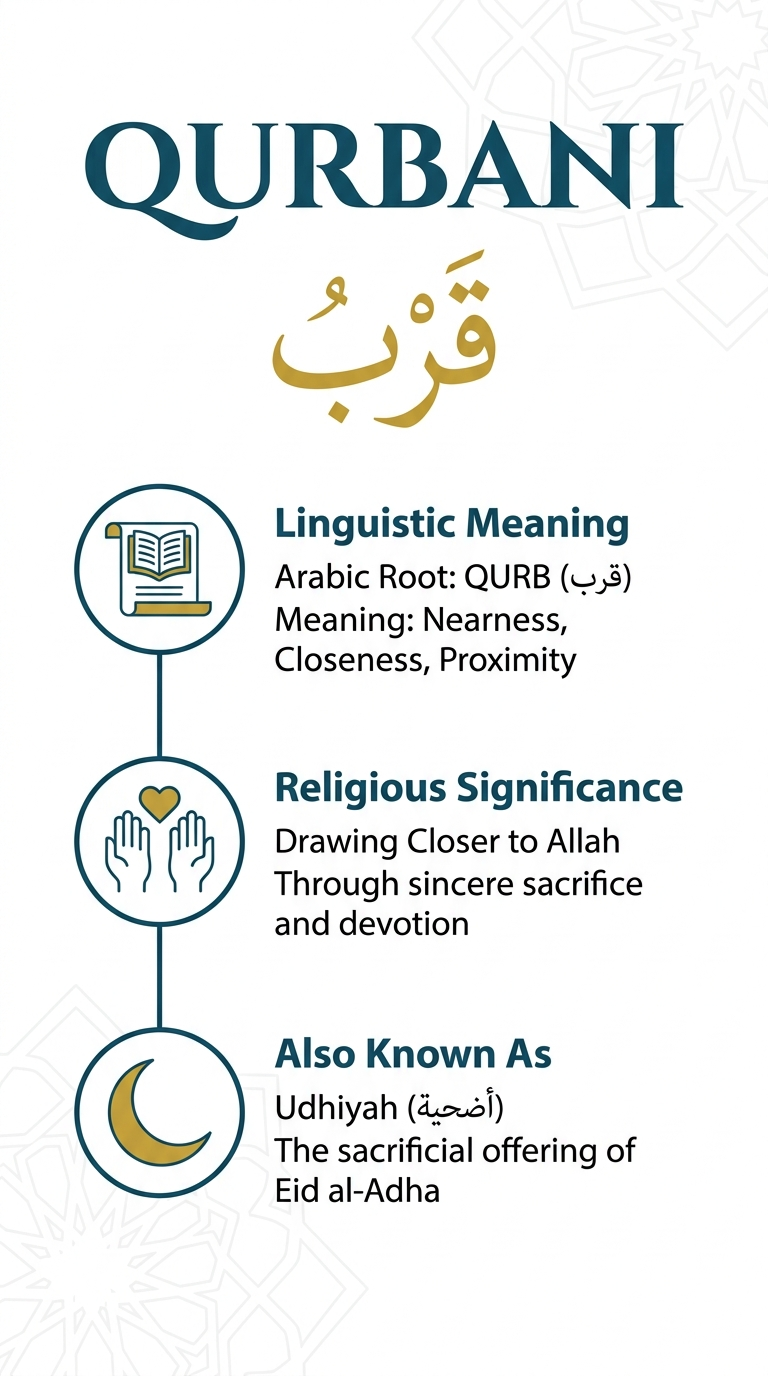
The term “Qurbani” derives from the Arabic word “Qurb” (قرب), which translates to “nearness,” “proximity,” or “approaching.” The Quranic meaning signifies drawing closer to Allah through an act of sincere devotion and sacrifice. In Arabic, the practice is called “Udhiyah” (أضحية), referring specifically to the sacrificial animal offered during Eid al-Adha.
Linguistic and Religious Definition
Linguistic Meaning: The word Qurbani expresses the concept of seeking nearness to the Divine through a heartfelt offering. It represents the believer’s willingness to give up something valuable for the sake of Allah, demonstrating that their love for Allah surpasses all worldly attachments.
Religious Definition: In Islamic terminology, Qurbani refers to the specific act of slaughtering a designated animal (sheep, goat, cow, or camel) during the days of Eid al-Adha (10th-13th of Dhul-Hijjah) as an act of worship, following the Sunnah of Prophet Ibrahim (Abraham). The practice commemorates Ibrahim’s supreme test of faith when Allah commanded him to sacrifice his beloved son Ismail.
What is Qurbani in Islam?
What is Qurbani in Islam? In Islamic teaching, Qurbani is a significant act of worship that combines submission, sacrifice, and social responsibility. It is one of the most blessed rituals a Muslim can perform during the year, connecting believers to the legacy of Prophet Ibrahim and the global Muslim community performing Hajj.
The Quran mentions the spiritual essence of sacrifice in Surah Al-Hajj:
“It is not their meat nor their blood that reaches Allah: it is your piety that reaches Him.” (Quran 22:37)
This verse reveals the true Qurbani meaning—the physical sacrifice is merely an outward expression of the inner devotion and submission that Allah truly values. The animal’s meat and blood do not reach Allah; rather, the sincere intention, the willing heart, and the consciousness of Allah (Taqwa) are what make the Qurbani acceptable.
Animal Sacrifice on Eid ul Adha: The Practice Explained
What is Eid Sacrifice?
What is Eid sacrifice? The Eid sacrifice, known as Qurbani or Udhiyah, is the ritual slaughter of a permissible animal during Eid al-Adha. This practice answers the question of how does Qurbani work in practical terms. Muslims who are financially capable purchase a designated animal—typically a sheep, goat, cow, or camel—and have it slaughtered according to Islamic guidelines during the four days of Eid.
Which Animals Are Sacrificed?
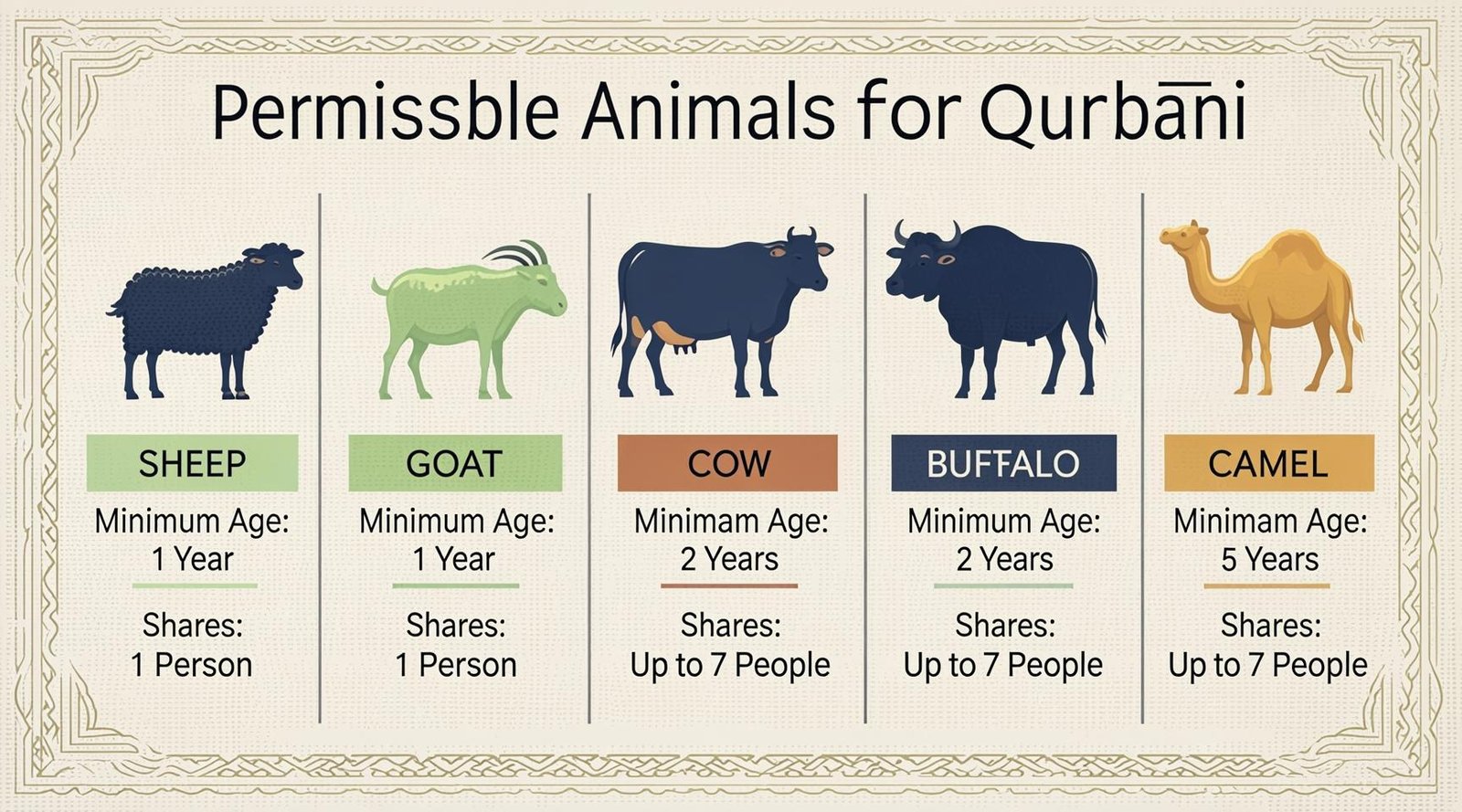
The animal sacrifice on Eid ul Adha must be from specific species. The following animals are permissible:
| Animal | Minimum Age | Number of Shares |
|---|---|---|
| Sheep | 1 year | 1 complete Qurbani |
| Goat | 1 year | 1 complete Qurbani |
| Cow | 2 years | Up to 7 people can share |
| Bull | 2 years | Up to 7 people can share |
| Buffalo | 2 years | Up to 7 people can share |
| Camel | 5 years | Up to 7 people can share |
Conditions for the Animal
The animal must meet the following conditions to be valid for Qurbani:
- Must be from the permitted species listed above
- Must have reached the minimum age requirement
- Must be free from major defects (blindness, severe illness, missing limbs, extreme emaciation)
- Must be healthy and able to walk to the slaughter place
- Must be treated with kindness before and during slaughter
How Does Qurbani Work?
Understanding how does Qurbani work involves knowing the complete process from intention to distribution:
Step 1: Intention (Niyyah) Make a sincere intention in your heart that you are performing Qurbani for the sake of Allah. This should be done before the time of slaughter.
Step 2: Purchasing the Animal Select a healthy animal that meets all Islamic requirements. Verify the age and inspect for any defects.
Step 3: Selecting the Time Qurbani can only be performed after Eid al-Adha prayer on the 10th of Dhul-Hijjah and continues until sunset on the 13th. For 2026, this means from 26 May (after Eid prayer) until 29 May (sunset).
Step 4: The Slaughter The slaughter must be performed by a Muslim, with a sharp knife, cutting the throat, windpipe, and two main blood vessels in one swift motion. The name of Allah (“Bismillah Allahu Akbar”) must be recited.
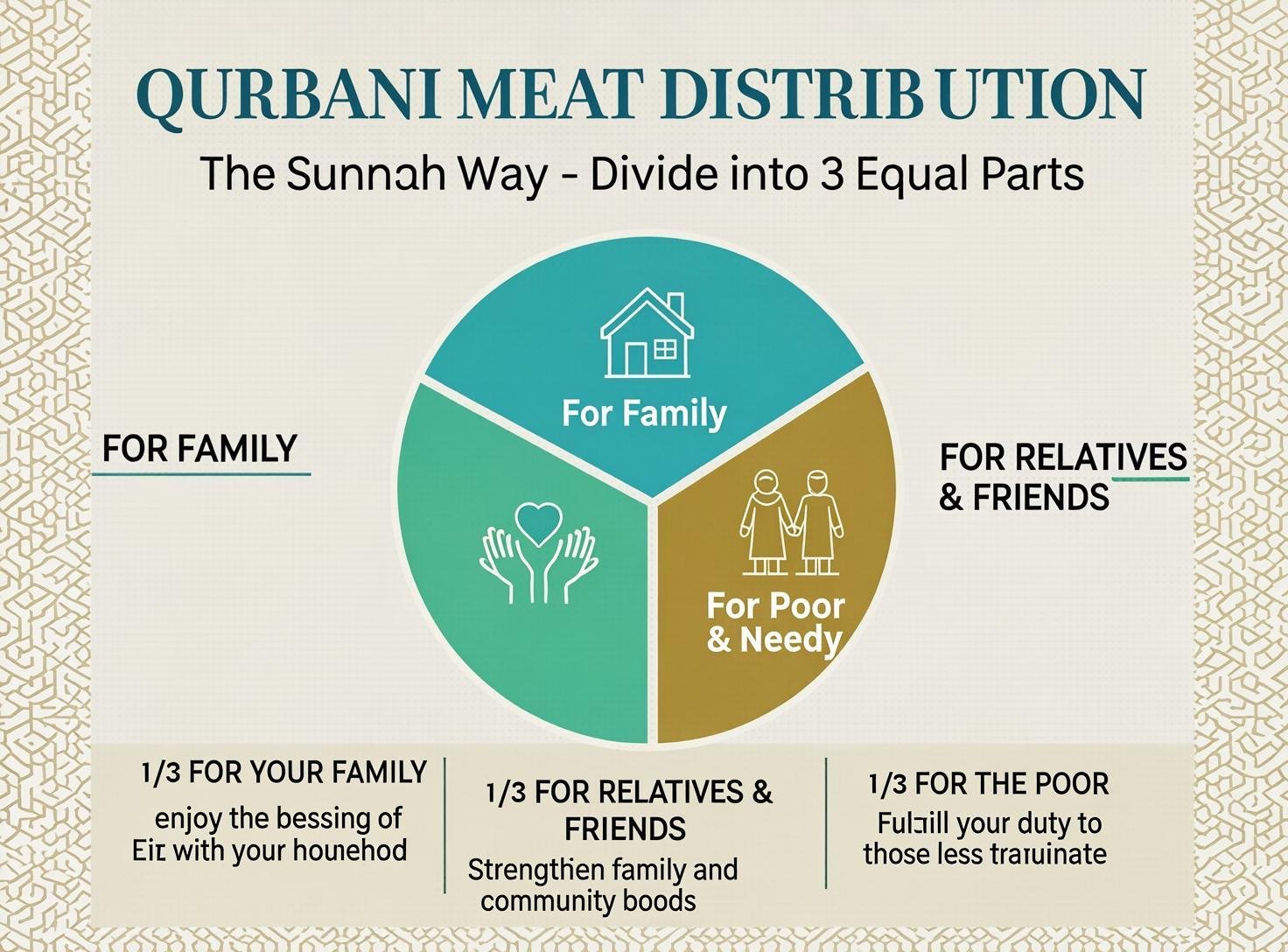
Step 5: Distribution The meat is divided into three equal portions: one for your family, one for relatives and friends, and one for the poor and needy.
Story of Qurbani: Prophet Ibrahim’s Supreme Test
The Origin of Qurbani
The story of Qurbani begins with Prophet Ibrahim (Abraham), who is revered in Islam as “Khalilullah” (the Friend of Allah). Ibrahim received a series of dreams in which Allah commanded him to sacrifice his beloved son Ismail. This divine command was the ultimate test of faith—a father being asked to sacrifice his child whom he had waited years to have.
Ibrahim’s Response to the Command
When Ibrahim understood that this recurring dream was a command from Allah, he did not hesitate. He informed his son Ismail of the divine instruction. The Quran records Ismail’s remarkable response:
“O my father, do as you are commanded. You will find me, if Allah wills, of the steadfast.” (Quran 37:102)
This exchange reveals the extraordinary faith of both father and son. Ismail, recognizing this as Allah’s will, submitted willingly and encouraged his father to proceed.
Allah’s Mercy and the Substitute
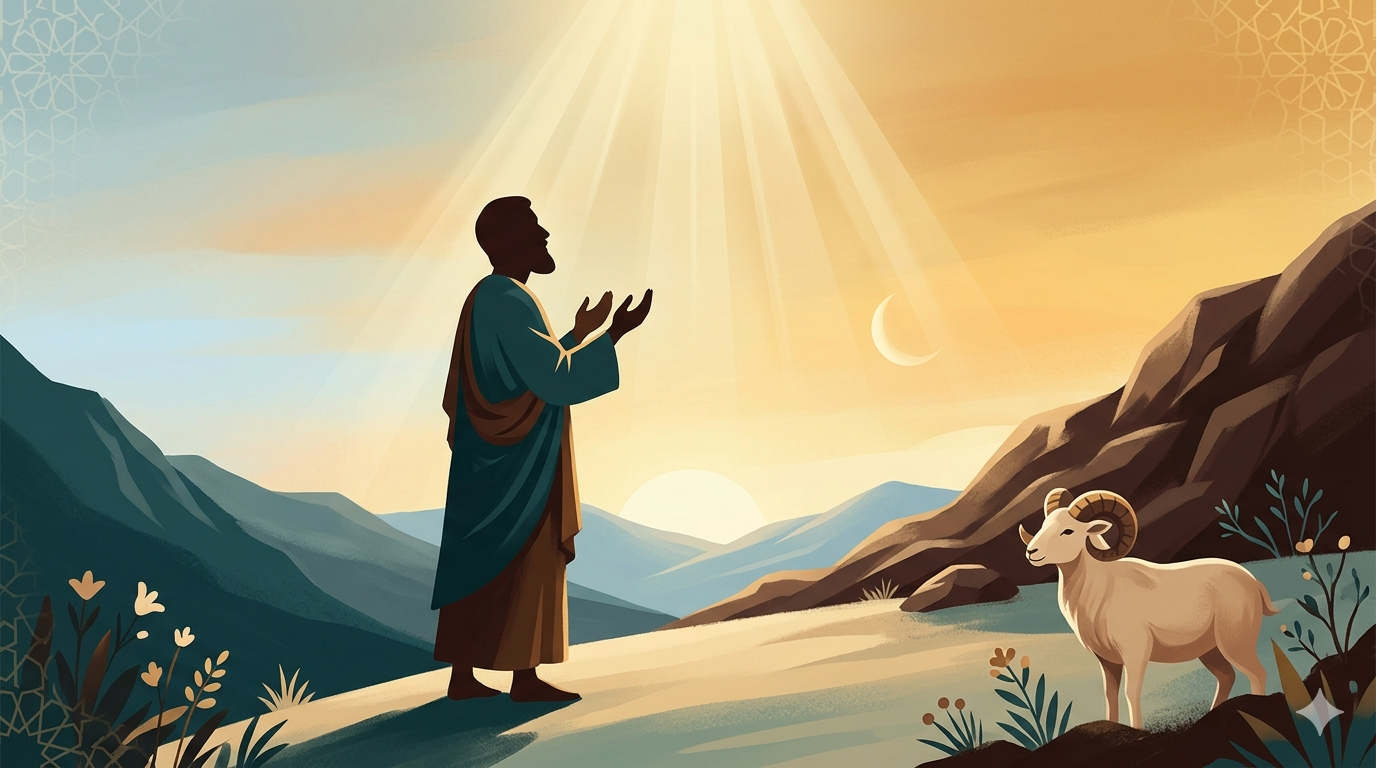
As Ibrahim prepared to carry out the sacrifice, blindfolded to avoid seeing his son’s face, Allah intervened. The Quran describes:
“And We called to him, ‘O Abraham, you have fulfilled the vision.’ Indeed, We thus reward the doers of good. Indeed, this was the clear trial. And We ransomed him with a great sacrifice.” (Quran 37:104-107)
Allah sent a ram to be sacrificed in place of Ismail. This miraculous intervention demonstrated that Allah does not desire human suffering—He tests faith but provides a way out for those who sincerely submit.
Was Ismail the Oldest Brother?
A common question arises: was Ismail the oldest brother by Quran? The Quran confirms that Ismail was the firstborn son of Prophet Ibrahim, born to Hajar (Hagar). Ibrahim’s second son, Ishaq (Isaac), was born later to Sarah. Therefore, according to Islamic teaching, Ismail was indeed the older brother. Some Biblical traditions suggest Isaac was the son to be sacrificed, but Islamic sources clearly identify Ismail as the son in this event, making him the older of Ibrahim’s two sons.
The Legacy of Prophetic Qurbani
The prophetic Qurbani established by Ibrahim continues through Prophet Muhammad (PBUH), who said:
“It is the Sunnah of your father Ibrahim. Every year, on the days of Eid al-Adha, Muslims worldwide revive this ancient tradition, connecting themselves to the legacy of the prophets.”
Qurbani Rules in Islam: Complete Guide
Understanding Qurbani Rules in Islam
Qurbani rules in Islam are derived from the Quran, Sunnah, and scholarly consensus. Following these rules ensures your sacrifice is valid and accepted. The main areas covered by these rules include: who must perform Qurbani, what animals are valid, when to perform it, and how to distribute the meat.
Who is Qurbani Compulsory On?
Who is Qurbani compulsory on? According to the Hanafi school of jurisprudence, Qurbani is wajib (obligatory) upon every Muslim who meets the following conditions:
1. Being Muslim Only Muslims are obligated to perform Qurbani, as it is an act of Islamic worship.
2. Sanity (Aql) The person must be of sound mind. Those with severe mental incapacity are not obligated.
3. Adulthood (Bulugh) The person must have reached puberty. However, many families perform Qurbani on behalf of their children as a pious act.
4. Financial Capability (Istita’ah) The person must possess wealth equal to or exceeding the Nisab threshold (the minimum amount required for Zakat).
5. Being Resident (Muqim) Travellers are exempt from the obligation, though they may choose to perform it.
Is Qurbani Farz?
Is Qurbani farz? There is a difference of scholarly opinion on the precise ruling:
- Hanafi School: Qurbani is Wajib (necessary/obligatory) for those who meet the conditions. Neglecting it without valid excuse is sinful.
- Maliki, Shafi’i, and Hanbali Schools: Qurbani is Sunnah Mu’akkadah (strongly emphasised Sunnah) for those who can afford it.
Given this difference, scholars advise that those who can afford Qurbani should not neglect it. It is a significant act of worship that should not be taken lightly. Those who are Hanafi by school should consider it obligatory, while others should still perform it due to its immense reward and significance.
When to Give Qurbani?
When to give Qurbani? The time for Qurbani begins after the Eid al-Adha prayer on the 10th of Dhul-Hijjah and ends at sunset on the 13th of Dhul-Hijjah. For UK Muslims in 2026, this means:
| Day | Date 2026 | Time Period |
|---|---|---|
| Day 1 | Tuesday, 26 May | After Eid prayer until sunset |
| Day 2 | Wednesday, 27 May | After Fajr until sunset |
| Day 3 | Thursday, 28 May | After Fajr until sunset |
| Day 4 | Friday, 29 May | After Fajr until sunset |
Critical Rule: Qurbani performed before Eid prayer is NOT valid and must be repeated. Always wait until after the Eid congregation has prayed in your locality.
Qurbani for Women
Women who meet the Nisab threshold are equally obligated to perform Qurbani. A married woman’s obligation is independent of her husband. If she has her own wealth exceeding the Nisab, she must arrange her own Qurbani. Her husband’s Qurbani does not fulfil her obligation unless he explicitly includes her in his intention.
Qurbani for Deceased Relatives
It is permissible and recommended to perform Qurbani on behalf of deceased parents and relatives. This can be done as:
- A bequest (if they left instructions before death)
- A voluntary act of charity on their behalf
- Part of ongoing charity (Sadaqah Jariyah) for the deceased
Many families include deceased parents in their Qurbani intention, earning reward for both the living and the deceased.
UK Qurbani: How to Perform in Britain
UK Qurbani Options
For Muslims asking about UK Qurbani, there are several ways to fulfil this obligation in Britain:
Option 1: Local Slaughter
- Purchase an animal from a farm or halal butcher
- Book a licensed halal slaughterhouse
- Attend the slaughter personally
- Arrange collection and distribution of meat
Option 2: Online Qurbani Services
- Choose a UK-registered Islamic charity
- Pay online for your Qurbani
- The charity performs slaughter and distributes meat to the poor
- Choose charities with 100% donation policy for maximum impact
Option 3: Through Your Mosque
- Many mosques organise collective Qurbani
- Register and pay through the mosque
- Mosque handles logistics and local distribution
UK Legal Requirements
When performing UK Qurbani, you must comply with British law:
- Slaughter must be performed at a licensed abattoir
- The animal must be stunned before slaughter (some exemptions apply for halal)
- Food safety regulations must be followed
- The butcher/slaughterer must be licensed
Choosing a UK Charity for Qurbani
When selecting an online Qurbani service:
- Verify UK Charity Commission registration
- Check for 100% donation policy
- Ensure they provide confirmation and reports
- Look for transparency about where animals are slaughtered
Gaza Qurbani: Remembering Those in Need
What is Gaza Qurbani?
Gaza Qurbani has become a significant consideration for Muslims worldwide as the humanitarian crisis in Gaza continues. While many Muslims in the UK perform their obligatory Qurbani locally or through international charities, the situation in Gaza presents an opportunity to extend additional generosity.
The Reality for Gaza Families This Eid
As we prepare our Qurbani, families in Gaza face a devastating reality:
- Meat prices have become prohibitively expensive
- Many families cannot access basic nutrition
- The traditional Eid celebration with meat is impossible for most
- Humanitarian aid is the only source of food for many households
How to Support Gaza During Qurbani Season
While performing your obligatory Qurbani, consider extending your generosity:
1. Additional Sadaqah for Gaza Beyond your Qurbani, donate food aid to Gaza through reputable charities like Your Impact Foundation, which operates with 100% donation policy and direct access to Gaza.
2. Include Gaza in Your Eid Budget Allocate a portion of your Eid spending to humanitarian aid for Gaza families who cannot afford meat.
3. Support Food Aid Programmes While we cannot directly send Qurbani meat to Gaza, we can support ongoing food distribution programmes that provide essential nutrition to families in need.
4. Make Dua for Gaza Include the people of Gaza in your supplications during these blessed days when duas are most accepted.
The Spirit of Qurbani and Humanitarian Need
The Qurbani meaning encompasses caring for those less fortunate. The Prophet (PBUH) said:
“None of you truly believes until he loves for his brother what he loves for himself.”
This Eid al-Adha, as we perform our Qurbani and enjoy the blessing of meat with our families, let us remember our brothers and sisters in Gaza who face Eid without the means to celebrate. Extending our generosity through food aid programmes embodies the true spirit of Qurbani—sharing with those in need and drawing closer to Allah through acts of compassion.
Prophetic Qurbani: Following the Sunnah
The Prophet’s Example
Prophetic Qurbani refers to the way Prophet Muhammad (PBUH) performed and taught the sacrifice. Understanding his example helps us perform Qurbani correctly.
The Prophet’s Practice:
- He performed Qurbani every year of his life in Madinah
- He sacrificed two rams each year—one for himself and one for his Ummah
- He slaughtered with his own hands
- He recited “Bismillah Allahu Akbar” at the time of slaughter
- He faced the animal toward the Qiblah
- He ate from the meat, gave gifts, and distributed to the poor
Prophetic Hadith on Qurbani
The Prophet (PBUH) said:
“The son of Adam does not do any deed on the Day of Sacrifice that is more beloved to Allah than shedding blood (of the sacrificial animal). It will come on the Day of Resurrection with its horns, hooves, and hide. The blood is accepted by Allah before it even reaches the ground, so sacrifice with an open heart.” (Tirmidhi)
This hadith emphasises the immense reward of Qurbani and encourages believers to perform it willingly and generously.
How to Perform Qurbani: Step-by-Step
Step 1: Check Your Obligation
Before performing Qurbani:
- Calculate your assets against the Nisab threshold
- Verify you are not a traveller (if travelling, consult a scholar)
- Ensure you have sufficient funds for a quality animal
Step 2: Choose Your Animal
- Select from sheep, goat, cow, buffalo, or camel
- Verify the animal meets the minimum age
- Inspect for defects and illness
- Choose a healthy, well-fed animal
Step 3: Make Your Intention
- Intend in your heart that this Qurbani is for Allah
- If sharing a large animal, ensure all partners have made intention
- Include any deceased relatives if you wish
Step 4: Arrange Slaughter
- Book a licensed slaughterhouse or arrange through a charity
- Ensure the slaughterer is Muslim
- Verify the time is after Eid prayer
Step 5: Distribution
Divide the meat into three equal parts:
- One-third for your family – Enjoy the blessing of Eid
- One-third for relatives and friends – Strengthen community ties
- One-third for the poor – Fulfil the social responsibility
Frequently Asked Questions
What is Qurbani?
Qurbani is the Islamic practice of animal sacrifice performed during Eid al-Adha to commemorate Prophet Ibrahim’s willingness to sacrifice his son for Allah. It involves slaughtering a permissible animal and distributing the meat to family, friends, and the poor.
What does Qurbani mean?
Qurbani comes from the Arabic root “Qurb” meaning “nearness.” It signifies seeking closeness to Allah through the act of sacrifice, demonstrating complete submission and devotion to the Divine.
Is Qurbani farz or Sunnah?
According to the Hanafi school, Qurbani is Wajib (obligatory) for those who can afford it. Other schools consider it Sunnah Mu’akkadah (strongly recommended). All scholars agree it should not be neglected by those who are financially capable.
Who is Qurbani compulsory on?
Qurbani is compulsory on every Muslim who is of sound mind, has reached puberty, possesses wealth exceeding the Nisab threshold, and is not a traveller.
When should Qurbani be performed?
Qurbani must be performed after Eid al-Adha prayer on the 10th of Dhul-Hijjah and can continue until sunset on the 13th of Dhul-Hijjah. In 2026 (UK), this is 26-29 May.
Can I give money instead of Qurbani?
No, Qurbani requires the actual slaughter of an animal. You cannot substitute it with a cash donation. However, you can pay a charity to perform Qurbani on your behalf, and you may give additional charity separately.
What animals can be used for Qurbani?
Permissible animals are: sheep (1+ year), goat (1+ year), cow (2+ years), buffalo (2+ years), and camel (5+ years). Chickens, ducks, and other birds are not valid for Qurbani.
How is Qurbani meat distributed?
The Sunnah is to divide the meat into three equal parts: one for your household, one for relatives and friends, and one for the poor and needy.
Can women perform Qurbani?
Yes, women who meet the Nisab threshold are obligated to perform Qurbani. Their obligation is independent of their husband’s Qurbani.
What if I performed Qurbani before Eid prayer?
Qurbani performed before Eid prayer is not valid and must be repeated during the proper time period (after Eid prayer on 10th-13th Dhul-Hijjah).
Conclusion: The True Meaning of Qurbani
What is Qurbani? It is more than an animal sacrifice—it is a profound act of worship that connects believers to the legacy of Prophet Ibrahim, demonstrates complete submission to Allah, and embodies the Islamic principles of generosity and social responsibility.
The Qurbani meaning encompasses drawing nearer to Allah through sincere sacrifice, remembering those less fortunate, and participating in the global Muslim community’s observance of Eid al-Adha. As we perform our Qurbani this year, let us remember the true spirit of this blessed practice: willing sacrifice, sincere devotion, and compassionate sharing with those in need.
This Eid al-Adha, as we follow the Qurbani rules in Islam and perform our sacrifice, let us also remember our brothers and sisters in Gaza who face this blessed occasion without the means to celebrate. May our Qurbani be accepted, our intentions purified, and our generosity extended to all those in need.
Preparing for Qurbani this Eid al-Adha?
Remember those who cannot afford meat.