
Key Takeaways
- Pension arrangements differ in how they build retirement benefits and when members can access their funds.
- Defined contribution pensions and self-invested personal pensions generally have an identifiable investment value, although access restrictions and personal circumstances matter.
- Defined benefit pensions promise benefits based on a scheme formula rather than an individual investment pot.
- A pension statement’s total value may not equal the amount a person can currently access or use.
- Any calculation involving retirement savings should identify the applicable method, eligible assets, liabilities and valuation date.
- Donors who want to support humanitarian projects should make a separate, informed decision about charitable giving.
Retirement planning can become complicated when someone holds several pension arrangements. A workplace pension might provide a defined contribution pot, a self-invested personal pension may contain multiple investments, and an older final salary scheme may promise a regular retirement income.
These arrangements do not work in the same way. Their valuations, access conditions and benefit structures can differ significantly.
Understanding those differences is essential when assessing personal finances or working through a religious financial obligation that depends on ownership, access and the type of asset held. A single formula should not automatically be applied to every pension arrangement.
This guide explains the main UK pension funds structures, identifies the questions to ask about each one and provides practical financial examples. It also distinguishes pension valuation from a separate decision to support a registered UK charity.
The Fundamentals of Retirement Savings and Financial Obligations
Before calculating anything, identify the pension arrangement and establish what the member owns or is entitled to receive.
A pension statement may show a fund value, projected retirement income, transfer value or estimated annual benefit. These figures describe different things and should not be treated as interchangeable.
What are the main types of UK pension schemes?
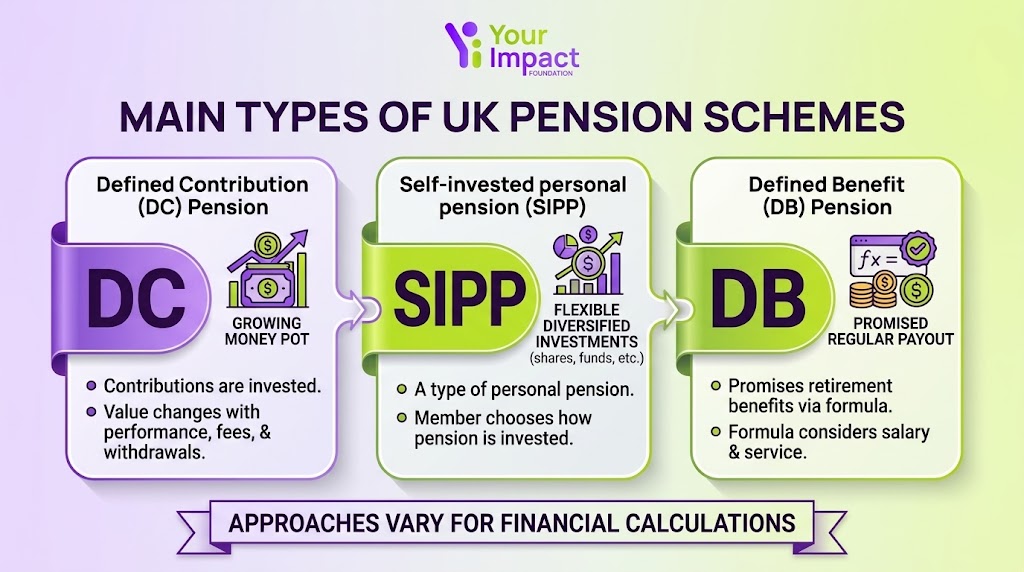
Three arrangements commonly require different approaches.
Defined contribution (DC) pension: Contributions are invested to build a fund. Its value changes with contributions, investment performance, fees and withdrawals.
Self-invested personal pension (SIPP): A type of personal pension that generally offers a wider choice of investments. The member can usually choose how the pension is invested within the scheme’s permitted options.
Defined benefit (DB) pension: The scheme promises retirement benefits calculated using a formula. The formula often considers pensionable salary and length of service, although scheme rules vary.
Why ownership and access matter
The amount displayed on a statement may not be the same as the amount available to spend today.
For example, a defined contribution pension may have a visible investment value, but withdrawals are subject to pension rules, tax treatment and scheme conditions. A defined benefit scheme may show a projected annual pension rather than a personal fund that the member can withdraw.
When assessing a pension, establish:
- What type of scheme it is.
- Whether the figure is a current value, transfer value or future projection.
- What rights the member currently holds.
- Whether access is restricted.
- Whether the valuation includes charges or other adjustments.
- Which calculation method applies to the financial obligation being assessed.
For UK pension information, the government’s MoneyHelper pension guidance and the GOV.UK pension information service provide useful starting points.
Defined Contribution Pensions: Understanding the Fund Value
A defined contribution pension builds a fund from contributions and investment returns. The final value is not guaranteed because investment values can rise or fall.
Workplace pension schemes and personal pensions may both use this structure.
What determines a defined contribution pension’s value?
The current value usually reflects the investments held in the pension, after relevant charges and adjustments.
For example, suppose a pension statement shows:
| Component | Illustrative value |
|---|---|
| Investment holdings | £42,000 |
| Cash held in the pension | £3,000 |
| Outstanding scheme charges or adjustments | £200 |
| Illustrative net statement value | £44,800 |
This example shows how a statement might present the components of a pension value. The actual calculation should follow the scheme’s statement and valuation conventions.
What should you check before using a pension value?
Check the statement date, whether all holdings are included and whether the displayed figure is a current fund value or another measure.
If the pension contains investments whose values fluctuate, use a consistent valuation date for any calculation. Avoid combining figures from different dates unless the method specifically requires it.
You should also distinguish between the value of the pension and the amount currently available for withdrawal. Pension access rules and tax consequences may affect withdrawals, even when a fund value is clearly stated.
How should restricted access be considered?
Some retirement arrangements have access restrictions until a specified age, subject to applicable exceptions and scheme rules. A member may therefore own pension rights without being able to withdraw the full amount immediately.
The treatment of those rights for a separate religious financial obligation depends on the relevant scholarly method. It should not be inferred solely from UK pension access rules.
Where the answer depends on whether the member has effective ownership or control, consult a qualified adviser who understands both the pension structure and the relevant religious guidance.
Self-Invested Personal Pensions: Understanding the Net Asset Value
A self-invested personal pension, or SIPP, is a personal pension that generally gives the member more choice over investments.
Depending on the provider and scheme, a SIPP may hold funds, shares, bonds, cash and other permitted investments. The precise investment options depend on the arrangement.
What does a SIPP statement show?
A SIPP statement may show the value of individual holdings, cash balances, charges and the total account value.
For example:
| Component | Illustrative value |
|---|---|
| Investment funds | £28,000 |
| Listed shares | £7,000 |
| Cash balance | £2,500 |
| Outstanding charges | £100 |
| Illustrative net value | £37,400 |
The arithmetic is:
£28,000 + £7,000 + £2,500 − £100 = £37,400
This is a simple example of calculating a net account value. It is not, by itself, a ruling about which assets must be included in a religious calculation.
Why a SIPP may need a more detailed review
A SIPP can contain several asset types. The calculation method may distinguish between investment holdings, cash and other assets, depending on the rules being applied.
Before calculating a separate obligation, confirm:
- The current value of each holding.
- The cash balance on the valuation date.
- Any charges or liabilities that the applicable method permits you to deduct.
- Whether all holdings are treated in the same way.
- Whether access restrictions affect the calculation.
- Whether the method applies to the full pension value or only a qualifying portion.
Do not automatically deduct every personal debt or future expense from the value. Only deductions permitted by the method being followed should be included.
Net value versus accessible value
Net asset value and accessible value are different concepts.
Net value describes the value of the assets after relevant adjustments. Accessible value concerns the amount that can currently be withdrawn or used, subject to scheme rules and tax.
A calculation method may use one concept rather than the other. The correct approach should be established before doing the arithmetic.
Defined Benefit Pensions: Understanding Final Salary Schemes
A defined benefit pension promises benefits according to a scheme formula. The amount may depend on pensionable salary, years of service and the scheme’s accrual rate.
Unlike a defined contribution pension, the member does not usually have an individual investment pot that directly represents the value of the promised retirement income.
How does a defined benefit pension work?
A scheme might calculate a member’s annual pension using a fraction of pensionable salary for each qualifying year of service.
For illustration, assume a scheme uses an accrual rate of 1/60 and a pensionable salary of £36,000, with 20 qualifying years.
The illustrative annual pension would be:
£36,000 × 20 ÷ 60 = £12,000 per year
This example explains the mechanics of a simplified scheme formula. Actual schemes may use different accrual rates, salary definitions, revaluation provisions, retirement ages and other conditions.
Is the projected annual pension the same as a pension pot?
No. A projected annual pension is an estimate of future income under the scheme’s rules. It is not the same as a cash investment balance.
A scheme may also provide a transfer value in certain circumstances. That figure is calculated under the scheme’s transfer rules and actuarial assumptions. It should not automatically be treated as equivalent to the value shown in a defined contribution account.
When assessing a defined benefit scheme, identify the exact figure being used:
- Projected annual retirement income.
- Accrued annual pension entitlement.
- A formal transfer value.
- Any lump-sum entitlement.
- Benefits payable to a spouse or other eligible beneficiary.
Each figure answers a different question.
Why defined benefit schemes may require specialist guidance
A defined benefit entitlement depends on scheme rules and may not be available as a lump sum. The treatment of a promised future income can therefore differ from the treatment of an accessible investment fund.
A generic calculation that applies a percentage to a projected annual pension may produce a misleading result if the underlying method does not support it.
Where the obligation depends on ownership, control, access or the valuation of a future entitlement, seek advice that considers the specific scheme documentation and the method you follow.
Comparing DC, DB and SIPP Arrangements
The following table summarises the main financial differences. It does not replace a ruling on how a separate religious obligation applies.
| Feature | Defined contribution pension | Self-invested personal pension | Defined benefit pension |
|---|---|---|---|
| Main structure | Investment fund built from contributions and returns | Personal pension with a choice of permitted investments | Promised retirement benefits calculated using a scheme formula |
| Typical statement figure | Current fund value | Total account or investment value | Accrued or projected annual pension |
| Investment risk | Usually borne by the member | Usually borne by the member | Investment and funding risks are generally managed by the scheme, subject to its structure |
| Is there a visible investment pot? | Usually yes | Usually yes | Usually no individual pot equivalent to a DC account |
| Access conditions | Subject to pension rules and scheme terms | Subject to pension rules and scheme terms | Benefits normally paid under scheme rules |
| Valuation issues | Investment values, cash and charges | Multiple holdings, cash, charges and investment values | Benefit formula, accrued rights and any available transfer value |
| Calculation approach | Identify the relevant fund value and applicable method | Review holdings and the applicable valuation method | Establish the exact benefit entitlement and obtain specialist guidance where needed |
Worked Calculation Examples
The following examples demonstrate basic arithmetic using illustrative figures. They do not establish a universal religious ruling or prescribe a single method for every pension arrangement.
Example 1: A defined contribution pension
Suppose a member’s current statement shows:
- Investment holdings: £24,000
- Cash: £2,000
- Applicable permitted deduction: £100
The illustrative net figure is:
£24,000 + £2,000 − £100 = £25,900
The next step is not automatically to apply a percentage. First, establish whether the method being followed includes the full pension value, a qualifying portion or another measure.
Example 2: A SIPP
Suppose a SIPP contains:
- Funds: £18,000
- Shares: £6,000
- Cash: £1,500
- Applicable permitted deduction: £50
The illustrative net account value is:
£18,000 + £6,000 + £1,500 − £50 = £25,450
This establishes the arithmetic value under the stated assumptions. It does not decide which holdings are included in a separate religious calculation.
Example 3: A defined benefit scheme
Suppose a member has an accrued entitlement to an estimated annual pension of £9,000.
That £9,000 represents annual income, not a £9,000 investment fund. It would therefore be misleading to place it directly into the same calculation used for a defined contribution pension without establishing a suitable valuation method.
The member should review the scheme documentation and seek qualified guidance on the treatment of the accrued entitlement.
What information do you need before calculating a pension-related obligation?
Prepare the following information:
- The pension type and provider.
- The latest statement and valuation date.
- The current fund value or accrued benefit.
- Any relevant access restrictions.
- The applicable rules for ownership and valuation.
- Any deductions allowed by the method being followed.
- The value of other relevant assets and liabilities, if the method requires them.
Once those details are confirmed, the arithmetic can be completed using the correct inputs. If the applicable rules are uncertain, resolve that question before relying on the result.
FAQs
Do pension arrangements all use the same calculation method?
No. Defined contribution pensions, self-invested personal pensions and defined benefit schemes have different structures. The relevant calculation depends on the type of benefit, access conditions and the method being followed.
Is a pension statement’s total value always the amount available to withdraw?
No. A statement may show a fund value or projected benefit, while access depends on pension legislation, scheme terms and tax rules. A defined benefit projection is also different from an individual investment pot.
How do I calculate the net value of a SIPP?
Add the current values of the relevant holdings and cash balances, then account for any deductions permitted by the calculation method. Confirm the valuation date and whether the method includes every asset in the account.
Can I use a defined benefit pension’s annual income as its fund value?
Not without an appropriate valuation method. Annual pension income and a cash transfer value are different measures. The scheme’s benefit documentation should be reviewed before any calculation is made.
Should I deduct personal debts from my pension value?
Do not assume that every debt or future expense can be deducted. The rules being followed determine which liabilities, if any, are eligible for deduction.
Where can I get help understanding my UK pension?
Start with your pension provider’s scheme documents and the government’s MoneyHelper pension guidance. If the question also depends on a religious ruling, consult a qualified adviser familiar with the relevant method and the specific pension arrangement.
Making an Informed Decision About Charitable Giving
Understanding retirement savings can help people make better financial decisions. It can also help them decide what support they can comfortably offer to humanitarian projects.
Before contributing, review the organisation’s public information, its donation terms and the options available on its official website.
You can learn more about Your Impact Foundation and check its details through the official Charity Commission register.
If you choose to support its work, visit the donation page to review the available options. Make sure you understand the terms before completing a payment.
The goal is to make financial decisions with care, use reliable information and choose charitable support that aligns with your circumstances and intentions.