
Yes. In most cases, you must pay zakat on money that other people owe you. But the exact ruling depends on which school of Islamic law you follow and whether the debtor can actually repay you. The Prophet Muhammad (peace be upon him) established zakat as a pillar of Islam to purify wealth and support those in need. So money that legally belongs to you — even when someone else holds it — generally falls under this obligation.
This guide covers every major scenario. We look at money friends owe you, business receivables, borrowed money, credit card debt, and invested funds. We break down the rulings from all four schools of Islamic law. And we give you practical steps to calculate zakat on money accurately in the UK.
What Does Zakat on Money Include?
Zakat on money applies to all wealth you fully own. This includes cash in your bank account, savings, gold, silver, and money that other people owe you. The Quran clearly mandates zakat on stored wealth. Allah says:
“Take from their wealth a charity by which you purify them and cause them increase, and invoke blessings upon them.” (Surah At-Tawbah 9:103)
In Islamic law, scholars use the Arabic term dayn (debt receivable) for money that sits in someone else’s hands but legally belongs to you. This covers personal loans you gave to family or friends, business receivables from customers, outstanding mahr (dowry), and installment payments from selling property. All of these represent wealth you own. The question is whether — and when — zakat on money applies while it remains out of your direct possession.
Most UK Muslims face this question at some point. You lend £5,000 to a relative. A client still owes your business £12,000. You wonder whether these amounts count towards your zakat calculation. The short answer is usually yes — but the details matter.
Do You Pay Zakat on Money Owed to You?
Yes, you generally pay zakat on money that people owe you. But scholars split this into two categories based on how likely you are to get the money back.
Strong receivables (dayn qawi): The debtor has enough money to repay you and acknowledges the debt. Most scholars say you must include this amount in your annual zakat calculation. The money is still yours — it just sits temporarily in someone else’s hands. You can reasonably access it if you ask.
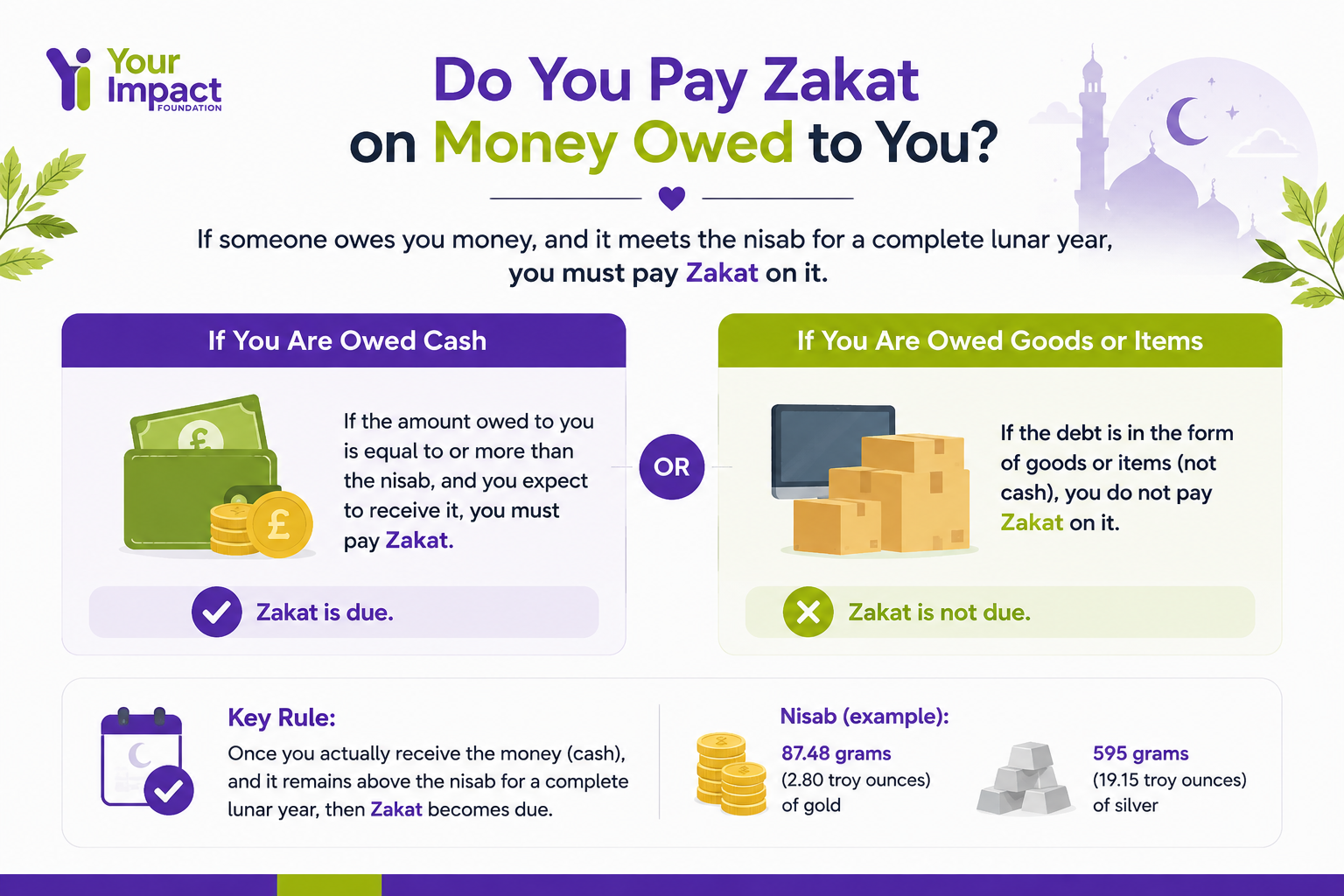
Weak or doubtful receivables (dayn da’if): The debtor is bankrupt, has disappeared, or denies the debt. In this case, most scholars say you do not pay zakat annually. The wealth is not truly accessible to you. However, if the debtor eventually repays you years later, you then pay zakat for one year on that amount.
The renowned scholar Ibn Qudamah states in Al-Mughni (Vol. 4): “If the debt is upon someone who acknowledges it and is capable of paying, its zakat is due for all years.” This principle forms the basis of how most schools handle zakat on money owed to you.
The International Islamic Fiqh Academy (IIFA) confirmed this split in its 1985 resolution. If the debtor is solvent, zakat applies for every year. If the debtor is insolvent, you pay zakat for one year only upon receiving the money.
How Do the Four Schools of Islamic Law Differ on Zakat on Money Owed?
Hanafi School: The Debt Origin Matters Most
The Hanafi school classifies every debt into three categories based on where the money came from. This classification decides whether zakat on money applies and when you pay it.
Strong debt (dayn qawi): Money owed from a cash loan you gave or from selling trade goods on credit. Zakat applies for every year the debt remains outstanding. If the debtor is solvent, you owe zakat each year but can delay actual payment until you start receiving repayments. If the debtor is insolvent, no zakat applies until they repay — then you pay for all previous years retroactively.
Medium debt (dayn mutawassit): Money owed from selling personal items like your car or house. The same yearly obligation applies, but you only start paying once you collect a full nisab amount.
Weak debt (dayn da’if): Money owed from sources like an unpaid mahr, injury compensation (diyah), or khul’ divorce settlement. No zakat applies for any year the money stays unpaid. The clock starts only after you receive it and hold it for one full lunar year.
Imam Al-Kasani explains this system in Badai’ al-Sanai (Vol. 2). Imam Al-Sarakhsi clarifies in Al-Mabsut that weak debt “is what is in exchange for what is not property; such as the mahr, the consideration for khul’, and settlement for intentional blood.”
Shafi’i School: Legal Ownership Means Zakat Is Due
The Shafi’i school takes the strictest position. If the money legally belongs to you, zakat on money is due every year — regardless of whether you can access it. The debtor’s status only affects when you pay, not whether you owe it.
If the debtor can pay, you treat the debt like cash in your savings account. You pay zakat annually from your other assets. If the debtor cannot pay, zakat still accrues for every year. You pay the total as a lump sum once you recover the money. Imam Al-Nawawi writes in Al-Majmu’: “The texts of Imam al-Shafi’i and his companions agreed that the woman must pay zakat on the dowry if a year passes over it… for the entire amount at the end of each year without dispute.”
The Shafi’i school does not differentiate between debt origins. A personal loan, mahr, and business receivable all follow the same rule.
Maliki School: No Zakat Until You Actually Receive the Money
The Maliki school takes the most lenient approach for individual creditors. Their reasoning centres on growth potential (nama’). Money sitting in someone else’s hands cannot grow for you. You cannot invest it or spend it. It remains frozen.
For personal loans and non-trade debts, you do not pay zakat on money for any year it stays unpaid. Once the debtor repays you, you pay zakat for one year only on that amount. Imam Malik states in the Mudawwana: “If a man has a debt on people and it remains for years, then he collects it; he pays zakat for one year.”
The only exception applies to active business owners (tajir muddir). If you constantly buy and sell goods, your trade receivables from solvent customers count as part of your annual zakat calculation. Al-Dardir details this in Al-Sharh al-Kabir.
Hanbali School: It Depends on the Debtor’s Ability to Pay
The Hanbali school focuses on one practical question: can you actually get the money back? If the debtor is solvent and willing to pay, zakat applies for every year, with payment deferred until collection. This matches the Shafi’i position.
If the debtor is insolvent or denying the debt, the school offers a range of opinions. The strict view holds zakat due for all past years upon receipt. The lenient view treats it as new wealth — no back-zakat, just one year after you receive it. Many contemporary Hanbali scholars, including Sheikh Ibn Baz and Sheikh Ibn Uthaymeen, favour a middle path: you pay one year’s zakat upon receipt. This balances fairness to the creditor with the obligation of purification.
Do You Pay Zakat on Borrowed Money?
No. You never pay zakat on money that you borrowed from someone else. Borrowed money does not belong to you. It belongs to the lender. You hold it temporarily and must return it. Since zakat only applies to wealth you own, borrowed money is completely exempt.
This applies regardless of the source. You borrowed £10,000 from your brother. You took out a personal loan from a bank. You received an interest-free loan (qard al-hasan) from a colleague. In every case, that money is a liability, not an asset. You do not include it in your zakat calculation.
However, there is an important distinction. If you borrowed money and still hold it in your account on your zakat date, you subtract the borrowed amount as a deductible liability. For example, you have £20,000 in savings and you owe £8,000 to a family member. You only pay zakat on money totalling £12,000.
The Prophet Muhammad (peace be upon him) made this principle clear. He said: “The person who lends and the person who borrows are the same in the sight of Allah regarding the obligation of zakat — zakat is on the lender, not the borrower.” (Recorded in Sunan Abi Dawud, Hadith 1563)
Do You Pay Zakat on Credit Card Debt?
Credit card debt does not cancel your zakat obligation. But you can usually deduct the amount that is currently due from your zakatable wealth.
Here is how it works in practice. On your zakat calculation date, check your credit card statement for the amount currently payable. If your minimum payment or full statement balance is £3,000 and it is due now, you deduct that £3,000 from your total zakatable wealth. If you have £15,000 in savings, you pay zakat on money totalling £12,000.
Most scholars agree that you can only deduct what is currently due. You cannot deduct your entire outstanding balance if only a portion is payable now. If your total credit card balance is £8,000 but only £2,000 is due this month, you deduct £2,000 — not the full £8,000.
This ruling comes from the principle established by the IIFA and confirmed by contemporary scholars. Zakat assesses your current net wealth, not your long-term debt journey. A long-term mortgage or student loan works the same way. You deduct only the instalments due within the next 12 months.
Dr. Monzer Kahf, a leading scholar in Islamic economics, confirms this approach in his research on zakatable assets and liabilities for the Islamic Research and Training Institute.
Do You Pay Zakat on Invested Money?
Yes. Zakat on money applies to your investments just as it applies to your cash savings. If you invested £50,000 in shares, property, or a business, you pay 2.5% on the current market value of those investments. The investment belongs to you. It has growth potential. Zakat purifies it.
For shares and stocks, you follow the trade-intention rule. If you buy shares with the intention of selling them for profit (trading), you pay zakat on the full market value at 2.5%. If you hold shares long-term for dividends, most scholars follow the Hanafi method: you pay zakat on 25% of the market value (representing the liquid assets within the company).
You can read more about this in our zakat calculator tool, which handles both methods automatically.
For fixed-term deposits or ISAs, the same principle applies. The money belongs to you, it grows over time, and you can access it. It counts as zakat on money in full. Many UK Muslims forget to include their ISA balances in their zakat calculation, which leads to underpayment.
Do You Pay Zakat on the Same Money Every Year?
Yes. Zakat is an annual obligation. You pay 2.5% on your zakatable wealth every lunar year (called the hawl). The same £10,000 in your savings account attracts zakat year after year.
This sometimes confuses people. They wonder: “I already paid zakat on this money last year. Why do I pay again?” The answer is that zakat is not a one-time tax. It functions as a yearly purification of your ongoing wealth. Think of it as an annual gratefulness payment on the blessing of wealth that Allah has sustained with you.
Allah describes zakat as a right of the poor in your wealth. The Quran states: “And in their wealth there is a due share for the beggar and the deprived.” (Surah Adh-Dhariyat 51:19)
The hawl (lunar year) starts when your wealth first reaches the nisab threshold — currently approximately £700 in the UK, based on the silver nisab. Once you set your zakat date, you pay on that same date every year. You can use our online zakat payment page to calculate and pay conveniently.
How Much Zakat Do You Pay on Money Owed?
You pay 2.5% on the total value of zakatable money that people owe you, provided the debtor is solvent. You calculate this alongside your other zakatable assets.
Here is a worked example. Fatima lives in the UK. On her zakat date, she has:
- Cash savings: £8,000
- Gold jewellery (above personal use): £3,000
- Money her brother owes her (he can repay): £5,000
- Money a former client owes her (client is bankrupt): £4,000
Fatima includes her savings, gold, and her brother’s debt. She excludes the bankrupt client’s debt because it is a weak receivable. Her total zakatable wealth is £16,000. Her zakat on money comes to £400 (2.5% of £16,000).
If her brother later cannot repay, she would stop including that £5,000. If the bankrupt client surprisingly pays her back next year, she pays zakat for one year on that £4,000 upon receipt.
Can You Count a Waived Debt as Zakat?
Yes. If you forgive a debt that someone owes you, you can count that forgiven amount as your zakat. This is a beautiful way to combine two acts of worship — zakat and releasing someone from hardship.
Dar al-Ifta al-Misriyya confirms this ruling: “There is no harm in waiving debts and counting them as zakat because this entails goodwill and facilitating matters for the debtor by relieving him of his debt.”
The condition is that the debtor must qualify as a valid zakat recipient. They must fall under one of the eight categories mentioned in the Quran (Surah At-Tawbah 9:60) — typically al-fuqara (the poor) or al-gharimun (the debt-ridden). If your debtor is wealthy and simply avoiding repayment, you cannot count the waiver as zakat.
The Prophet Muhammad (peace be upon him) strongly encouraged releasing debtors from their obligations. He said: “Whoever relieves a Muslim of a burden from the burdens of the world, Allah will relieve him of a burden from the burdens of the Day of Resurrection.” (Sahih Muslim, Hadith 2568)
Practical Steps to Calculate Zakat on Money in the UK
Follow these steps to calculate your zakat on money accurately.
Step 1: List all your zakatable assets. Include cash savings, current account balances, ISA funds, gold and silver above personal use, invested money, and strong receivables (money owed to you by solvent debtors). Exclude weak receivables, borrowed money, and personal items like your car or home.
Step 2: Deduct your immediate liabilities. Subtract credit card balances currently due, loan instalments payable within the next 12 months, rent due, and utility bills payable now.
Step 3: Check the nisab. The current nisab in the UK is approximately £700 (based on the silver threshold). If your net total exceeds this amount, zakat is due.
Step 4: Calculate 2.5%. Multiply your net zakatable wealth by 0.025. This is your zakat amount.
Step 5: Pay your zakat. Distribute your zakat to eligible recipients promptly. You can pay your zakat online in the UK through Your Impact Foundation. We ensure your zakat reaches those who need it most.
For a faster calculation, use our free zakat calculator, which handles all these steps automatically — including the treatment of money owed to you.
Key Takeaways on Zakat on Money
Zakat on money that people owe you is generally due, but the details depend on the school of law and the debtor’s financial situation. The Hanafi school classifies debts by origin. The Shafi’i school requires zakat on all debts annually. The Maliki school defers zakat until you receive payment. The Hanbali school focuses on the debtor’s ability to pay.
You never pay zakat on borrowed money. Credit card debt can reduce your zakatable amount, but only the portion currently due. Invested money attracts zakat at 2.5%. And you pay zakat on the same wealth every year — it is an annual purification, not a one-time tax.
If you are unsure about any scenario, consult a qualified scholar. And when you are ready to pay, calculate your zakat and fulfil this pillar of Islam with confidence.
FAQs: Zakat on Money Owed, Borrowed, and Invested
Q1: Do I pay zakat on money people owe me?
Yes. If someone owes you money and they have the ability to repay, most scholars agree that you include this amount in your annual zakat calculation. The money legally belongs to you, so it counts as part of your zakatable wealth. If the debtor is bankrupt or denying the debt, you generally do not pay zakat until you actually recover the money.
Q2: Do I pay zakat on borrowed money?
No. Borrowed money belongs to the lender, not to you. You do not pay zakat on any money you borrowed — whether from a bank, a family member, or a friend. However, if you still hold the borrowed cash on your zakat date, you can deduct the outstanding borrowed amount from your zakatable assets.
Q3: Do you pay zakat on credit card debt?
Credit card debt does not exempt you from zakat. But you can deduct the amount that is currently due and payable from your total zakatable wealth. Most scholars say you cannot deduct your entire outstanding balance — only the portion due within the next 12 months or the current statement balance.
Q4: Do you pay zakat on invested money?
Yes. All investments you own — including shares, stocks, ISAs, and business capital — attract zakat at 2.5% of their current market value. For long-term shares, many scholars follow the Hanafi method and apply zakat on 25% of the market value, which represents the company’s liquid assets.
Q5: Do you pay zakat on the same money every year?
Yes. Zakat is an annual obligation. You pay 2.5% every lunar year on wealth that remains above the nisab threshold. The same money in your savings or investments attracts zakat each year. Zakat purifies your wealth annually — it is not a one-time payment.
Q6: What money do you pay zakat on?
You pay zakat on cash savings, bank balances, gold, silver, business inventory, invested money, and money owed to you by solvent debtors. You do not pay zakat on personal items like your home, car, clothing, or furniture. Borrowed money is also exempt because it does not belong to you.
Q7: How much zakat do I pay on money owed to me?
You pay 2.5% on money owed to you, but only if the debtor is solvent and acknowledges the debt. Add this amount to your other zakatable assets, deduct your immediate liabilities, and calculate 2.5% of the total. If the debtor is insolvent, you pay no zakat until you recover the money — then you pay one year’s zakat on the received amount.