The International Day for the Eradication of Poverty falls on 17 October 2026. It highlights a global challenge that Zakat was designed to address at its roots: poverty and financial vulnerability.
The World Bank’s September 2026 update estimates that about 811 million people are living below the $3-per-person-per-day international poverty line in 2026. The Bank also notes that these 2025 and 2026 figures are nowcasts rather than final survey estimates.
For Muslims, this year’s End Poverty Day offers an opportunity to look beyond emergency relief.
Food parcels can help a family today.
Medical assistance can help during a crisis.
But livelihood support can help a household build an income for tomorrow.
That is where Zakat can become more than a yearly payment.
When distributed according to Islamic rules, Zakat can help eligible people meet essential needs, reduce financial pressure and, where appropriate, support pathways toward greater economic stability.
If you are ready to pay your Zakat, you can pay Zakat online through Your Impact Foundation.
Key Takeaways
- The International Day for the Eradication of Poverty is observed every year on 17 October. The UN formally designated the date in 1992.
- The UN’s Third Decade for the Eradication of Poverty runs from 2018 to 2027, with the overarching theme of accelerating global action toward a world without poverty.
- The World Bank’s September 2026 update estimates about 811 million people below the $3-a-day poverty line in its 2026 nowcast.
- The Qur’an identifies the poor and needy among the recipients of Zakat in Surah At-Tawbah 9:60.
- Zakat can provide immediate assistance, but eligible Zakat programmes can also be designed around longer-term economic needs where Islamic rules permit.
- Livelihood projects can include income-generating assets, vocational skills, agricultural support and small-enterprise opportunities.
- Not every charitable project is automatically eligible for Zakat. The programme and beneficiaries must meet the relevant Islamic requirements.
- 17 October 2026 is an opportunity to learn about poverty and turn that awareness into responsible charitable action.
What Is the International Day for the Eradication of Poverty?
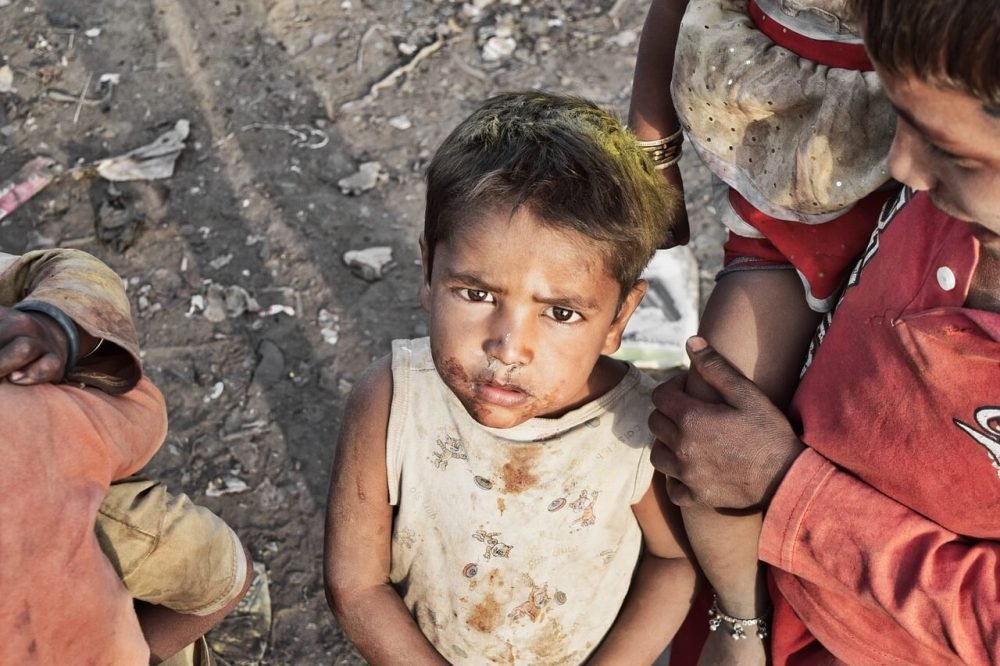
The International Day for the Eradication of Poverty is a United Nations observance held every year on 17 October.
The UN General Assembly officially established the day through Resolution 47/196 on 22 December 1992. Its history goes back to 17 October 1987, when more than 100,000 people gathered at the Trocadéro in Paris to honour people affected by extreme poverty, hunger and violence.
The day is not simply about counting how many people live in poverty.
It also focuses on dignity, participation and the experiences of people living in poverty.
The UN says people experiencing poverty should have a central role in efforts to eradicate poverty and improve their communities.
When Is End Poverty Day 2026?
End Poverty Day 2026 is Saturday, 17 October 2026.
The date is fixed each year.
It is commonly referred to as:
- End Poverty Day
- UN International Day for the Eradication of Poverty
- International Day for Eradication of Poverty
- October 17 International Day for the Eradication of Poverty
All of these terms refer to the same annual UN observance.
Why Is October 17 Important?
October 17 provides an annual opportunity to discuss poverty and the actions needed to reduce it.
The UN’s wider poverty-eradication agenda forms part of the Sustainable Development Goals, particularly SDG 1: No Poverty.
The goal is broader than increasing household income.
It also includes social protection, access to basic services, resilience and opportunities for people living in vulnerable situations.
Poverty in 2026: What Do the Numbers Show?
Poverty remains a major global challenge despite decades of progress.
The World Bank’s latest September 2026 update uses a new international poverty line of $3.00 per person per day, based on 2021 purchasing power parities. The Bank estimates that approximately 811 million people live below this line in 2026.
The World Bank also stresses that figures for 2025 and 2026 are nowcasts, meaning they are estimates based on available data and economic projections rather than complete survey observations.
Poverty Is Not Only About Income
A household can experience poverty through several connected problems.
These can include:
- Inadequate food
- Unsafe housing
- Limited healthcare
- Lack of education
- Unemployment
- Debt
- Poor sanitation
- Limited access to clean water
- Lack of productive assets
- Economic shocks
- Conflict or displacement
The UN therefore treats poverty as a multidimensional challenge rather than simply a shortage of cash.
This distinction matters when deciding how charitable funds can create meaningful impact.
A family may need food today.
But if the household has no reliable income, the same problem can return next month.
How Zakat Addresses Poverty
Zakat is an obligatory form of Islamic wealth redistribution that provides support to specific categories of eligible recipients.
The Qur’an provides the central framework in Surah At-Tawbah 9:60.
It identifies eight categories:
- The poor
- The needy
- Those administering Zakat
- Those whose hearts are to be reconciled
- People in bondage
- People in debt
- Those in the cause of Allah
- Stranded travellers
The first two categories directly relate to poverty and financial need.
This makes poverty relief a central part of the Zakat framework.
Zakat Is Different From General Charity
Zakat is not simply another donation.
It is an obligation with specific rules.
Sadaqah is voluntary.
A person can give Sadaqah to many beneficial causes that do not necessarily qualify for Zakat.
Zakat, however, must be distributed in accordance with Islamic eligibility requirements.
That distinction should remain clear when choosing a Zakat charity.
Can Zakat Really Help People Escape Poverty?
Zakat can help reduce poverty by meeting immediate needs and, where Islamic rules permit, supporting interventions that improve a recipient’s ability to become financially stable.
The important distinction is between relief and empowerment.
Relief addresses an immediate shortage.
Empowerment addresses some of the conditions that keep a household financially vulnerable.
For example:
Immediate support
A qualifying recipient may need help with:
- Food
- Essential household expenses
- Medical needs
- Qualifying debt
- Basic necessities
Longer-term support
Where the project and recipient meet applicable Zakat requirements, assistance may potentially support:
- Productive assets
- Vocational training
- Income-generating equipment
- Agricultural inputs
- Small-scale enterprise
- Skills development
The exact permissibility of using Zakat for particular livelihood projects can vary according to Islamic jurisprudence.
A charity should therefore have a clear Zakat policy and qualified Sharia oversight rather than simply labelling every development project as Zakat-eligible.
Zakat as a Poverty-Eradication System
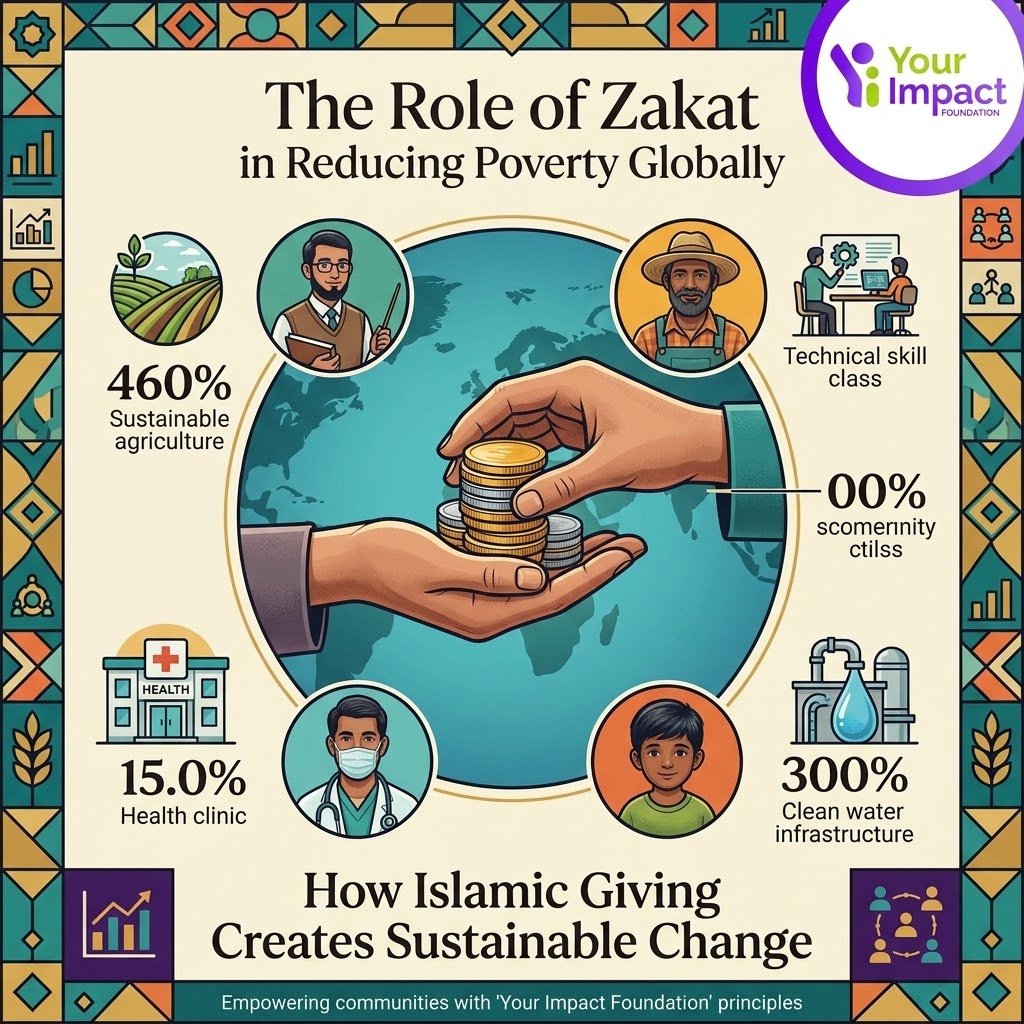
The strongest way to understand Zakat is not as a one-day poverty campaign.
It is a recurring system of wealth transfer.
Those who meet the conditions for paying Zakat contribute a portion of qualifying wealth.
Those who fall within eligible recipient categories can receive support.
This creates a structured connection between wealth and need.
The Zakat cycle
1. Wealth reaches the Zakat threshold
↓
2. The eligible Muslim calculates their Zakat
↓
3. Zakat is paid
↓
4. The charity assesses eligible recipients
↓
5. Funds reach qualifying beneficiaries
↓
6. Immediate needs are addressed
↓
7. Where appropriate, support can contribute to greater financial stability
This does not mean every Zakat payment should fund a business or livelihood project.
Some people need direct financial assistance.
Others may benefit from tools, training or income-generating support.
The correct approach depends on the recipient’s circumstances and the relevant Islamic rules.
What Are Livelihood Projects?
Livelihood projects provide people with resources or skills that can help them generate sustainable income.
Examples include:
- Livestock
- Agricultural tools
- Sewing machines
- Vocational training
- Small-business equipment
- Farming inputs
- Trade skills
- Microenterprise support
The purpose is to help a household move toward greater financial independence.
For example, providing a sewing machine to a trained person may create an opportunity to earn income from tailoring.
Providing livestock may give a rural household food or income-producing assets.
The exact impact depends on local conditions, training, market access and ongoing support.
Why Livelihood Projects Matter
Emergency aid remains essential.
A family facing hunger cannot wait for a five-year development programme.
But emergency assistance alone may not address the reason the household remains vulnerable.
This creates two different charitable needs.
Relief
“How can we help this family survive this crisis?”
Livelihood support
“How can this family strengthen its ability to support itself?”
Both can matter.
The best approach depends on the situation.
The Islamic Development Bank’s Lives and Livelihoods Fund provides an example of development finance focused on helping people overcome barriers in areas including healthcare, agriculture and basic infrastructure. The programme reports 37 projects across 22 member countries since its inception in 2016.
This broader development model reinforces an important point.
Poverty reduction usually requires more than one intervention.
How Livelihood Projects Can Break the Poverty Cycle
Create an income source
A productive asset can help a person earn rather than repeatedly depend on emergency assistance.
Improve household food security
An income-generating activity can help families purchase food more consistently.
Agricultural projects can sometimes provide food directly as well.
Support children’s education
More stable household income can help parents meet school-related costs.
The impact will vary by household and location.
Build resilience
A household with an income source may have more capacity to withstand future financial shocks.
Restore economic dignity
Being able to earn a living can give people greater control over their financial decisions.
This is why poverty reduction should consider both immediate needs and long-term opportunity.
How Your Zakat Can Support Livelihood Projects
Your Impact Foundation describes its livelihood programme as supporting families through income-generating assets and opportunities.
Its current programme highlights examples such as chickens, sewing machines and agricultural or enterprise-related support.
The organisation describes its objective as helping vulnerable households move toward greater self-reliance rather than relying indefinitely on emergency assistance.
However, donors should distinguish between Zakat-eligible funding and general Sadaqah.
Before directing Zakat toward a specific livelihood project, confirm that:
- The beneficiaries are Zakat-eligible.
- The project structure complies with the charity’s Zakat policy.
- The relevant Islamic scholars approve the model.
- Funds are separated and accounted for appropriately.
What Could a Livelihood Project Look Like?
Consider a hypothetical household with one adult who has tailoring skills but no equipment.
Emergency food support may help the family eat this month.
A suitable livelihood intervention could provide the equipment needed to generate income.
The pathway could look like this:
Training or existing skill
↓
Income-generating equipment
↓
Production
↓
Local sales
↓
Household income
↓
Greater financial stability
This is an example of how a livelihood intervention can address a constraint rather than repeatedly treating the same symptom.
It is not a guarantee of income.
Markets, skills, demand and household circumstances all affect the outcome.
Zakat and the Eight Categories of Recipients
The Qur’an’s framework is essential when discussing Zakat for poverty alleviation.
Surah At-Tawbah 9:60 does not say that all charitable projects can receive Zakat.
It identifies specific recipient categories.
The poor and needy
These categories directly connect Zakat with poverty relief.
However, determining whether someone qualifies as poor or needy requires assessment.
People in debt
People who meet the relevant conditions of the gharimin category may be eligible for Zakat.
Stranded travellers
Someone who is cut off from sufficient resources during travel may qualify under the ibn al-sabil category.
Other categories
The Qur’an also identifies other categories that have their own conditions and scholarly discussions.
This is why responsible Zakat distribution requires more than simply identifying a charitable project.
The recipient and the programme must satisfy the applicable rules.
What Is the Difference Between Zakat and Sadaqah for Poverty Relief?
| Zakat | Sadaqah |
|---|---|
| Obligatory for Muslims who meet the conditions | Voluntary |
| Has specific eligibility and calculation rules | More flexible |
| Recipients are defined in Qur’an 9:60 | Can support a wider range of beneficial causes |
| Must follow Zakat distribution rules | Can support projects such as general development or public benefit |
| Usually calculated annually for qualifying wealth | Can be given at any time |
Both can help people experiencing poverty.
But they should not be treated as interchangeable funds.
Why October 17 Is a Useful Date for Zakat Awareness
The international day for eradication of poverty provides a natural opportunity to educate Muslim communities about Zakat.
October can become a point for asking:
- Who qualifies for Zakat?
- How is Zakat calculated?
- Where does Zakat go?
- Can Zakat support livelihood programmes?
- How does Zakat differ from Sadaqah?
- How can charitable giving address poverty beyond emergency food aid?
This makes 17 October International Day for the Eradication of Poverty more than an awareness date.
For Muslim donors, it can become a reminder to review their charitable responsibilities.
Act on Poverty Day
Awareness matters.
Action matters too.
If you are eligible to pay Zakat, consider using October 17 as a reminder to review whether your Zakat is due.
If you have already calculated your Zakat, you can choose a transparent distribution channel.
Pay your Zakat online through Your Impact Foundation.
If you are researching how Islamic charity can contribute to longer-term poverty reduction, read Beyond Food Aid: How Sustainable Livelihood Projects Break the Cycle of Poverty.
Support livelihood opportunities
Your Impact Foundation’s livelihood programme focuses on income-generating support for vulnerable families, including examples such as livestock and equipment.
Give where the need is greatest
Not every urgent situation can be predicted.
A flexible donation can allow a charity to respond to changing humanitarian needs.
If you are giving Sadaqah rather than Zakat, consider the Need Is Greatest Fund.
How to Choose a Zakat Charity
Before paying Zakat, look beyond the donation button.
Check Zakat eligibility
Does the charity clearly explain who can receive Zakat?
Check its Zakat policy
Does it explain how Zakat funds are separated from general donations?
Check registration
For UK donors, verify the organisation through the appropriate charity regulator.
Check distribution
Does the organisation explain where and how Zakat is distributed?
Check impact reporting
Look for meaningful information about beneficiaries, programmes and outcomes.
Check Sharia governance
For complex Zakat programmes, look for clear evidence of qualified Islamic oversight.
Check transparency
A donor should be able to understand how their Zakat is handled.
Can Zakat End Poverty Completely?
No single Zakat programme can eliminate global poverty on its own.
Poverty has many causes.
These include:
- Unemployment
- Conflict
- Low wages
- Poor infrastructure
- Lack of education
- Health problems
- Debt
- Climate shocks
- Economic instability
- Weak social protection
Zakat is one tool within a much larger poverty-reduction system.
Its strength comes from combining an Islamic obligation with structured redistribution toward eligible recipients.
When paired with appropriate livelihood and development interventions, it can contribute to greater financial stability.
Frequently Asked Questions
What is the International Day for the Eradication of Poverty?
The International Day for the Eradication of Poverty is a UN observance held every year on 17 October. The UN General Assembly formally designated the date in 1992.
When is the International Day for the Eradication of Poverty 2026?
The International Day for the Eradication of Poverty 2026 is on 17 October 2026.
What is End Poverty Day?
End Poverty Day is a commonly used name for the International Day for the Eradication of Poverty, observed annually on October 17.
Why is October 17 called the International Day for the Eradication of Poverty?
The UN chose October 17 to recognise the history of the anti-poverty movement and encourage international action against poverty and destitution. The General Assembly formally established the observance in 1992.
How many people live in extreme poverty in 2026?
The World Bank’s September 2026 Poverty and Inequality Platform nowcast estimates about 811 million people living below the $3-per-person-per-day poverty line in 2026. The Bank notes that post-2024 figures are nowcasts rather than final survey estimates.
What is Zakat?
Zakat is an obligatory form of Islamic charity for Muslims who meet the relevant conditions. Its recipients are defined in Surah At-Tawbah 9:60.
Can Zakat help eradicate poverty?
Zakat can contribute to poverty reduction by transferring wealth to eligible recipients. Depending on Islamic rules and programme design, support may address immediate needs or contribute to longer-term economic stability.
Can Zakat fund livelihood projects?
It can potentially fund certain livelihood interventions when the beneficiaries and project structure meet the relevant Zakat requirements. However, not every livelihood or development project is automatically Zakat-eligible. Donors should check the charity’s Zakat policy or consult a qualified scholar.
What are livelihood projects?
Livelihood projects provide people with assets, skills or opportunities that can help them generate income. Examples include vocational training, agricultural inputs, livestock and income-generating equipment.
Are livelihood projects better than food aid?
They serve different purposes.
Food aid can address immediate hunger.
Livelihood programmes aim to strengthen longer-term income and resilience.
During an emergency, immediate food assistance may be essential. When conditions allow, livelihood support can address some of the economic constraints behind recurring poverty.
What is the difference between Zakat and Sadaqah?
Zakat is obligatory for eligible Muslims and has defined recipient categories. Sadaqah is voluntary and can support a broader range of charitable purposes.
Who can receive Zakat?
The Qur’an identifies eight categories in Surah At-Tawbah 9:60, including the poor, needy, Zakat administrators, people in debt and stranded travellers.
Can I pay Zakat online?
Yes. Muslims can use online donation services to pay Zakat, provided the organisation has an appropriate process for receiving and distributing Zakat.
How can I support poverty reduction on October 17?
You can learn about the causes of poverty, calculate your Zakat if it is due, pay Zakat through a transparent organisation, support eligible poverty-relief programmes or contribute Sadaqah to livelihood initiatives.
Turn End Poverty Day Into Action
The International Day for the Eradication of Poverty reminds us that poverty is more than a statistic.
It can mean a parent unable to provide enough food.
It can mean a household trapped in debt.
It can mean a person with skills but no tools to earn an income.
It can mean a family that needs emergency support today and a sustainable opportunity tomorrow.
Zakat provides Muslims with a structured way to support people who fall within its eligible categories.
The Qur’an specifically identifies the poor and needy among Zakat’s recipients.
But responsible giving requires more than sending money.
It requires understanding eligibility.
It requires transparent distribution.
And where appropriate, it can mean supporting programmes that help families move toward greater financial stability.
This 17 October 2026, consider turning awareness into action.
Learn how Zakat can contribute to ending poverty.
A donation may meet an urgent need.
A well-designed livelihood intervention may create an opportunity.
And Zakat, when distributed according to its Islamic framework, can help connect those with qualifying wealth obligations to people who have genuine financial need.
The goal is not only to relieve poverty today, but to help create a path toward greater stability tomorrow.