
Introduction: The Immense Reward When You Feed the Fasting
When you feed the fasting in Ramadan, you unlock one of the most extraordinary rewards in Islam—receiving the same spiritual merit as the person who fasted, without any reduction in their reward. This remarkable promise, recorded in authentic hadith, has inspired generations of Muslims to prioritise providing iftar meals to those observing the Ramadan fast. For UK Muslims seeking to maximise their good deeds during the blessed month, understanding the hadith about feeding the fasting and the spiritual benefits involved can transform both the giver and receiver.
Charity in Islam holds a position of paramount importance, with countless Quranic verses and prophetic traditions emphasising its virtue. Among all forms of charitable giving, feeding the fasting person occupies a special place due to its direct connection to one of the five pillars of Islam—sawm (fasting). The Prophet Muhammad (peace be upon him) was known for his unparalleled generosity, and his charity increased even more during Ramadan. This comprehensive guide explores the authentic hadiths, scholarly commentary, and practical ways UK Muslims can participate in this blessed act of worship.
The concept of feeding those who fast encompasses far more than simply providing food. It represents a beautiful convergence of spiritual devotion, communal solidarity, and humanitarian compassion. Whether you are providing a simple iftar meal for a single fasting person or contributing to programmes that feed 60 people as part of kaffarah obligations, the spiritual significance remains profound. This guide will walk you through everything you need to know about the rewards, hadiths, and practical methods for feeding the fasting in today’s world.
Related Resources:
- How to Fast in Ramadan Guide — Complete fasting rules and duas
- Automate Ramadan Donations — Never miss Laylatul Qadr giving
- Zakat Calculator — Calculate your Zakat correctly
- Kaffarah & Fidya — Fulfil your obligations
The Primary Hadith About Feeding the Fasting
The most famous hadith about feeding the fasting is recorded by Imam Ahmad and Ibn Khuzaymah, narrated by Zayd ibn Khalid al-Juhani (may Allah be pleased with him). The Prophet Muhammad (peace be upon him) said: “Whoever gives food to a fasting person to break his fast, he will have a reward like his, without that detracting from his reward in the slightest.”
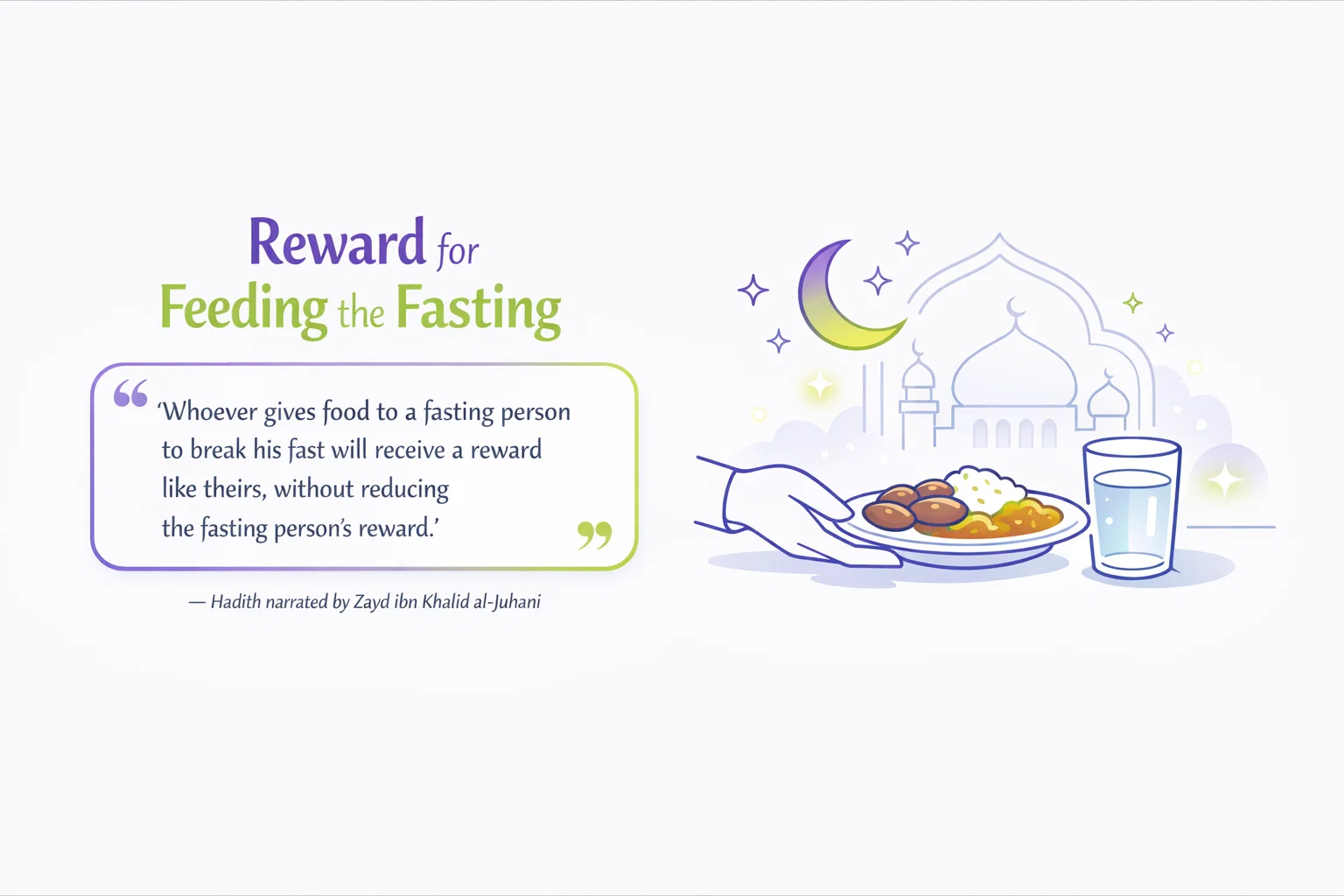
This feeding the fasting hadith represents one of the most generous promises in Islamic tradition. The scholars of Islam have marvelled at this divine generosity, noting that it allows those who cannot fast—whether due to illness, travel, or other legitimate reasons—to still earn the complete reward of fasting simply by facilitating someone else’s worship. The beauty of this arrangement lies in its inclusivity; the path to earning the reward of a fasting person is open to everyone, regardless of their physical ability to observe the fast themselves.
What is the reward for feeding a fasting person? The answer, as established in this primary hadith, is a reward equivalent to the fasting person’s reward—without any diminishment whatsoever. This means that if a fasting person earns a thousand units of reward for their day of worship, the person who provides their iftar meal earns the same thousand units, and the fasting person’s reward remains at a thousand units intact. The multiplication occurs through Allah’s infinite generosity, not by dividing the original reward.
Understanding the Reward of Feeding a Fasting Person
The reward of feeding a fasting person extends beyond mere equivalence to the faster’s reward. Islamic scholars have elaborated on various dimensions of this reward, drawing from multiple hadiths and Quranic principles. When you feed the fasting, you participate in multiple acts of worship simultaneously: facilitating someone’s worship, providing sustenance to a believer, strengthening communal bonds, and practising the prophetic sunnah of generosity.
The Mathematical Miracle of the Reward
Consider the extraordinary nature of the reward described in the hadith. In worldly terms, if two people share a reward, each would receive half. But Allah’s generosity operates on an entirely different principle—He grants the full reward to both the giver and the receiver. This reflects the divine attribute of al-Karim (the Generous) and demonstrates that Allah’s bounty has no limits. As one scholar beautifully expressed: “Allah did not make the reward of feeding a fasting person a portion of the faster’s reward; rather, He made it like the reward in its entirety.”
Furthermore, during Ramadan, all good deeds are multiplied significantly. The Prophet (peace be upon him) said: “The best charity is that given in Ramadan.” When you feed the fasting during this blessed month, you combine the inherent virtue of feeding a fasting person with the multiplied rewards of Ramadan. If the feeding occurs during the last ten nights, particularly on Laylatul Qadr (the Night of Power), the rewards multiply even further—one good deed on Laylatul Qadr is better than a thousand months of worship.
Why This Reward is So Great
Islamic scholars have offered several explanations for why feeding a fasting person carries such immense reward. First, by providing iftar, you enable the fasting person to complete their act of worship with ease and comfort. You become a facilitator of their worship, and in Islam, the one who facilitates a good deed shares in its reward. Second, you provide for a believer at a time when their need is greatest—at the moment of breaking their fast, when they are most vulnerable to hunger and thirst.
Third, feeding the fasting combines multiple virtues: charity (sadaqah), honouring a fellow Muslim, strengthening family and community ties, and following the sunnah of the Prophet (peace be upon him). Fourth, the act demonstrates true faith (iman), as it shows belief in Allah’s promises and willingness to spend from what He has provided. These combined factors elevate feeding the fasting to one of the most meritorious acts a Muslim can perform during Ramadan.
Table 1: Reward Multipliers for Feeding the Fasting
| Time/Context | Reward Multiplier | Notes |
| Any time in Ramadan | Equal to fasting | Base reward from hadith |
| Last 10 nights | Significantly multiplied | Best charity in Ramadan |
| Laylatul Qadr | Better than 1000 months | Seek odd nights (21, 23, 25, 27, 29) |
| Feeding multiple people | Reward × number fed | Feed 60 people = 60× reward |
Additional Authenticated Hadiths About Feeding the Fasting
Beyond the primary hadith recorded by Ibn Khuzaymah, numerous other authenticated traditions illuminate the virtues of feeding the fasting. These hadiths provide additional context, encouragement, and practical guidance for Muslims seeking to maximise their charitable giving during Ramadan. Charity quotes from Islam traditions consistently emphasise the extraordinary status of providing food to those in need, particularly during the blessed month.
Hadith from At-Tirmidhi
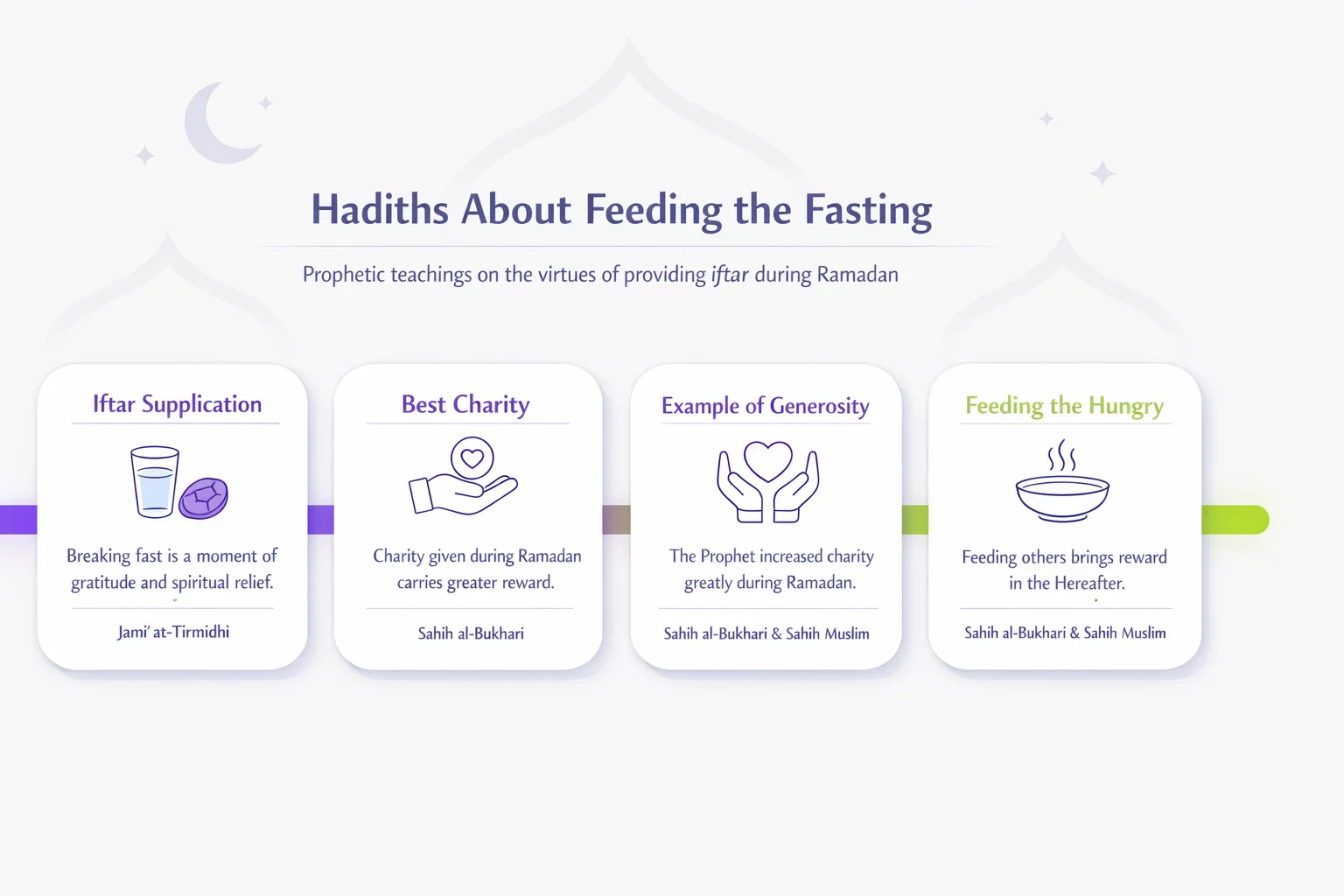
A beautiful hadith recorded by At-Tirmidhi describes the Prophet’s practice of breaking fast. He would say: “The thirst has gone, the veins are moistened, and the reward is confirmed, if Allah wills.” This supplication, made at the moment of breaking fast, expresses both physical relief and spiritual hope. It reminds us that iftar is not merely a meal but a moment of gratitude and spiritual affirmation. When we provide iftar to others, we enable them to experience this blessed moment of relief and gratitude.
Hadith on the Best Charity
The Prophet Muhammad (peace be upon him) said, as recorded by Al-Bukhari: “The best charity is that given in Ramadan.” This hadith specifically elevates all forms of charity during the blessed month. Combined with the hadith about feeding the fasting, it establishes a powerful incentive: feeding the fasting during Ramadan represents the convergence of two tremendous virtues—the virtue of providing iftar and the virtue of giving charity in Ramadan. Scholars note that this combination makes feeding the fasting one of the most rewarding acts possible during this month.
Hadith on the Prophet’s Generosity
Ibn Abbas (may Allah be pleased with him) reported: “The Prophet (peace be upon him) was the most generous of people, and he was even more generous in Ramadan when Jibreel would meet him. He would meet him every night of Ramadan to study the Quran. And when Jibreel met him, the Prophet was more generous in doing good than the blowing wind” (Al-Bukhari & Muslim). This hadith establishes the prophetic model for Ramadan generosity. The Prophet’s charity increased dramatically during this month, setting an example for all Muslims to follow.
Hadith on Feeding Others Generally
While not specific to Ramadan, the following hadith recorded by Al-Bukhari and Muslim applies beautifully to feeding the fasting: The Prophet (peace be upon him) said: “Any Muslim who feeds a Muslim who is hungry, Allah will feed him from the fruits of Paradise on the Day of Resurrection.” This hadith establishes a direct connection between feeding the hungry in this world and being fed from Paradise in the Hereafter. When applied to feeding the fasting during Ramadan, the reward is even greater, as the need is more acute and the spiritual context is more blessed.
Table 2: Key Hadith References for Feeding the Fasting
| Source | Topic | Key Teaching |
| Ibn Khuzaymah | Feeding the Fasting | Equal reward without diminishment |
| Al-Bukhari | Best Charity | Charity in Ramadan is most virtuous |
| At-Tirmidhi | Breaking Fast Dua | Gratitude and spiritual affirmation at iftar |
| Muslim | Feeding the Hungry | Fed from fruits of Paradise on Day of Judgment |
Charity in Islam: The Broader Context
To fully appreciate the significance of feeding the fasting, it is essential to understand the broader concept of charity in Islam. The Arabic term for charity, “sadaqah,” derives from a root meaning “truth” or “sincerity,” indicating that true charity springs from a sincere heart. Islam establishes charity not merely as a voluntary good deed but as a fundamental pillar of faith and a means of spiritual purification. The Quran and Sunnah are replete with charity quotes that inspire believers to give generously.
Quranic Foundations of Charity
The Quran establishes charity as a defining characteristic of the believers. In Surah Al-Baqarah (2:177), righteousness is defined not merely by facing a particular direction in prayer, but by believing in Allah, the Last Day, the angels, the Book, and the prophets—and significantly, by giving wealth, in spite of love for it, to relatives, orphans, the needy, the traveller, those who ask, and for freeing slaves. This comprehensive definition places feeding the hungry at the very heart of Islamic faith.
Another powerful verse, often quoted among charity quotes in Islam, appears in Surah Al-Insan (76:8-9): “And they give food in spite of love for it to the needy, the orphan, and the captive, saying: ‘We feed you only for the countenance of Allah. We wish not from you reward nor gratitude.'” This verse establishes the pure intention that should motivate all charitable giving—seeking only Allah’s pleasure without expecting anything in return from the recipients.
Inspiring Charity Quotes from Islam
The Prophet Muhammad (peace be upon him) provided numerous sayings that continue to inspire charitable giving among Muslims today. These charity quotes from Islam traditions emphasise both the spiritual and practical benefits of generosity:
- “Charity does not decrease wealth.” (Muslim) — This profound statement assures believers that giving in charity does not diminish their provision; rather, Allah replaces and multiplies what is spent for His sake.
- “Protect yourselves from the Fire, even with half a date.” (Al-Bukhari & Muslim) — This hadith demonstrates that even the smallest contribution counts, making charity accessible to everyone regardless of means.
- “The believer’s shade on the Day of Resurrection will be his charity.” (Al-Bayhaqi) — This beautiful image of charity providing shade on the scorching Day of Judgment motivates believers to give generously.
- “Whoever fulfils the need of his brother, Allah will fulfil his need.” (Al-Bukhari & Muslim) — This hadith establishes a direct relationship between helping others and receiving Allah’s help.
What is Iftar in Islam: Understanding the Meal That Breaks the Fast
What is iftar in Islam? Iftar is the evening meal with which Muslims break their Ramadan fast at sunset (Maghrib). The word “iftar” literally means “breakfast” or “breaking of the fast.” This meal holds profound spiritual significance beyond its physical function of nourishment. It represents the completion of a day’s worship through fasting, a moment of gratitude and relief, and an opportunity for communal gathering and hospitality.
The Prophet Muhammad (peace be upon him) established a beautiful sunnah for iftar. He would break his fast with fresh dates before praying Maghrib. If fresh dates were not available, he would use dried dates. If neither were available, he would break his fast with water. Anas ibn Malik reported: “The Prophet (peace be upon him) used to break his fast before praying with fresh dates. If there were no fresh dates, he would break his fast with dried dates. If there were no dried dates, he would take a few sips of water” (Abu Dawud & At-Tirmidhi). This graduated approach to breaking the fast demonstrates the prophetic emphasis on immediate nourishment.
The Spiritual Significance of Iftar
The moment of iftar carries immense spiritual weight. The fasting person has spent the day in worship through abstention, enduring hunger and thirst for Allah’s sake. As sunset approaches, anticipation builds for the moment when they can finally break their fast. This moment of relief and gratitude is precious in Allah’s sight. The Prophet (peace be upon him) said: “There are two joys for the fasting person: one when he breaks his fast, and the other when he meets his Lord” (Al-Bukhari & Muslim).
When you feed the fasting and provide iftar to someone, you participate in this sacred moment. You become the means through which Allah grants relief to His servant. The gratitude the fasting person feels at iftar extends to those who provided the meal, earning the provider both worldly blessings and otherworldly reward. This is why providing iftar is considered one of the most blessed forms of charity—because it touches the fasting person at a moment of maximum spiritual and physical significance.
Feed 60 People: The Kaffarah Connection
The phrase “feed 60 people” appears in Islamic jurisprudence in the context of kaffarah (expiation) for certain violations of religious obligations. Understanding this connection provides practical guidance for those who need to fulfil kaffarah requirements while also offering an opportunity for Muslims seeking to maximise their charitable impact. When you feed 60 people as kaffarah, you simultaneously fulfil a religious obligation and earn the reward of feeding the fasting.
When Feeding 60 People Becomes Obligatory
According to Islamic jurisprudence, feeding 60 poor people becomes obligatory in several situations. The most common scenario involves deliberately breaking a Ramadan fast without valid excuse. In such a case, the person must perform kaffarah by freeing a slave (which is not applicable in contemporary times), or fasting for two consecutive months, or feeding sixty poor people. Since most people today cannot fast for two consecutive months due to work and other obligations, feeding 60 people has become the standard method of kaffarah.
Additionally, feeding 60 people may be required for breaking an oath (yamin) deliberately. The Quran states: “Allah will not impose blame upon you for what is meaningless in your oaths, but He will impose blame upon you for [breaking] what you intended of oaths. So its expiation is the feeding of ten needy people from the average of that which you feed your families or clothing them or the freeing of a slave. But whoever cannot find [or afford] that—then a fast of three days” (Surah Al-Ma’idah 5:89). Some scholars interpret this as allowing feeding 60 people as an alternative when other options are not feasible.
How Much Does It Cost to Feed 60 People?
For UK Muslims wondering about the practical cost of feeding 60 people, the amount varies depending on the organisation and region where the meals are provided. Through Your Impact Foundation, providing iftar for 60 people costs approximately £250, which breaks down to roughly £4 per person for a complete iftar meal. This relatively modest sum—equivalent to the cost of a restaurant meal for one person in the UK—enables you to fulfil a significant religious obligation while earning immense spiritual reward.
It is worth noting that feeding 60 people during Ramadan carries additional spiritual benefits beyond fulfilling kaffarah. Since the reward for feeding one fasting person equals the reward of fasting itself, feeding 60 fasting people could potentially earn a reward equivalent to 60 days of fasting. This extraordinary multiplication of reward demonstrates Allah’s generosity and encourages believers to view religious obligations not as burdens but as opportunities for spiritual advancement.
Practical Ways to Feed the Fasting in Ramadan
For UK Muslims inspired by the hadith about feeding the fasting, numerous practical opportunities exist to participate in this blessed act of worship. From individual initiatives to organised programmes, the pathways to providing iftar meals are diverse and accessible. Understanding these options helps believers choose the method that best fits their circumstances, resources, and the impact they wish to achieve.
Supporting Established Charities
One of the most efficient ways to feed the fasting is by supporting established charitable organisations that specialise in Ramadan food programmes. Your Impact Foundation (UK Charity No. 1192710) operates comprehensive feed the fasting programmes in crisis zones including Gaza, Yemen, and Syria. These programmes provide both hot iftar meals and food packs that sustain families throughout Ramadan. By contributing to such organisations, you leverage their existing infrastructure, local partnerships, and expertise to ensure your donation reaches those most in need.
The charity offers several donation tiers that make feeding the fasting accessible to Muslims of all financial means. A donation of £40 can provide iftar meals for eight people, while £100 can supply a family of six with food for the entire month of Ramadan. For those fulfilling kaffarah obligations, £250 can feed 60 people—a complete fulfilment of the kaffarah requirement. The 100% Zakat policy ensures that Zakat donations reach eligible recipients without any deduction for administrative costs.
Community Iftar Programmes
Mosques and Islamic centres across the UK host nightly iftar programmes throughout Ramadan, funded entirely by community donations. Contributing to these programmes—whether financially or through volunteering—provides an excellent way to participate in feeding the fasting at the local level. These gatherings bring together Muslims from diverse backgrounds to break their fast collectively, embodying the spirit of brotherhood and unity that Ramadan promotes. The Prophet (peace be upon him) emphasised the importance of communal eating, and community iftars represent this prophetic practice in action.
Individual and Family Initiatives
Beyond institutional giving, individual Muslims can feed the fasting through personal initiatives. Preparing iftar meals at home and distributing them to neighbours, the elderly, students, or anyone who might be fasting alone creates meaningful connections within the community. Some families make it a Ramadan tradition to prepare a certain number of iftar meals each week, involving children in the process to teach them the values of charity and community service from a young age. These grassroots efforts complement larger programmes and ensure that no member of the community is forgotten during Ramadan.
Frequently Asked Questions About Feeding the Fasting
What is the reward for feeding a fasting person?
The reward for feeding a fasting person is equivalent to the reward of the fasting person himself, without any reduction in the original faster’s reward. This is established in the hadith recorded by Ibn Khuzaymah, where the Prophet (peace be upon him) said: “Whoever gives food to a fasting person to break his fast, he will have a reward like his, without that detracting from his reward in the slightest.” During Ramadan, this reward is multiplied further, and if the feeding occurs during the last ten nights or on Laylatul Qadr, the rewards are exponentially greater.
Can I use Zakat to feed the fasting?
Yes, Zakat can be used to feed the fasting, provided that the recipients qualify as eligible according to Islamic law. The poor and needy are among the eight categories specified in the Quran as legitimate Zakat recipients. When donating Zakat for feed the fasting programmes, ensure that the charity operates a 100% Zakat policy and verifies the eligibility of recipients. Your Impact Foundation maintains such a policy, ensuring that Zakat donations reach only those who qualify.
Do I need to feed a full meal to get the reward?
The hadith about feeding the fasting mentions giving “food” without specifying the amount or type. Scholars explain that even providing a few dates and water to break someone’s fast qualifies for the reward mentioned in the hadith. The Prophet (peace be upon him) said: “Whoever gives iftar to one who is fasting will have a reward like his” (At-Tirmidhi). The emphasis is on facilitating the breaking of the fast, not on providing an elaborate meal. However, providing a complete, nutritious meal brings additional reward as it better serves the recipient’s needs.
Does feeding non-fasting people count?
The specific reward of “equal to the fasting person’s reward” applies to feeding those who are actually fasting. However, feeding any hungry person carries immense virtue in Islam. The Prophet (peace be upon him) said: “Any Muslim who feeds a Muslim who is hungry, Allah will feed him from the fruits of Paradise on the Day of Resurrection” (Al-Bukhari & Muslim). This general reward for feeding the hungry applies year-round, while the special reward for feeding the fasting is specific to Ramadan.
Can I feed the fasting on behalf of deceased relatives?
Yes, feeding the fasting can be done on behalf of deceased relatives as a form of sadaqah jariyah (ongoing charity). The Prophet (peace be upon him) permitted giving charity on behalf of the deceased, and such acts benefit both the giver and the one on whose behalf it is given. This practice is particularly meaningful during Ramadan, when the rewards of all good deeds are multiplied. Many Muslims choose to sponsor iftar meals in memory of parents, spouses, or other loved ones who have passed away.
Take Action: Feed the Fasting This Ramadan
The hadith about feeding the fasting presents an extraordinary opportunity for UK Muslims to earn immense spiritual reward while fulfilling a humanitarian obligation. Whether you contribute financially to organised programmes, volunteer at community iftars, or prepare meals for neighbours and those fasting alone, the reward remains guaranteed by the Prophet’s promise. In a world where millions of Muslims struggle to break their fast with even the most basic sustenance, your contribution can make a profound difference.
Your Impact Foundation invites you to participate in their feed the fasting programmes serving Gaza, Yemen, and Syria. For just £40, you can provide iftar meals for eight people. For £100, you can sustain a family throughout the blessed month. And for £250, you can feed 60 people—fulfilling a complete kaffarah obligation while earning the reward equivalent to 60 days of fasting. The 100% Zakat policy ensures that your Zakat donations reach eligible recipients without any deduction.
Feed the Fasting — Earn the Reward of a Fasting Person
Donate Now: https://yourimpactfdn.org/donate/feed-the-fasting-this-ramadan/