
Iman increases through daily Quran recitation, consistent salah, dhikr, seeking knowledge, keeping righteous company, giving charity, voluntary fasting, reflecting on Allah’s signs, sincere repentance, and intentional dua. These are the actions the Prophet Muhammad ﷺ and his companions practised to keep their faith strong — and they are the very same steps that every Muslim can take today, regardless of where they are on their spiritual journey.
If you have ever felt your connection to Allah fade, if prayer has started to feel mechanical, or if you have wondered why your iman seems to go up and down, you are not alone. This happens to every Muslim. The Sahabah themselves experienced iman dips and openly asked the Prophet ﷺ, “My iman is decreasing when I am away from you, how to increase iman?” What matters is not that your iman fluctuates — what matters is knowing how to bring it back, how to protect it, and how to make it stronger than before.
What Is Iman in Islam?
Iman in Islam means to believe in the heart, declare with the tongue, and act upon with the limbs. This three-part definition comes from the famous Hadith of Jibreel (Gabriel), in which the Angel Jibreel appeared to the Prophet Muhammad ﷺ in the form of a man and asked him about Islam, Iman, and Ihsan. The Prophet ﷺ replied: “Iman is to believe in Allah, His angels, His books, His messengers, the Day of Judgement, and to believe in the Divine Decree (Qadr), both its good and its bad.” (Sahih Muslim 8)
The word iman comes from the Arabic root aman, which means to believe, to be safe, and to find peace. This is deeply significant — true iman does not just mean intellectual belief. It means finding inner safety, tranquillity, and peace through your relationship with Allah. When iman is strong, the heart is at rest. When iman is weak, the heart feels restless and lost.
Iman rests on six pillars, known as Arkan al-Iman, which every Muslim must believe in with full conviction:
- Belief in Allah — the One God, Creator of everything
- Belief in His Angels (Mala’ikah) — beings created from light who carry out Allah’s commands
- Belief in His Divine Books (Kutub) — the Quran, Torah, Psalms, Gospel, and all revealed scriptures
- Belief in His Messengers (Rusul) — from Adam to Muhammad ﷺ, the final Messenger
- Belief in the Day of Judgement (Yawm al-Qiyamah) — the Day when all deeds will be accounted for
- Belief in Divine Decree (Qadr) — Allah’s complete knowledge and control over all things
These six pillars form the foundation of a Muslim’s aqeedah (creed). Without them, iman is incomplete. Understanding what iman truly means is the first step to strengthening it — you cannot increase what you do not understand.
Give Sadaqah today to purify your heart and strengthen your connection to Allah.
What Are the Three Levels of Iman According to the Hadith of Gabriel?
The three levels of religious practice in Islam are Islam (outer submission), Iman (inner belief), and Ihsan (spiritual excellence). These levels were defined in the same Hadith of Jibreel and represent a spiritual progression that every Muslim can climb.
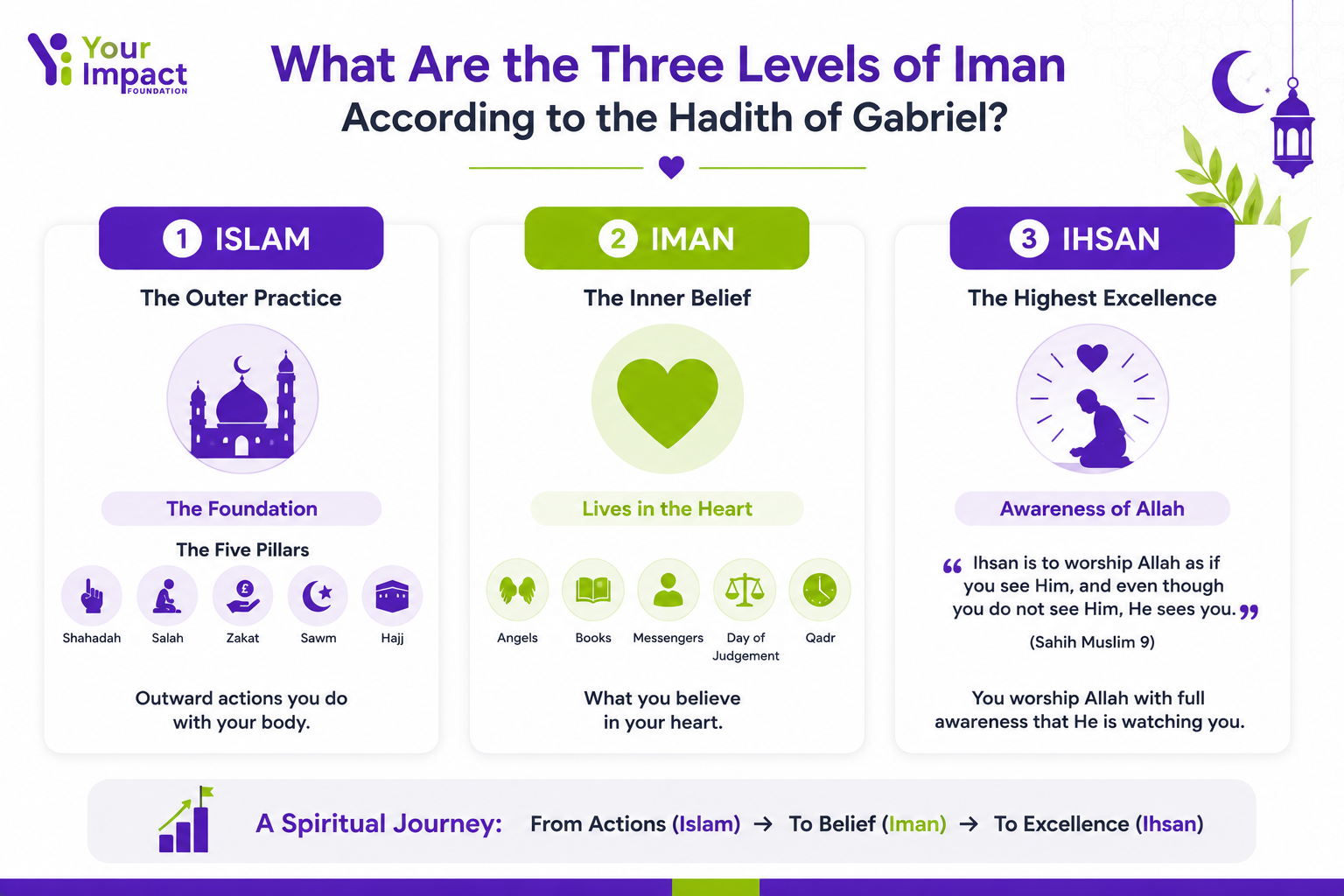
Islam is the outer practice — the Five Pillars: Shahadah, Salah, Zakat, Sawm, and Hajj. It is the foundation that every Muslim begins with. You can practise Islam outwardly while your inner faith is still developing.
Iman goes deeper. It is the inner belief in Allah, His angels, His books, His messengers, the Day of Judgement, and Qadr. Iman lives in the qalb (heart) — the spiritual centre of a person. While Islam is what you do with your body, iman is what you hold in your heart. Many people perform the actions of Islam without truly feeling the depth of iman.
Ihsan is the highest level. The Prophet ﷺ defined it beautifully: “Ihsan is to worship Allah as if you see Him, and even though you do not see Him, He sees you.” (Sahih Muslim 9) This is the state of muraqabah — constant, beautiful awareness that Allah is watching you at every moment. When a Muslim reaches the level of Ihsan, every action becomes an act of worship because it is done with full consciousness of Allah.
Most Muslims operate at the level of Islam. The goal of every believer should be to climb from Islam to Iman, and from Iman to Ihsan. This is exactly what the ten steps in this guide will help you achieve.
Does Iman Increase and Decrease According to the Quran and Hadith?
Yes — iman absolutely increases and decreases. This is confirmed by multiple verses of the Quran and several Hadith of the Prophet ﷺ. It is not a static state. It fluctuates like the ocean tide, rising and falling based on your actions, your environment, and your connection to Allah.
The Quran describes this clearly in Surah Al-Anfal:
“The believers are only those who, when Allah is mentioned, their hearts become fearful, and when His verses are recited to them, it increases them in faith…” (Surah Al-Anfal 8:2)
And in Surah At-Tawbah:
“And whenever a surah is revealed, some of them say: ‘Which of you has had his iman increased by it?’ As for those who believe, it has increased their iman, and they rejoice.” (Surah At-Tawbah 9:124)
The Prophet ﷺ also confirmed this. Umayr ibn Habeeb al-Khatmi (RA) reported: “Iman increases and decreases.” When he was asked how, he replied: “If we remember our Lord and fear Him, it increases. If we are heedless and forget, it decreases.” (Narrated by al-Darimi)
The Sahabah themselves experienced iman fluctuations. They would attend gatherings of knowledge and feel their iman soar, then return to their daily lives and feel it settle. This is completely normal. The key is not to panic when iman dips — but to know how to bring it back, which is exactly what the next sections cover.
Give Sadaqah today to purify your heart and strengthen your connection to Allah. [Donate to YIF]
Why Does My Iman Decrease? (7 Common Reasons)
Iman decreases when you commit sins without repenting, neglect worship, surround yourself with bad influences, or become absorbed in worldly distractions. The Prophet ﷺ warned about the things that silently erode faith, and the scholars of Islam have identified the most common causes of spiritual decline. Understanding these reasons is essential before you can fix them.
1. Committing Sins Without Repentance (Tawbah)
Every sin — no matter how small — leaves a mark on the heart. When sins are repeated without sincere tawbah (repentance), these marks accumulate and create what the Quran calls a “disease of the heart” (marad al-qalb). Allah says: “In their hearts is a disease, and Allah has increased their disease.” (Surah Al-Baqarah 2:10) The Prophet ﷺ said: “When a servant commits a sin, a black spot appears on his heart. If he repents, his heart is polished. If he returns to the sin, the spot increases until it covers his entire heart.” (Sunan Ibn Majah 4244)
2. Excessive Worldly Distraction and Social Media
Ghafalah (heedlessness) is one of the greatest enemies of iman. When a Muslim spends hours scrolling through social media, consuming entertainment, and chasing the dunya (worldly life), the heart becomes numb to the remembrance of Allah. The Quran warns: “O you who have believed, do not let your wealth and your children divert you from the remembrance of Allah.” (Surah Al-Munafiqun 63:9) The constant stream of content keeps the mind busy but leaves the soul empty.
3. Keeping Bad Company
The Prophet ﷺ said: “A person follows the religion of his close friend, so let each of you look at who he takes as a close friend.” (Sunan Abu Dawud 4833) If your friends mock salah, make jokes about Islam, or drag you into sin, your iman will inevitably suffer. The company you keep shapes your heart — either lifting it or pulling it down.
4. Neglecting the Quran and Salah
The Quran is the primary tool for increasing iman, as Surah Al-Anfal 8:2 states. When you stop reading the Quran and start delaying or skipping salah, you are cutting off the two main sources of spiritual nourishment. Missing Fajr consistently is particularly damaging — the Prophet ﷺ described it as the prayer that marks the difference between a believer and a hypocrite.
5. Missing Fajr Consistently
The early morning prayer is a spiritual anchor. The Prophet ﷺ said: “Whoever prays the two cool prayers — Fajr and Asr — will enter Paradise.” (Sahih al-Bukhari 574) When a Muslim sleeps through Fajr habitually, it weakens their discipline, their willpower, and their iman. The shaitan (devil) actively works to make Fajr the first prayer to slip, because he knows its importance.
6. Excess Useless Talk and Gossip
Riya (showing off), backbiting, gossip, and idle talk consume spiritual energy without producing any good. The Quran calls backbiting “eating the flesh of your dead brother” (Surah Al-Hujurat 49:12). Every moment spent in useless conversation is a moment not spent in dhikr (remembrance of Allah), dua, or reflection — all of which increase iman.
7. Not Making Enough Dua
Some Muslims only make dua when they are in trouble. But dua is not just an emergency tool — it is the constant conversation between a servant and their Lord. When you stop making dua regularly, you slowly lose that intimate connection with Allah, and iman weakens as a result.
Give Sadaqah today to purify your heart and strengthen your connection to Allah. [Donate to YIF]
How to Increase Iman and Taqwa: 10 Practical Steps
The most effective ways to increase iman are: reading the Quran daily, praying all five salah on time, establishing morning and evening adhkar, making intentional dua, seeking beneficial knowledge, keeping righteous company, giving charity regularly, fasting voluntarily, practising muraqabah (self-awareness of Allah), and repenting sincerely after every sin. These steps are not theoretical — they are the exact actions the Prophet ﷺ and the Sahabah used to protect and strengthen their faith.
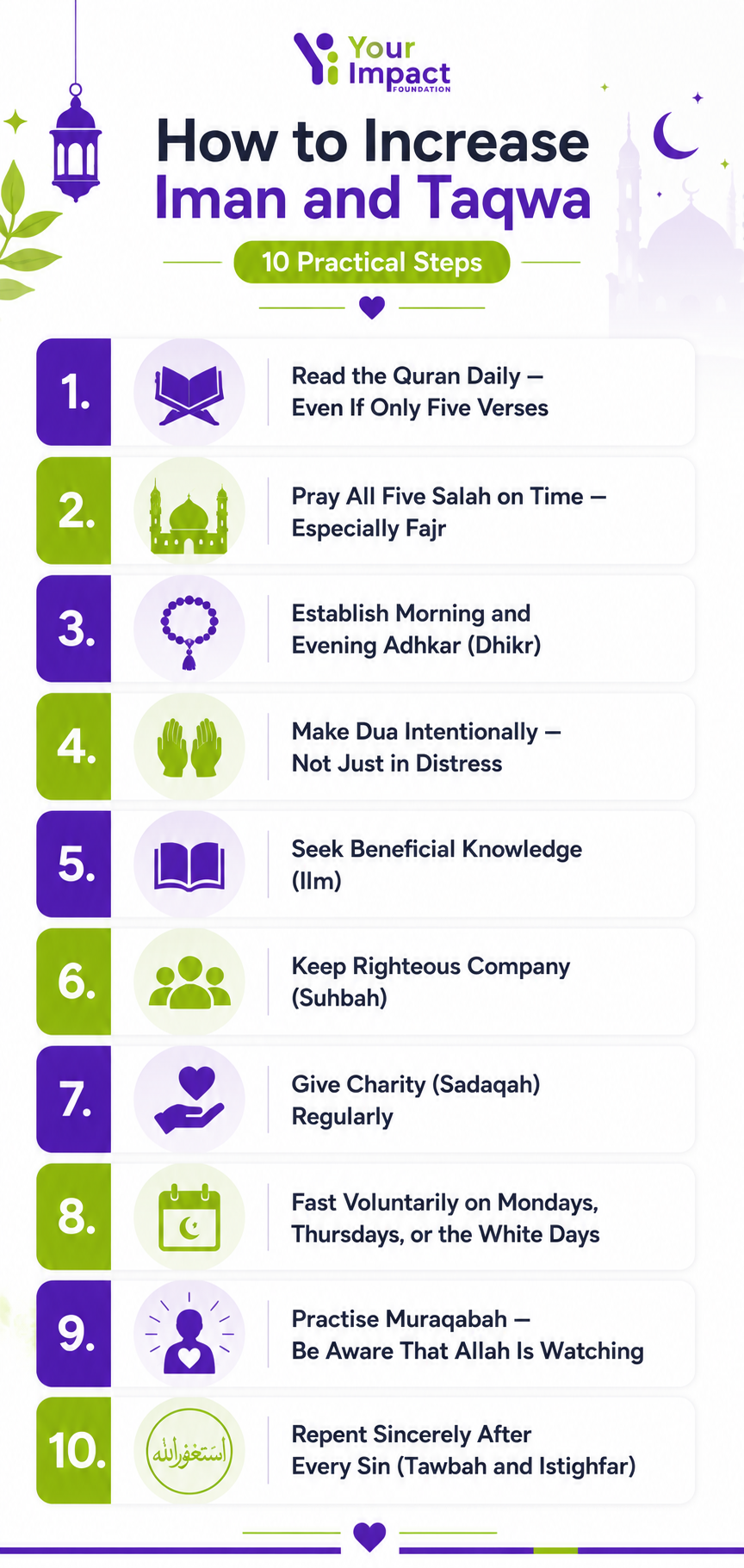
1. Read the Quran Daily — Even If Only Five Verses
The Quran is the most powerful tool for increasing iman. Allah explicitly states that reciting His verses increases faith: “When His verses are recited to them, it increases them in faith.” (Surah Al-Anfal 8:2) You do not need to read an entire juz a day. Start with five verses. Read them slowly, with tadabbur (reflection), not speed. Understand what Allah is saying to you. The Prophet ﷺ said: “Whoever reads a letter from the Book of Allah will have a reward, and that reward will be multiplied by ten.” (Sunan at-Tirmidhi 2910) Even one page a day can transform your iman over time.
2. Pray All Five Salah on Time — Especially Fajr
Salah is the second pillar of Islam and the direct connection between you and Allah. The Prophet ﷺ said: “The first thing the people will be accountable for on the Day of Judgement is the prayer.” (Sunan an-Nasa’i 391) Praying all five salah on time, with focus and humility, is one of the most consistent ways to keep iman strong. Fajr in particular is essential — conquering your bed for the sake of Allah trains your nafs (soul) in discipline and sincerity.
3. Establish Morning and Evening Adhkar (Dhikr)
The Prophet ﷺ prescribed specific adhkar (words of remembrance) for morning and evening. These are not optional extras — they are spiritual armour. Reciting them at the same time each day trains your heart to turn to Allah at the beginning and end of every day. Allah says: “Verily, in the remembrance of Allah do hearts find rest.” (Surah Ar-Ra’d 13:28) Start with the simplest: Subhan Allah, Alhamdulillah, Allahu Akbar — thirty-three times each after every salah.
4. Make Dua Intentionally — Not Just in Distress
Dua is the weapon of the believer and the essence of worship. The Prophet ﷺ said: “Nothing is more honourable to Allah than supplication.” (Sunan at-Tirmidhi 3370) Do not wait for hardship to make dua. Make dua in every sujud, every morning, every evening, and before sleeping. Ask Allah specifically to increase your iman — this is one of the most powerful duas you can make: “Ya Allah, increase me in knowledge, faith, and certainty.”
5. Seek Beneficial Knowledge (Ilm)
Ilm (Islamic knowledge) protects and strengthens iman. The more you know about Allah, His names, His attributes, and His commands, the stronger your iman becomes. The Prophet ﷺ said: “Seeking knowledge is an obligation upon every Muslim.” (Sunan Ibn Majah 224) This does not mean you need to enrol in a madrasah. Read one Islamic book, listen to one scholarly lecture, or study one topic each week. Over time, this knowledge builds a fortress around your iman that trials cannot easily break.
6. Keep Righteous Company (Suhbah)
The people around you shape your heart. The Prophet ﷺ said: “A person follows the religion of his close friend.” (Sunan Abu Dawud 4833) Surround yourself with friends who remind you of Allah, who encourage you to pray on time, who avoid backbiting, and who motivate you to be better. If you do not have such friends in person, seek them online through Islamic study circles, YouTube scholars, and Muslim communities.
7. Give Charity (Sadaqah) Regularly
Sadaqah is one of the most practical ways to increase iman. The Prophet ﷺ said: “Charity does not decrease wealth.” (Sahih Muslim 2588) When you give something — even a small amount — for the sake of Allah, you are demonstrating trust in Him. Every pound you give is a proof that your iman is alive and active. Give regularly, even if it is just a few pounds a month. The act of giving softens the heart and reminds you of the blessings Allah has given you.
8. Fast Voluntarily on Mondays, Thursdays, or the White Days
The Prophet ﷺ fasted on Mondays and Thursdays regularly. When asked why, he said: “That is the day on which I was born, and the day on which I was sent as a Messenger.” (Sahih Muslim 1162) He also recommended fasting the three White Days (13th, 14th, and 15th of every Islamic month). Voluntary fasting (sawm) teaches the nafs self-discipline, increases gratitude for Allah’s blessings, and draws you closer to Him.
9. Practise Muraqabah — Be Aware That Allah Is Watching
Muraqabah is the practice of being constantly aware that Allah sees you. It is the essence of Ihsan — “worshipping Allah as if you see Him.” You do not need to be in the mosque to practise muraqabah. While working, driving, cooking, or speaking to someone, remind yourself: Allah is watching me right now. Is He pleased with what I am doing? This single habit can transform your entire spiritual life.
10. Repent Sincerely After Every Sin (Tawbah and Istighfar)
Tawbah (sincere repentance) is the door that never closes. No matter how many times you have fallen into sin, the door to Allah’s forgiveness is always open. The Prophet ﷺ said: “Allah extends His hand at night to accept the repentance of the sinner of the day, and extends His hand during the day to accept the repentance of the sinner of the night.” (Sahih Muslim 2759) Make istighfar part of your daily routine — say “Astaghfirullah” 100 times a day. This was the daily practice of the Prophet ﷺ, who despite being forgiven of all his past and future sins, still sought forgiveness more than seventy times a day.
How to Increase Iman in Allah: Building a Deeper Connection
To increase iman in Allah, reflect on His names and attributes, remember death frequently, pray Tahajjud, and practise muraqabah. These practices move you beyond the surface level of worship into a deep, personal relationship with your Creator.
Know Allah through His Names. Allah has 99 beautiful names — Ar-Rahman (The Most Merciful), Al-Ghafur (The Forgiving), Al-Qareeb (The Near One), Al-Wadud (The Loving). When you understand these names, your relationship with Allah transforms from fear to love, from distance to intimacy.
Remember death. The Prophet ﷺ said: “Remember frequently the destroyer of pleasures — death.” (Sunan an-Nasa’i 1608) Death is not meant to frighten you — it is meant to wake you up. When you remember that this life is temporary, the things that weaken your iman — status, money, social media — lose their grip on your heart.
Pray Tahajjud. The night prayer (Tahajjud or Qiyam al-Layl) was the Prophet’s ﷺ secret to the strongest iman. In the quiet hours of the night, when the world is asleep and distractions are gone, standing before Allah in prayer does something to the heart that nothing else can. Even two rak’ahs can reignite your iman.
Practise gratitude (Shukr). The Quran says: “If you are grateful, I will certainly give you more.” (Surah Ibrahim 14:7) Count your blessings every day. Write them down if you can. A heart that is filled with gratitude to Allah cannot easily be overtaken by ingratitude or doubt.
How Do I Become a Better Muslim When Iman Feels Low?
Start small, stay consistent, and do not despair. Even the Sahabah experienced iman dips — what matters is returning to Allah. The Prophet ﷺ said: “By Him in Whose hand is my soul, if you did not sin, Allah would replace you with people who would sin and then seek His forgiveness, and He would forgive them.” (Sahih Muslim 2749)
When your iman feels low, do not abandon your salah. This is the shaitan’s greatest trick — making you feel so unworthy that you stop practising Islam altogether. Keep praying, even if your heart feels empty. The heart will follow the actions, not the other way around.
Follow this simple action plan for low-iman days:
- Make istighfar 100 times — “Astaghfirullah, Astaghfirullah, Astaghfirullah”
- Read just one page of the Quran with translation and reflection
- Pray two rak’ahs of nafl prayer with complete focus
- Call or message a practising friend — even a brief conversation about Islam can lift your heart
- Give even a small amount in charity — the act of giving itself purifies the heart
- Go to sleep with the intention of waking up for Fajr
- Do not look at your phone for the first 30 minutes after waking up
The process of tazkiyah an-nafs (purification of the soul) is a lifelong journey. Some days your iman will feel incredibly strong — on those days, thank Allah and use that energy to do more good. Other days it will feel weak — on those days, be patient with yourself and return to the basics. What matters is the overall direction of your heart, not any single moment.
Give Sadaqah today to purify your heart and strengthen your connection to Allah. [Donate to YIF]
Frequently Asked Questions
What does imaan mean in Islam?
Imaan (or iman) in Islam means to believe in the heart, declare with the tongue, and act upon with the limbs. It is founded on six pillars: belief in Allah, His angels, His books, His messengers, the Day of Judgement, and Divine Decree (Qadr). The word comes from the Arabic root aman, meaning to believe and to find safety.
What is the fastest way to increase iman?
The fastest way to increase iman is to read the Quran daily with reflection (tadabbur), pray all five salah on time (especially Fajr), and make istighfar sincerely and frequently. The Prophet ﷺ said: “When His verses are recited to them, it increases them in faith” (Surah Al-Anfal 8:2). Even five verses a day can significantly strengthen your iman over time.
Can I increase my iman after sinning a lot?
Yes, absolutely. Allah’s mercy is greater than any sin. The Prophet ﷺ said: “Allah extends His hand at night to accept the repentance of the sinner of the day” (Sahih Muslim 2759). Never despair of Allah’s mercy. Sincere tawbah (repentance), consistent istighfar, and returning to your salah will restore your iman. The door of forgiveness never closes.
How do I know if my iman is increasing?
Signs of increasing iman include: feeling peace and tranquillity in salah, finding it easier to give up sins naturally, crying from the fear or love of Allah, enjoying Quran recitation and dhikr, being patient in hardships, desiring good for others, and feeling discomfort when near sinful environments. The Prophet ﷺ said: “Taste the sweetness of faith” (Sahih Muslim 34).
What is the difference between iman and Islam?
Islam is the outer practice — the Five Pillars: Shahadah, Salah, Zakat, Sawm, and Hajj. Iman is the inner belief — the six pillars of faith: belief in Allah, angels, books, messengers, the Day of Judgement, and Qadr. Islam is what you do with your body; iman is what you hold in your heart. Ihsan is the highest level: worshipping Allah as if you see Him.
Why does my iman go up and down?
Iman fluctuates because it is affected by your actions, your environment, and your spiritual habits. When you read Quran, pray on time, keep good company, and avoid sins, iman rises. When you neglect worship, engage in sins, keep bad company, or become absorbed in the dunya, iman falls. The Quran confirms this: “It increases them in faith” (Surah Al-Anfal 8:2). This is normal — even the Sahabah experienced it.