Quick Answer: Eid ul Adha 2026 UK Dates
When is Eid ul-Adha 2026 in the UK? Eid al-Adha 2026 is expected to fall on Tuesday, 26 May 2026 in the United Kingdom, subject to moon sighting confirmation. The celebration lasts for four days, from 26-29 May 2026. Muslims across the UK will gather for Eid prayers at local mosques and open spaces to mark the Festival of Sacrifice.
Eid ul-Adha, also known as the “Festival of Sacrifice” or “Bakrid,” is one of the two major Islamic holidays celebrated worldwide. The date varies each year based on the Islamic lunar calendar, falling on the 10th day of Dhul-Hijjah, the final month of the Islamic calendar. This comprehensive guide covers everything UK Muslims need to know about Eid al-Adha 2026, including confirmed dates, detailed prayer rules, complete Qurbani guidance, Nisab calculations, and how to make the most of this blessed occasion.
Eid ul-Adha 2026 UK Dates: Confirmed Schedule
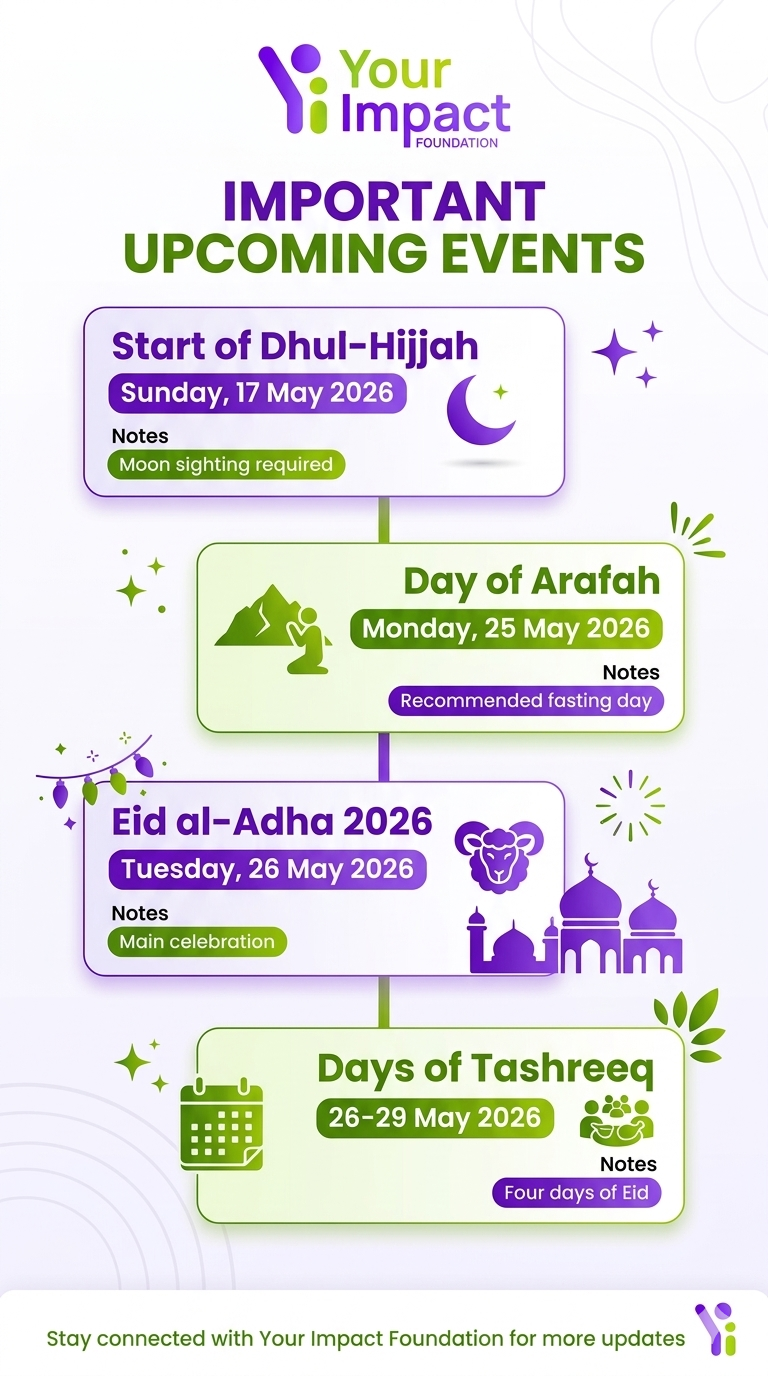
The Eid al-Adha 2026 date in the UK depends on the sighting of the moon for the month of Dhul-Hijjah. Based on astronomical calculations and moon sighting predictions:
| Event | Expected Date | Notes |
|---|---|---|
| Start of Dhul-Hijjah | Sunday, 17 May 2026 | Moon sighting required |
| Day of Arafah | Monday, 25 May 2026 | Recommended fasting day |
| Eid al-Adha 2026 | Tuesday, 26 May 2026 | Main celebration |
| Days of Tashreeq | 26-29 May 2026 | Four days of Eid |
Moon Sighting Considerations
The Islamic calendar follows lunar cycles, meaning dates shift approximately 11 days earlier each Gregorian year. For Eid al-Adha 2026 UK, local mosques and Islamic centres will announce the confirmed date following moon sighting reports. It is recommended to check with your local mosque or the London Central Mosque for official announcements closer to the date.
Some communities follow global moon sighting (uniting with Makkah), while others follow local UK sightings. This can occasionally result in different dates between communities, though astronomical calculations suggest Tuesday, 26 May 2026 as the most likely date for Eid al-Adha in the UK.
What is Eid al-Adha? Meaning and Significance
Eid al-Adha commemorates the willingness of Prophet Ibrahim (Abraham) to sacrifice his son Ismail in obedience to Allah’s command. Before the sacrifice could be completed, Allah provided a ram to be sacrificed instead, demonstrating that true faith requires complete submission to divine will.
The Story Behind Eid al-Adha
Prophet Ibrahim received a dream in which Allah commanded him to sacrifice his beloved son Ismail. Despite the immense difficulty of this command, Ibrahim prepared to fulfil it with unwavering faith. When he informed his son, Ismail accepted Allah’s decree and urged his father to proceed.
As Ibrahim prepared to carry out the sacrifice, Allah intervened and provided a ram as a substitute. This event demonstrated that Allah tests the faith of His servants but does not desire human suffering. The annual Qurbani (animal sacrifice) performed during Eid al-Adha honours this supreme act of faith and obedience.
Spiritual Significance
Eid al-Adha teaches Muslims several profound lessons:
- Submission to Allah – Complete trust in divine wisdom even when commands seem difficult
- Sacrifice and generosity – Willingness to give up what we love for a greater purpose
- Family devotion – The story highlights the faith of both father and son
- Compassion for others – Qurbani meat is distributed to family, friends, and the poor
- Unity of the Ummah – Muslims worldwide perform the same rituals simultaneously
Eid ul Adha Prayer: Complete Rules and Method
Eid prayer is a Sunnah mu’akkadah (emphatic Sunnah) performed on the morning of Eid al-Adha. Understanding the detailed rules ensures your prayer is performed correctly and in accordance with Islamic teachings.
Is Eid Prayer Obligatory or Sunnah?
There is a difference of opinion among Islamic scholars regarding the ruling of Eid prayer:
- Hanafi School: Eid prayer is Wajib (obligatory) for every Muslim who is required to perform Jumu’ah prayer
- Maliki, Shafi’i, and Hanbali Schools: Eid prayer is a confirmed Sunnah (Sunnah Mu’akkadah) or Fard Kifayah (communal obligation)
Regardless of the scholarly differences, attending Eid prayer is highly encouraged and considered one of the most important acts of worship on the day of Eid. Missing it without valid excuse is discouraged.
Who Should Attend Eid Prayer?
Eid prayer is recommended for:
- All adult Muslim men
- Women (including those who are menstruating, though they should not pray, they can attend for the blessing and khutbah)
- Children who have reached the age of understanding
- Those travelling (though they may be exempt)
Conditions for Valid Eid Prayer
The following conditions must be met for the Eid prayer to be valid:
- Time: The prayer must be performed within the prescribed time period
- Intention: Must make the intention for Eid prayer
- Congregation: Should be performed in congregation (though valid alone according to some scholars)
- Number of Rak’ahs: Must be exactly two rak’ahs
- Takbeers: Must include the additional takbeers
- Khutbah: Should be followed by the Eid sermon (though the prayer is valid without it)
Detailed Method of Eid Prayer
Step 1: Making Intention (Niyyah)
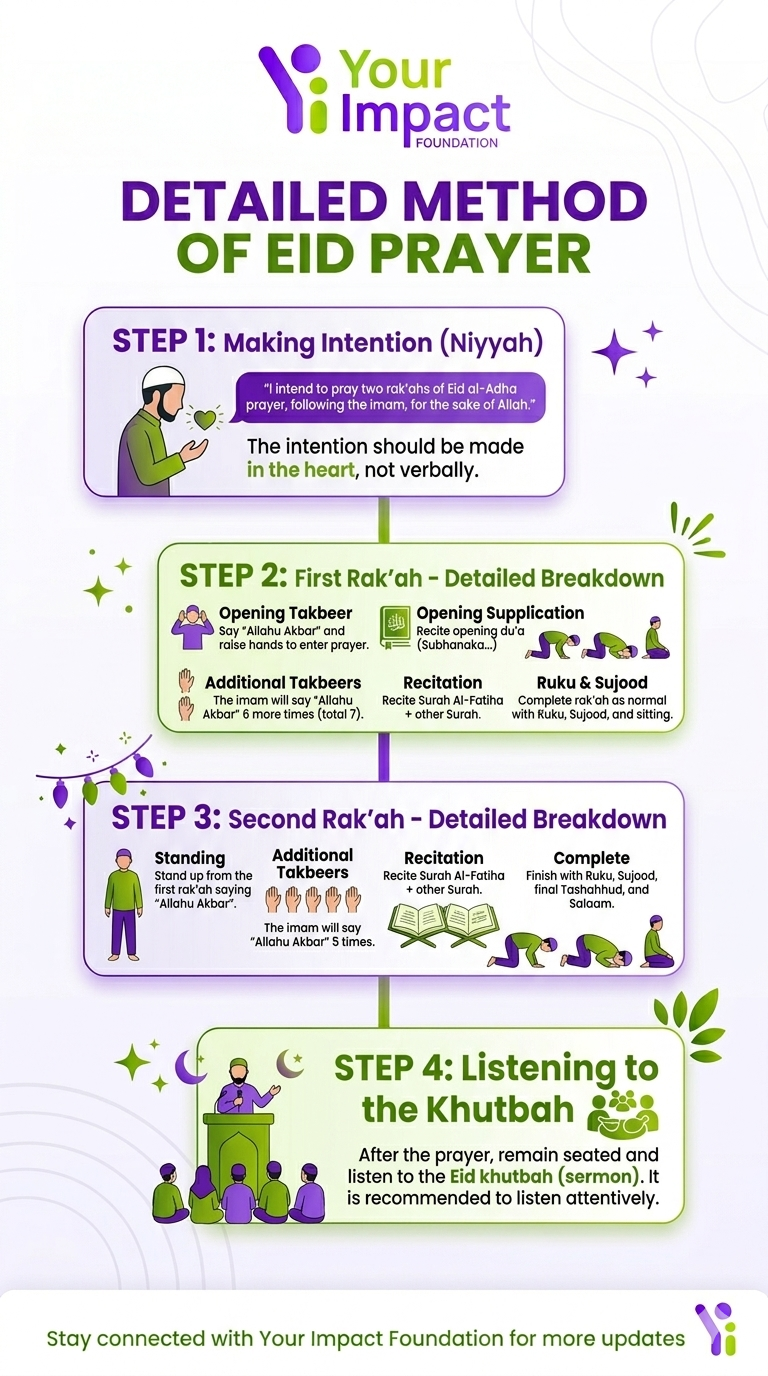
Before beginning, make the intention in your heart: “I intend to pray two rak’ahs of Eid al-Adha prayer, following the imam, for the sake of Allah.” The intention should be made in the heart, not verbally.
Step 2: First Rak’ah – Detailed Breakdown
- Opening Takbeer: Say “Allahu Akbar” while raising your hands to your ears (as in regular prayer) to enter the prayer
- Opening Supplication: Recite the opening du’a (Subhanaka Allahumma…)
- Additional Takbeers: The imam will say “Allahu Akbar” six more times (total seven takbeers including the opening one). Raise your hands to your ears for each takbeer and then fold them
- Recitation: Recite Surah Al-Fatiha, followed by another Surah (commonly Surah Al-A’la or Surah Qaf)
- Ruku and Sujood: Complete the rak’ah as normal with ruku, sujood, and sitting
Step 3: Second Rak’ah – Detailed Breakdown
- Standing: Stand up from the first rak’ah saying “Allahu Akbar”
- Additional Takbeers: The imam will say “Allahu Akbar” five times. Raise your hands for each and fold them
- Recitation: Recite Surah Al-Fatiha, followed by another Surah (commonly Surah Al-Ghashiyah or Surah Al-Qamar)
- Complete: Finish with ruku, sujood, final tashahhud, and salaam
Step 4: Listening to the Khutbah
After the prayer, remain seated and listen to the Eid khutbah (sermon). It is recommended to listen attentively, though it is not obligatory in the same way as Jumu’ah khutbah.
Number of Takbeers in Eid Prayer
| School of Thought | First Rak’ah | Second Rak’ah | Total Additional |
|---|---|---|---|
| Hanafi | 7 takbeers | 5 takbeers | 12 additional |
| Shafi’i | 7 takbeers | 5 takbeers | 12 additional |
| Maliki | 7 takbeers | 5 takbeers | 12 additional |
| Hanbali | 7 takbeers | 5 takbeers | 12 additional |
Note: The opening takbeer (to start prayer) is included in the count. So there are 6 additional takbeers in the first rak’ah and 5 additional in the second rak’ah.
What to Do If You Miss the Eid Prayer
If you miss the Eid prayer in congregation, you have the following options:
• Join another congregation: Find another mosque with a later prayer time • Pray individually: You may pray two rak’ahs on your own (Hanafi view differs—consult your local scholar) • Make up the intention: Ensure you attend next year with proper preparation
Recommended Acts Before Eid Prayer
The following Sunnah acts are recommended before attending Eid prayer:
- Ghusl (Ritual Bath): Take a full bath before going to prayer
- Wear Best Clothes: Dress in your finest clean clothes
- Apply Perfume: Men should apply fragrance (ittar/non-alcoholic perfume)
- Eat After Prayer: Unlike Eid al-Fitr, it is recommended to eat from your Qurbani meat after the prayer
- Walk to Mosque: If possible, walk rather than drive
- Different Routes: Take one route to the mosque and a different route returning
- Recite Takbeer: Say the Eid takbeer aloud on the way to prayer
Eid Takbeer
The Eid takbeer should be recited from the morning of Arafah until the days of Tashreeq (13th Dhul-Hijjah):
“Allahu Akbar, Allahu Akbar, Allahu Akbar, La ilaha illallah, Allahu Akbar, Allahu Akbar, wa lillahil hamd.”
Translation: Allah is the Greatest, Allah is the Greatest, Allah is the Greatest. There is no god but Allah. Allah is the Greatest, Allah is the Greatest, and all praise belongs to Allah.
Some add: “Allahu Akbar Kabira, wal hamdulillahi Kathira, wa Subhanallahi bukratan wa asila.”
Eid ul Adha 2026 UK Prayer Times
Eid prayer time follows the same rules as other prayers—it cannot be performed before sunrise. The recommended time begins approximately 15-20 minutes after sunrise and continues until just before the time for Dhuhr prayer.
When Does Eid Prayer Time Begin?
According to the majority of scholars, Eid prayer time begins when the sun has risen approximately the height of a spear (around 15-20 minutes after sunrise) and ends just before the Dhuhr prayer time begins.
Estimated Eid Ul Adha 2026 UK Prayer Times for Major UK Cities
Expected Eid al-Adha 2026 UK Prayer Times (26 May 2026):
| City | Sunrise | Earliest Prayer | Dhuhr Begins | Common Mosque Sessions |
|---|---|---|---|---|
| London | 05:02 | 05:22 | 13:01 | 06:00, 07:30, 09:00, 10:30 |
| Birmingham | 04:57 | 05:17 | 12:59 | 06:00, 07:30, 09:00 |
| Manchester | 04:52 | 05:12 | 12:57 | 05:45, 07:00, 08:30, 10:00 |
| Bradford | 04:49 | 05:09 | 12:56 | 05:30, 07:00, 08:30, 10:00 |
| Leeds | 04:50 | 05:10 | 12:57 | 05:45, 07:15, 08:45 |
| Glasgow | 04:42 | 05:02 | 13:17 | 05:30, 07:00, 08:30 |
| Edinburgh | 04:46 | 05:06 | 13:15 | 05:45, 07:15, 09:00 |
| Liverpool | 04:54 | 05:14 | 12:57 | 06:00, 07:30, 09:00 |
| Bristol | 04:59 | 05:19 | 13:00 | 06:00, 07:30, 09:00 |
| Sheffield | 04:51 | 05:11 | 12:57 | 05:45, 07:15, 08:45 |
Note: Times are approximate for 26 May 2026. Always confirm with your local mosque for exact schedules.
Eid Ul Adha 2026 UK: Complete Rules and Requirements
Qurbani, also known as Udhiyah, is the animal sacrifice performed during Eid al-Adha to honour Prophet Ibrahim’s willingness to sacrifice his son. This section provides comprehensive guidance on all aspects of Qurbani, including who must perform it, what animals are valid, how shares work, and detailed rules for correct performance.
Is Qurbani Obligatory?
The ruling on Qurbani differs among the Islamic schools of jurisprudence:
Hanafi School: Qurbani is Wajib (obligatory) for every Muslim who meets the conditions. It is considered a necessary act of worship that should not be neglected without valid reason.
Maliki, Shafi’i, and Hanbali Schools: Qurbani is a strongly emphasised Sunnah (Sunnah Mu’akkadah) for those who can afford it. It is highly recommended but not obligatory in the strict sense.
Given the difference of opinion, most scholars advise that those who can afford Qurbani should not neglect it, as it is a significant act of worship that draws the believer closer to Allah.
Who Must Perform Qurbani? Detailed Conditions
Qurbani becomes obligatory or recommended when a Muslim meets the following conditions:
1. Islam The person must be a Muslim. Non-Muslims are not required to perform Qurbani.
2. Sanity (Aql) The person must be of sound mind. Those with severe mental illness that affects their understanding are not obligated.
3. Adulthood (Bulugh) The person must have reached puberty. However, parents often perform Qurbani on behalf of their young children as a pious act.
4. Financial Capability (Istita’ah) This is the most important condition. A person must possess wealth that meets or exceeds the Nisab threshold.
5. Resident (Muqim) The person must be resident, not a traveller. Those on a journey during Eid al-Adha are exempt, though they may still perform Qurbani if they wish.
Nisab Threshold for Qurbani: Complete Calculation Guide
The Nisab is the minimum amount of wealth a Muslim must possess before certain obligations apply. For Qurbani, the Nisab is the same as for Zakat.
Current Nisab Values (as of May 2026):
| Standard | Nisab Amount | Approximate Value (GBP) |
|---|---|---|
| Silver Standard | 595 grams silver | £430-£460 |
| Gold Standard | 85 grams gold | £5,500-£6,000 |
Which Standard Should You Use?
Most scholars recommend using the silver standard for Qurbani obligation, as it is more inclusive and beneficial to the poor. Using the silver standard means more people qualify for Qurbani obligation, ensuring more meat reaches those in need.
What Assets Are Counted?
For Qurbani Nisab calculation, count: • Cash in hand and in bank accounts • Gold and silver jewellery/coins • Investments (stocks, shares, bonds) • Money owed to you (that you expect to receive) • Business inventory and assets
What Is Exempt?
The following are NOT counted toward Nisab: • Your primary residence (the house you live in) • Your personal vehicle(s) • Household furniture and appliances • Personal clothing and belongings • Tools of your trade
Example Calculation:
A person has:
- £5,000 in savings
- £2,000 in investments
- £500 gold jewellery
- £200 owed by a friend
Total: £7,700
This exceeds the silver Nisab (£430-£460), so Qurbani is required.
Qurbani for Women and Children
Women: Women who meet the Nisab threshold are equally obligated to perform Qurbani. A married woman’s obligation is independent of her husband—she must arrange her own Qurbani if she has her own wealth.
Children: Children who have not reached puberty are not obligated. However, it is recommended for parents to perform Qurbani on behalf of their children if they can afford it. This teaches children about the Sunnah and increases family blessings.
Elderly and Ill: Those who are mentally capable but physically unable to arrange slaughter should still perform Qurbani by appointing someone to do it on their behalf. Online Qurbani services are particularly helpful for the elderly and ill.
Valid Animals for Qurbani
Only certain animals are permissible for Qurbani. The following table provides complete details:
| Animal | Arabic Name | Minimum Age | Valid Age Signs | Shares Available |
|---|---|---|---|---|
| Sheep | Daanah/Ghanam | 1 year | Has entered its second year | 1 share (full animal) |
| Goat | Ma’iz | 1 year | Has entered its second year | 1 share (full animal) |
| Cow | Baqar | 2 years | Has entered its third year | Up to 7 shares |
| Bull | Thawr | 2 years | Has entered its third year | Up to 7 shares |
| Buffalo | Jammus | 2 years | Has entered its third year | Up to 7 shares |
| Camel | Jamal | 5 years | Has entered its sixth year | Up to 7 shares |
Important Age Considerations: • The age must be completed—counting starts from birth • A sheep that is 6 months old but appears to be a year old is NOT valid (age, not appearance, matters) • When in doubt, choose an older animal
Qurbani Share Rules: Complete Guide
Understanding how shares work is essential for those participating in collective Qurbani.
Small Animals (Sheep/Goat): One sheep or goat equals one complete Qurbani share. It cannot be divided among multiple people. If a family of four all needs to perform Qurbani, they would need four sheep/goats or share in a large animal.
Large Animals (Cow, Buffalo, Camel): These animals can be shared by up to seven people. Each person receives a full share of the meat.
Detailed Share Rules:
- Intention Matters: Each partner must make intention for Qurbani (not just for meat)
- Equal Division: Meat should be divided equally among all partners (by weight, not volume)
- Mixed Intentions: If some partners intend Qurbani and others only want meat, the Qurbani is valid for those with proper intention
- Varying Contributions: Even if one person pays more, shares should be equal in meat distribution
- Family Sharing: Family members can share a large animal together
Example: Family Qurbani with One Cow
A family has:
- Father (obligated)
- Mother (obligated)
- 2 adult sons (both obligated)
- 1 adult daughter (obligated)
- Grandmother (obligated)
Total: 6 obligated members Solution: Purchase one cow with 6 shares (one share remains for another person or can be given as charity)
Animals NOT Valid for Qurbani
The following animals CANNOT be used for Qurbani:
- Wild animals: Deer, gazelle, wild buffalo
- Birds: Chicken, duck, turkey, goose (not valid for Eid Qurbani)
- Fish: Not valid for Qurbani
- Horses, donkeys, mules: Not valid for Qurbani
Defects That Invalidate Qurbani
An animal with certain defects is NOT acceptable for Qurbani:
Major Defects (Invalidates Qurbani):
| Defect | Description |
|---|---|
| Blindness | One or both eyes completely blind |
| Obvious illness | Severe sickness that is apparent |
| Lameness | Cannot walk to the place of slaughter |
| Missing limb | Missing a leg, tail, or ear from birth or cut off |
| Extreme thinness | So emaciated that marrow is gone from bones |
| Missing teeth | Missing most or all teeth (affects eating) |
| Severed ear/tail | More than one-third cut off |
Minor Defects (Disliked but Valid):
- Broken horn (but not completely missing)
- Missing a few teeth (not most)
- Slightly lame but can still walk
- Small cut on ear (less than one-third)
Best Practice: Choose a healthy, defect-free animal to honour the sacrifice and ensure the best quality meat for distribution.
Qurbani Do’s and Don’ts: Complete Guide
Following the proper etiquette ensures your Qurbani is accepted and blessed.
Do’s of Qurbani (Mustahabbat)
Before Qurbani:
- Choose a healthy, defect-free animal
- Feed and water the animal well before slaughter
- Treat the animal with kindness and gentleness
- Make intention the night before or on Eid morning
- Recite “Bismillah Allahu Akbar” at the time of slaughter
During Qurbani:
- Sharpen the knife before slaughter (not in front of the animal)
- Perform slaughter quickly to minimize suffering
- Cut the throat, windpipe, and two blood vessels in one stroke
- Ensure the animal is facing the Qiblah
- Have a sharp knife ready before bringing the animal
After Qurbani:
- Divide meat into three equal parts
- Distribute to the poor promptly
- Give some to neighbours and relatives
- Keep some for your family
- Thank Allah for the blessing
Don’ts of Qurbani (Makruhat/Muharramat)
What to Avoid:
- Do NOT slaughter one animal in front of another.
- Do NOT sharpen the knife in front of the animal.
- Do NOT waste any part of the animal unnecessarily
- Do NOT sell the meat, skin, or any part of the Qurbani animal.
- Do NOT give the butcher their payment from the Qurbani meat.
- Do NOT let the animal see the knife before slaughter.
- Do NOT begin slaughtering until the animal is calm
Specific Prohibitions:
- Do NOT perform Qurbani before Eid prayer (the time begins after Eid prayer in most views)
- Do NOT use an animal that has obvious defects
- Do NOT keep ALL the meat for yourself (against the Sunnah)
- Do NOT delay distribution of the poor’s share
Can You Sell Qurbani Meat or Skin?
No. It is not permitted to sell any part of the Qurbani animal, including the meat, the skin/hide, the horns, any other part
If you sell any part, the money must be given as charity. The skin can be used personally or given to charity, but not sold.
Giving the Butcher from Qurbani Meat
It is not correct to give the butcher their fee from the Qurbani meat. The butcher should be paid separately. However, you may give the butcher a portion as a gift (not as payment).
Qurbani Distribution: The Three Parts
The Sunnah of Qurbani distribution divides the meat into three equal parts:
Part 1: For Yourself and Family (One-Third)
Keep one portion for your household. This allows your family to enjoy the blessing of Eid and share in the spiritual reward of the sacrifice. There is no restriction on how you use this portion—you can cook it for Eid meals, preserve it, or share it with guests.
Part 2: For Relatives and Friends (One-Third)
Share one portion with your relatives, friends, and neighbours. This strengthens family bonds and community ties, spreading the joy of Eid. When giving to relatives, consider those who may not have performed Qurbani themselves.
Part 3: For the Poor and Needy (One-Third)
The most important portion is that which goes to the poor. This portion should be given to those who cannot afford meat and may go without during Eid. This embodies the true spirit of Qurbani—sharing with those less fortunate.
Who Should Receive the Poor’s Share?
The poor’s share should be given to: • Those who cannot afford Qurbani themselves • The poor and needy in your community • Widows and orphans • Those in debt or financial hardship • Neighbours who are struggling
Can You Give All Meat to the Poor?
Yes, it is permissible to give all the meat to the poor. In fact, giving more to the needy is encouraged. Some scholars recommend giving the entire Qurbani to charity if you can afford to do so, as this maximizes the benefit to those in need.
When to Perform Qurbani: Time Rules
The time for Qurbani begins after the Eid al-Adha prayer and ends at sunset on the 13th of Dhul-Hijjah (the fourth day of Eid).
Qurbani Time Schedule
| Day | Date (2026) | Time Period |
|---|---|---|
| Day 1 | Tuesday, 26 May | After Eid prayer until sunset |
| Day 2 | Wednesday, 27 May | After Fajr until sunset |
| Day 3 | Thursday, 28 May | After Fajr until sunset |
| Day 4 | Friday, 29 May | After Fajr until sunset |
Important Rules:
- Qurbani performed BEFORE Eid prayer is NOT valid (must be repeated)
- Qurbani can be performed any time during the four days
- Best practice is to perform on the first day after Eid prayer
- The last moment is sunset on the 4th day of Eid
What If Eid Prayer Times Differ?
If Eid prayer times differ between mosques in your area, the safest approach is to wait until Eid prayer has been performed in your locality before doing Qurbani.
How to Perform Qurbani in the UK 2026
Muslims in the UK have several options for fulfilling their Qurbani obligation:
Option 1: Local Slaughter (DIY Qurbani)
Some Muslims prefer to perform Qurbani locally:
Process:
- Find a reputable animal supplier (farms, halal butchers)
- Verify the animal meets age and quality requirements
- Book a licensed halal slaughterhouse in advance
- Attend the slaughter yourself (recommended) or appoint someone
- Arrange meat collection and distribution
Considerations:
- Requires advance planning and booking
- Must follow UK food safety regulations
- More hands-on involvement
- Can involve family in the process
Option 2: Online Qurbani Services
Many Islamic charities offer online Qurbani services:
Process:
- Choose a reputable UK registered charity
- Pay online for your Qurbani share
- The charity arranges slaughter and distribution
- Meat distributed to poor communities abroad or in UK
Considerations:
- Convenient and easy
- Supports communities in developing countries
- Choose charities with 100% donation policy
- Ensure charity is UK registered for accountability
Option 3: Mosque and Community Organisations
Many mosques organise collective Qurbani:
Process:
- Register with your local mosque
- Pay for your share
- Mosque arranges collective purchase and slaughter
- Meat distributed according to Sunnah
Considerations:
- Builds community spirit
- Mosque ensures Islamic requirements met
- Often supports local poor and needy
Day of Arafah 2026: The Blessed Day Before Eid
The Day of Arafah falls on the 9th of Dhul-Hijjah, one day before Eid al-Adha. For those not performing Hajj, fasting on this day is highly recommended.
Significance of the Day of Arafah
The Prophet Muhammad (PBUH) said: “Fasting on the Day of Arafah expiates the sins of the previous year and the coming year.” (Muslim)
This makes the Day of Arafah one of the most blessed days of the Islamic calendar. The fast is so significant that it wipes away two years of sins for those who observe it sincerely.
What to Do on the Day of Arafah
For those not performing Hajj:
- Fast from dawn to sunset – Highly recommended
- Increase in worship – More prayers, Quran recitation
- Make abundant dua – Especially at Arafah time (late afternoon)
- Seek forgiveness – Repent from past sins
- Give charity – Prepare for Eid generosity
- Prepare for Eid – Plan your Qurbani and celebration
Day of Arafah 2026 UK Date: Expected Wednesday, 25 May 2026
Dua on the Day of Arafah
The best dua to make on the Day of Arafah:
“La ilaha illallah, wahdahu la sharika lah, lahul mulk wa lahul hamd, wa huwa ala kulli shay’in qadir.”
(There is no god but Allah alone, with no partner. To Him belongs all sovereignty and praise, and He is over all things omnipotent.)
The Spirit of Giving This Eid al-Adha
Eid al-Adha is fundamentally about sacrifice and sharing. The act of Qurbani teaches us to let go of what we love for the sake of Allah and to share our blessings with those less fortunate. This spirit of generosity extends beyond the three days of Eid, inspiring Muslims to support humanitarian causes throughout the year.
Remembering Those Who Cannot Celebrate
As we prepare for Eid al-Adha 2026 in the UK, millions of Muslims around the world face circumstances that make celebration difficult. Conflict, poverty, and humanitarian crises prevent many families from enjoying the blessings of Eid.
In Gaza, families face an unprecedented food crisis. The price of meat has become prohibitive, and many households cannot access basic nutrition. While we in the UK prepare our Qurbani and celebrate with family feasts, our brothers and sisters in Gaza struggle to put any food on their tables. The tradition of dividing Qurbani meat into three parts—with one portion specifically for the poor—reminds us of our duty to those in need. This year, that duty calls us to remember Gaza, where families cannot afford meat and face severe food insecurity.
Extending Your Eid Generosity
The Prophet Muhammad (PBUH) said: “None of you truly believes until he loves for his brother what he loves for himself.” This Hadith reminds us that our celebration is incomplete when fellow Muslims suffer.
This Eid al-Adha, consider extending your generosity beyond your obligatory Qurbani:
- Support food aid programmes for families who cannot afford meat
- Remember orphans who have no family to celebrate with
- Include humanitarian giving in your Eid budget
- Make dua for those facing hardship around the world
Organisations like Your Impact Foundation (UK Charity No. 1192710) work directly in Gaza to provide food aid to families facing severe hunger. With a 100% donation policy, every pound you give goes directly to those in need—no deductions, no overheads taken from your contribution. Your generosity this Eid can bring hope to families who face the festival without the means to celebrate.
Eid al-Adha Celebration Guide UK 2026
Preparing for Eid
Complete preparation checklist for Eid al-Adha:
Spiritual Preparation:
- Fast on the Day of Arafah (9th Dhul-Hijjah)
- Increase worship and Quran recitation
- Make intention for Qurbani
- Seek forgiveness from family and friends
Physical Preparation:
- Take ghusl (ritual bath) on Eid morning
- Trim nails and remove unwanted hair
- Wear your best clean clothes
- Apply perfume (for men)
Practical Preparation:
- Arrange Qurbani in advance
- Confirm Eid prayer time and location
- Plan family visits and gatherings
- Prepare gifts for children (Eidi)
Eid Traditions and Activities
Eid al-Adha celebrations in the UK typically include:
- Eid prayers at mosques – Joining the congregation for special prayers
- Family gatherings – Visiting relatives and sharing meals
- Gift giving – Exchanging presents, especially for children
- Eidi – Giving money or gifts to younger family members
- Community events – Fairs, festivals, and activities organised by mosques and community centres
- Qurbani meals – Preparing and sharing meat from the sacrifice
Frequently Asked Questions
When is Eid ul Adha 2026 UK?
Eid al-Adha 2026 is expected on Tuesday, 26 May 2026 in the UK, subject to moon sighting confirmation. The celebration lasts for four days.
What time is Eid prayer UK 2026?
Eid al-Adha prayer can be performed approximately 15-20 minutes after sunrise. Most mosques in the UK organise multiple prayer sessions between 5:30 AM and 10:00 AM on 26 May 2026. Check with your local mosque for exact timings.
How many days is Eid al-Adha celebrated?
Eid al-Adha is celebrated for four days, from the 10th to the 13th of Dhul-Hijjah. These are known as the Days of Tashreeq.
Who must perform Qurbani?
Qurbani is obligatory for every Muslim who is of sound mind, has reached puberty, possesses wealth exceeding the Nisab threshold, and is not a traveller. The Nisab threshold is currently approximately £430-£460 (silver standard).
What is the Nisab for Qurbani 2026?
The Nisab threshold is the same as for Zakat. Using the silver standard, it is approximately 595 grams of silver, valued at around £430-£460 in May 2026. The gold standard is 85 grams of gold, valued at approximately £5,500-£6,000.
How many takbeers in Eid prayer?
There are 7 takbeers in the first rak’ah (including the opening takbeer) and 5 takbeers in the second rak’ah, making 12 takbeers total.
Can I donate money instead of Qurbani?
Qurbani must involve the actual sacrifice of an animal—it cannot be replaced with a cash donation. However, you can pay for Qurbani to be performed on your behalf through a charity, and you can additionally donate to humanitarian causes in the spirit of Eid.
How is Qurbani meat distributed?
The Sunnah divides Qurbani meat into three equal parts: one for your family, one for relatives and friends, and one for the poor and needy.
Can I perform Qurbani before Eid prayer?
No. Qurbani performed before Eid prayer is not valid. The time for Qurbani begins after the Eid al-Adha prayer.
What animals are valid for Qurbani?
Valid animals are: sheep (1 year+), goat (1 year+), cow (2 years+), buffalo (2 years+), and camel (5 years+). Chickens, ducks, and other birds are not valid for Eid Qurbani.
What is the difference between Eid al-Fitr and Eid al-Adha?
Eid al-Fitr marks the end of Ramadan fasting, while Eid al-Adha commemorates Prophet Ibrahim’s willingness to sacrifice his son. Eid al-Adha includes the Qurbani sacrifice and coincides with Hajj.
Conclusion: Making Your Eid Ul Adha 2026 UK Meaningful
Eid al-Adha 2026 in the UK will be celebrated on approximately 26 May, bringing Muslims together for prayer, sacrifice, and celebration. As we prepare for this blessed occasion, let us remember the true spirit of Eid—sacrifice, obedience, and sharing with those less fortunate.
The story of Prophet Ibrahim teaches us that true faith requires complete submission to Allah’s will. It also teaches us the importance of sacrifice and generosity. As we perform our Qurbani and celebrate with family, let us extend our compassion to those who cannot celebrate—the poor, the hungry, and those affected by humanitarian crises around the world.
This Eid al-Adha, may your Qurbani be accepted, your prayers answered, and your generosity multiply your rewards. Eid Mubarak!
Planning your Eid ul Adha 2026?
Remember those who cannot afford meat this Eid.
Support Gaza Food Aid through Your Impact Foundation
Website: https://yourimpactfdn.org/
UK Charity No. 1192710 | 100% Donation Policy | Direct Gaza Access