
Introduction: Understanding Fasting for Ramadan
Fasting for Ramadan represents one of the most profound acts of worship in Islam, standing as the fourth of the Five Pillars that form the foundation of Muslim life. For Muslims across the United Kingdom and around the world, Ramadan offers a transformative spiritual journey through abstention from food, drink, and other physical needs from dawn until sunset.
This comprehensive guide will walk you through everything you need to know about how to fast in Ramadan, from the basic rules and requirements to practical tips for making your fast successful and spiritually rewarding.
The Arabic term for fasting is “sawm,” which literally means “to abstain” or “to refrain.” This definition captures the essence of Ramadan fasting—it is not merely a physical act of going without food and water, but a comprehensive spiritual discipline that encompasses abstention from all forms of wrongdoing, including unkind words, harmful actions, and negative thoughts.
The Prophet Muhammad (peace be upon him) emphasised this holistic understanding when he said: “Whoever does not give up false speech and acting upon it, Allah has no need of his giving up his food and drink” (Al-Bukhari). This hadith reminds us that true fasting engages the entire being—body, heart, and soul.
Why do we fast for Ramadan? The Quran answers this fundamental question in Surah Al-Baqarah (2:183): “O you who have believed, decreed upon you is fasting as it was decreed upon those before you that you may become righteous.”

This verse establishes that the ultimate purpose of fasting is taqwa—God-consciousness or piety. Through the physical challenge of fasting, Muslims develop spiritual awareness, self-discipline, and empathy for those less fortunate. Understanding this purpose transforms fasting from a mere ritual into a meaningful journey of personal and spiritual growth.
The Pillars of Fasting: Niyyah and Abstinence
The rules of fasting for Ramadan are built upon two essential pillars that must be present for a fast to be valid and accepted. Understanding these pillars is fundamental for anyone learning how to do Ramadan fasting correctly. The first pillar is the niyyah (intention), and the second is abstention from all things that break the fast during the prescribed hours. Together, these pillars transform a physical act of abstention into a valid act of worship that draws the believer closer to Allah.
The Intention for Fasting in Ramadan (Niyyah)
The intention for fasting in Ramadan is the first and most crucial pillar of a valid fast. In Islamic jurisprudence, actions are judged by intentions, as the Prophet Muhammad (peace be upon him) stated: “Actions are but by intentions, and every man shall have only that which he intended” (Al-Bukhari & Muslim). For Ramadan fasting, the intention must be made in the heart to fast for the sake of Allah, seeking His pleasure and fulfilling this obligatory act of worship.
Unlike some acts of worship that require verbal declaration, the niyyah for fasting is an internal matter of the heart. A Muslim simply needs to consciously intend to fast for Ramadan before dawn breaks. Many scholars recommend making the intention each night before sleeping, ensuring that if one wakes up after dawn, the fast remains valid. The intention should be: “I intend to fast tomorrow for the month of Ramadan.” Some Muslims also recite a formal niyyat for fasting, though the verbal formula is not obligatory—the heart’s intention is what matters most.
It is important to note that the intention for fasting in Ramadan differs from voluntary fasts. For obligatory fasts like Ramadan, the intention should ideally be made before dawn. However, for voluntary (nafl) fasts, the intention can be made up until midday, provided one has not already done anything that would break a fast. This flexibility highlights the mercy inherent in Islamic legislation while emphasising the special status of Ramadan fasting.
Abstention: What the Fast Requires
The second pillar of fasting involves abstaining from all things that break the fast from the break of dawn (Fajr) until sunset (Maghrib). This abstention is not limited to food and drink but encompasses a broader range of actions and substances. Understanding these rules to fasting for Ramadan ensures that your worship remains valid and accepted. The primary things from which a fasting person must abstain include:
- Food and drink of any kind, whether nutritious or not, consumed deliberately
- Sexual intercourse and deliberate sexual discharge
- Deliberate vomiting (according to the majority of scholars)
- Menstruation and post-natal bleeding (for women)
- Deliberate consumption of substances that enter the body through natural openings
When Does Fasting Start for Ramadan?
Understanding when does fasting start for Ramadan is essential for proper observance of this blessed month. The beginning of Ramadan is determined by the sighting of the new moon (hilal), following the prophetic tradition: “Fast when you see the new moon, and break your fast when you see the new moon” (Al-Bukhari & Muslim).
This moon-sighting methodology means that the start date of Ramadan varies each year in the Gregorian calendar, moving forward by approximately 11 days annually. For UK Muslims, this creates a beautiful diversity of experiencing Ramadan across different seasons over the course of their lifetimes.
On a daily basis, fasting begins at the break of dawn (al-fajr as-sadiq), which is the true dawn when light begins to spread horizontally across the horizon. This is distinct from the false dawn (al-fajr al-kadhib) that appears earlier as a vertical pillar of light. Muslims must stop eating and drinking before this true dawn begins, marking the start of the daily fast. In the UK, local mosque timetables provide accurate suhoor ending times, typically set a few minutes before the actual dawn to provide a safety margin.
What Age Do You Start Fasting for Ramadan?
A common question among Muslim families is what age do you start fasting for Ramadan? According to Islamic jurisprudence, fasting becomes obligatory upon reaching the age of puberty (bulugh), which is typically around 12-15 years old for boys and 9-15 years old for girls, depending on individual development. However, scholars strongly encourage parents to introduce children to fasting gradually before this age, allowing them to build capacity and love for the practice.
The companions of the Prophet (peace be upon him) would encourage their children to fast from a young age, even if they would break their fast partway through the day. This practice, known as training or tarbiyah, helps children develop the physical and spiritual habits necessary for full fasting when they reach maturity. Many UK Muslim families follow a graduated approach: young children might fast for half a day, then gradually extend to full days as they grow older. This approach makes the transition to obligatory fasting smoother and more sustainable.
How Long is Fasting for Ramadan?
The question of how long is fasting for Ramadan encompasses both the duration of the month itself and the daily fasting hours. Ramadan lasts for either 29 or 30 days, depending on the moon sighting for the month of Shawwal that marks Eid al-Fitr. This variation is divinely ordained, as the Prophet (peace be upon him) said: “The month is twenty-nine nights” (Al-Bukhari), referring to the lunar cycle. Muslims must complete either 29 or 30 fasts, depending on the actual sighting.
How long do you have to fast for Ramadan on a daily basis? The daily fasting duration depends entirely on geographical location and time of year. In the United Kingdom, fasting hours vary significantly depending on when Ramadan falls in the lunar calendar. When Ramadan occurs during summer months, UK Muslims may fast for 16-19 hours, from early morning (around 2:30-3:00 AM for suhoor ending) until late evening (around 9:00-10:00 PM for iftar). Conversely, during winter months, fasting may be as short as 8-10 hours.
This variation presents unique challenges and opportunities. Longer fasts test endurance and patience, while shorter fasts allow for more time devoted to additional worship and Quran recitation. Regardless of duration, the spiritual reward remains constant—the Prophet (peace be upon him) taught that Allah says: “Fasting is for Me and I will reward it.” The intention and effort matter more than the physical difficulty, ensuring that Muslims in all locations and seasons can equally benefit from this blessed act of worship.
Table 1: Estimated Fasting Hours in UK Cities (Ramadan 2026)
| City | Suhoor End | Iftar Time | Fasting Hours |
| London | 4:28 AM | 7:58 PM | 15h 30m |
| Birmingham | 4:22 AM | 8:05 PM | 15h 43m |
| Manchester | 4:12 AM | 8:15 PM | 16h 03m |
| Glasgow | 3:48 AM | 8:35 PM | 16h 47m |
Suhoor: The Pre-Dawn Meal and Dua
Suhoor is the blessed meal consumed before dawn, marking the final opportunity to eat and drink before the day’s fast begins. The Prophet Muhammad (peace be upon him) emphasised the importance of suhoor, stating: “Eat suhoor, for in suhoor there is blessing” (Al-Bukhari & Muslim). This prophetic encouragement highlights that suhoor is not merely a practical necessity but a spiritually beneficial practice that distinguishes Muslim fasting from the fasting of other communities.
The blessings of suhoor are manifold. Physically, it provides the energy and hydration needed to sustain the body through the fasting hours. Spiritually, waking up in the last portion of the night to eat provides an opportunity for tahajjud prayers and supplication during a time when Allah’s mercy is closest to His servants.
The Prophet (peace be upon him) said: “Our Lord descends to the lowest heaven when one-third of the night remains and says: ‘Who will call upon Me, that I may answer him? Who will ask of Me, that I may give him? Who will seek My forgiveness, that I may forgive him?'” (Al-Bukhari). Combining suhoor with night worship multiplies the spiritual benefits of this blessed time.
Ramadan Dua for Closing Fast (Suhoor Dua)
While there is no specific obligatory dua for beginning the fast at suhoor, many Muslims recite the following intention (niyyah) before dawn: “Nawaytu an asuma ghadan lillahi ta’ala min shahri Ramadan” (I intend to fast tomorrow for the sake of Allah Almighty in the month of Ramadan). This verbal affirmation of intention, combined with the heart’s sincere purpose, prepares the believer for a day of worship.
The suhoor dua for fasting in Ramadan may also include general supplications for strength, guidance, and acceptance of one’s worship. Many Muslims recite the following prayer: “Allahumma as-sawma aji’a, fa-ghfir li ma qaddamtu wa ma akhkhartu” (O Allah, I intend to fast, so forgive me for what I have sent forth and what I have delayed). Remembering Allah at this time connects the physical act of eating with the spiritual intention of worship.
What to Eat for Suhoor: Practical Tips

Tips on fasting for Ramadan often focus heavily on suhoor nutrition, as the pre-dawn meal determines one’s energy and comfort throughout the day. The best suhoor foods are those that provide sustained energy release and adequate hydration. Complex carbohydrates such as oats, whole grains, and brown rice digest slowly, providing steady energy throughout the day. Protein sources like eggs, yoghurt, and lean meats help maintain muscle mass and promote satiety. Fruits and vegetables provide essential vitamins and hydration, while dates—a prophetic food—offer natural sugars and minerals.
- Oatmeal with milk, dates, and nuts for slow-releasing energy
- Eggs with wholegrain bread for protein and complex carbohydrates
- Yoghurt with fruits and granola for probiotics and hydration
- Plenty of water—aim for at least 2-3 glasses to hydrate properly
- Avoid salty and spicy foods that increase thirst during the day
Iftar: Breaking Your Fast the Sunnah Way
The moment of iftar—breaking the fast at sunset—represents one of the most joyous and spiritually significant times of the Ramadan day. The Prophet Muhammad (peace be upon him) said: “There are two joys for the fasting person: one when he breaks his fast, and the other when he meets his Lord” (Al-Bukhari & Muslim). This hadith captures the dual happiness of the faster: the immediate pleasure of eating after a day of abstention, and the ultimate joy of receiving Allah’s reward in the Hereafter.
The end of fasting for Ramadan each day is marked by the Maghrib prayer time, when the sun has completely set below the horizon. It is important not to delay breaking the fast unnecessarily, as the Prophet (peace be upon him) emphasised promptness: “The people will remain upon goodness so long as they hasten to break the fast” (Al-Bukhari & Muslim). UK Muslims should have their iftar ready before sunset so they can break their fast immediately upon hearing the adhan or checking the prayer time.
Dua for Breaking Fast Ramadan
The dua for breaking fast ramadan is a prophetic supplication that has been recited by Muslims for over fourteen centuries. The most well-known iftar dua is: “Allahumma inni laka sumtu wa bika amantu wa ‘alayka tawakkaltu wa ‘ala rizqika aftartu” (O Allah, I have fasted for Your sake, believed in You, relied upon You, and broken my fast with Your provision). This beautiful supplication acknowledges Allah as the source of both the ability to fast and the provision to break it.
Another commonly recited prayer to say when fasting for Ramadan concludes is: “Dhahaba al-zama’u wa’btallat al-‘urooq wa thabata al-ajru insha’Allah” (The thirst has gone, the veins are moistened, and the reward is confirmed, if Allah wills). This dua, recorded by Abu Dawud, expresses both physical relief and spiritual hope, perfectly capturing the essence of the iftar moment.
The Sunnah Method of Breaking Fast
Following the prophetic example in breaking the fast brings both spiritual reward and physical benefit. The Prophet (peace be upon him) would break his fast with fresh dates before praying Maghrib. If fresh dates were unavailable, he would use dried dates. If neither were available, he would break his fast with water.
Anas ibn Malik reported: “The Prophet (peace be upon him) used to break his fast before praying with fresh dates. If there were no fresh dates, he would break his fast with dried dates. If there were no dried dates, he would take a few sips of water” (Abu Dawud & At-Tirmidhi).
Dates provide an excellent source of quick-releasing sugar that helps restore blood glucose levels after a day of fasting. They also contain potassium, magnesium, and fibre, making them nutritionally ideal for iftar. Following this with water ensures proper rehydration before the Maghrib prayer. After praying, a full meal can be enjoyed. This graduated approach to eating prevents overwhelming the digestive system and allows for a more comfortable transition from fasting to eating.
What Can and Cannot Break Your Fast
One of the most practical aspects of learning how do you fast for Ramadan is understanding what invalidates the fast. The rules of fasting for Ramadan are generally straightforward, but certain situations require clarity. This section addresses the most common questions that UK Muslims ask about things that might affect their fast.
Can You Drink Water While Fasting for Ramadan?
Can you drink water while fasting for ramadan? The answer is a definitive no—drinking water deliberately during fasting hours breaks the fast completely. This ruling applies to all fluids, including water, juice, tea, coffee, and any other beverage. The abstention from both food and drink is fundamental to Ramadan fasting, as established in the Quran: “Eat and drink until the white thread of dawn becomes distinct to you from the black thread [of night]. Then complete the fast until the sunset” (Surah Al-Baqarah 2:187).
Can you drink water when fasting for ramadan if you forget? If a person forgets they are fasting and eats or drinks something, their fast remains valid. The Prophet (peace be upon him) said: “Whoever forgets that he is fasting and eats or drinks, let him complete his fast, for it is Allah Who has fed him and given him to drink” (Al-Bukhari & Muslim). However, as soon as one remembers, they must stop eating or drinking immediately. This mercy reflects Allah’s understanding of human nature and removes anxiety from the fasting experience.
Can I Brush My Teeth While Fasting for Ramadan?
Can i brush my teeth while fasting for ramadan? This is one of the most frequently asked questions about fasting hygiene. The majority of scholars permit brushing teeth during Ramadan fasting, provided that toothpaste is not swallowed. The Prophet (peace be upon him) used the miswak (tooth-stick) while fasting, establishing that oral hygiene during fasting is permissible. Using a miswak is actually recommended, as it is a sunnah practice that freshens the mouth without any risk of breaking the fast.
When brushing with toothpaste, caution is required to avoid swallowing any substance. Many scholars recommend using minimal toothpaste and rinsing carefully, or alternatively, brushing without toothpaste during fasting hours. If any toothpaste is accidentally swallowed, the fast would need to be made up (qada) after Ramadan. For those concerned about this risk, using a miswak or brushing with water alone provides a safe alternative that maintains oral hygiene throughout the day.
Can You Chew Gum While Fasting for Ramadan?
Can you chew gum while fasting for ramadan? Chewing gum is generally considered to break the fast according to the majority of scholars, even if the gum does not contain sugar or flavour. This is because chewing gum stimulates saliva production and often releases substances into the mouth that are then swallowed. Additionally, the act itself resembles eating, and the prophetic guidance encourages us to avoid anything that borders on breaking the fast.
Some contemporary scholars have permitted chewing gum that has no nutritional value and does not dissolve, provided nothing is swallowed. However, to be cautious and ensure the validity of one’s fast, it is better to avoid chewing gum entirely during fasting hours. The spirit of fasting involves complete abstention, and avoiding doubtful matters is part of maintaining a pure and accepted fast.
Can You Smoke While Fasting for Ramadan?
Can you smoke while fasting for ramadan? Smoking of any kind—including cigarettes, vaping, and shisha—breaks the fast. The reasoning is that smoke contains particles that reach the throat and lungs, which scholars consider analogous to substances that enter the body through the mouth. Additionally, many vaping products contain nicotine and other substances dissolved in liquid, which definitely invalidates the fast if consumed.
Beyond the fasting ruling, Muslims are generally encouraged to quit smoking entirely, as it is harmful to the body that Allah has entrusted to us. Ramadan presents an excellent opportunity to break the smoking habit, as the month of fasting provides both physical detoxification and spiritual motivation. Many Muslims have successfully quit smoking during Ramadan, turning the challenge of abstaining during the day into a stepping stone for permanent cessation.
Table 2: Quick Reference — What Breaks Your Fast
| Action | Breaks Fast? | Notes |
| Drinking water deliberately | Yes | Must make up the fast |
| Eating/drinking forgetfully | No | Continue fasting |
| Brushing teeth (without swallowing) | No | Use miswak or minimal paste |
| Chewing gum | Yes | Avoid during fasting hours |
| Smoking / Vaping | Yes | Good time to quit! |
| Using inhaler (asthma) | No* | *Consult scholar for your situation |
Who is Exempt from Fasting for Ramadan?
Islam provides merciful exemptions from fasting for those who are unable to fast due to legitimate reasons. Understanding these exemptions is essential for anyone wondering how to do ramadan fasting when facing health challenges or difficult circumstances. The Quran addresses this in Surah Al-Baqarah (2:185): “Allah intends for you ease and does not intend for you hardship.” This principle of ease guides the rulings on exemptions from fasting.
Fasting for Ramadan While Pregnant or Breastfeeding
Fasting for ramadan while pregnant or breastfeeding is a common concern for Muslim women. According to the majority of scholars, pregnant and breastfeeding women are permitted to break their fast if they fear harm to themselves or their baby. This permission is based on the broader exemption for those who are ill or unable to bear the fast. Each woman should assess her individual circumstances, consult with healthcare providers, and make an informed decision.
If a pregnant or breastfeeding woman breaks her fast due to genuine concern for her health or her baby’s wellbeing, she is required to make up the missed fasts later when she is able. Some scholars also permit paying fidya (feeding a poor person for each missed day) as an alternative, particularly if making up the fasts would be extremely difficult. Women should consult with knowledgeable scholars about the specific ruling that applies to their situation, as the details vary depending on individual circumstances.
Is Fasting for Ramadan Safe and Healthy?
Is fasting for ramadan safe? For the vast majority of healthy adults, Ramadan fasting is completely safe and may even offer health benefits. Research has shown that intermittent fasting can improve metabolic health, insulin sensitivity, and cardiovascular markers. However, individuals with certain medical conditions should consult their healthcare provider before fasting, and those with serious conditions may qualify for exemption.
Is fasting for ramadan healthy? The benefits of fasting for ramadan extend beyond the spiritual realm to include potential physical benefits. Studies have shown that Ramadan fasting can lead to weight loss, reduced inflammation, improved blood sugar control, and better lipid profiles in some individuals. The month-long period of regulated eating can also help reset eating habits and promote mindfulness about food consumption. However, these benefits depend on eating nutritious foods during non-fasting hours and avoiding overeating at iftar.
Those who are exempt from fasting include: the elderly who cannot bear fasting, those with chronic illnesses that would be worsened by fasting, travellers on long journeys, menstruating women, women with post-natal bleeding, and those with mental conditions that prevent understanding the fast. Each of these categories has specific rulings regarding whether the fasts must be made up later or whether fidya should be paid instead.
Penalty for Not Fasting During Ramadan
Understanding the penalty for not fasting during ramadan helps Muslims appreciate the seriousness of this obligation while also understanding the mercy built into Islamic law. The consequences for missing fasts vary depending on the reason and circumstances. It is important to note that missing fasts without valid excuse is considered a major sin, while those with legitimate reasons have clear pathways to fulfil their religious obligations.
For those who miss fasts due to valid reasons such as illness, travel, pregnancy, or menstruation, the requirement is simply to make up the missed days (qada) before the next Ramadan. There is no additional penalty—just the obligation to fast those days later. This should be done as soon as reasonably possible, rather than delaying indefinitely. Many Muslims make up their missed fasts during the shorter days of winter or during the voluntary fasting days such as the six days of Shawwal or Mondays and Thursdays.
For those who deliberately break their fast without valid reason during Ramadan, the penalty is more severe. According to the majority of scholars, they must make up the broken fast and also perform kaffarah (expiation). The kaffarah for deliberately breaking a Ramadan fast is freeing a slave, and if that is not possible, fasting for two consecutive months, and if that is not possible, feeding sixty poor people. In today’s context, most scholars advise feeding sixty poor people, which equates to a significant charitable donation. This severe penalty underscores the seriousness of deliberately violating the Ramadan fast.
How to Do Ramadan Fasting for the First Time
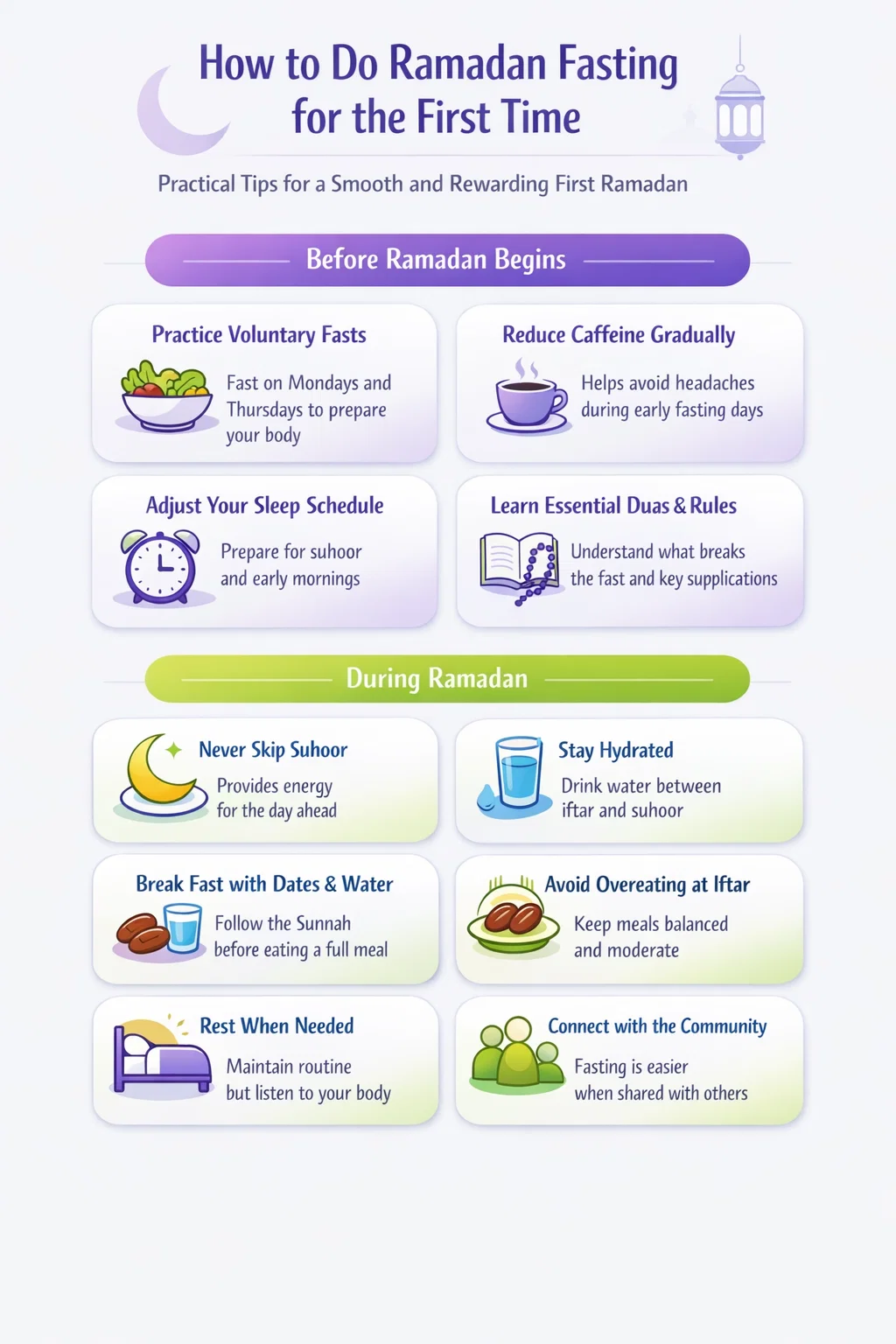
For those learning how to do ramadan fasting for the first time, whether as new Muslims or as young people reaching the age of obligation, the prospect of fasting for an entire month can seem daunting. However, with proper preparation and realistic expectations, your first Ramadan can be a deeply rewarding experience. Here are practical tips for first-time fasters to help make the transition smooth and spiritually fulfilling.
Before Ramadan Begins
- Start practising voluntary fasts in the months before Ramadan, such as on Mondays and Thursdays, to condition your body
- Gradually reduce caffeine intake to minimise withdrawal headaches during the first days of fasting
- Adjust your sleeping schedule gradually to accommodate suhoor and early mornings
- Learn the duas for suhoor and iftar and understand the basic rules of what breaks the fast
During Ramadan
- Never skip suhoor—it provides essential energy for the day ahead
- Stay hydrated during non-fasting hours by drinking water between iftar and suhoor
- Break your fast with dates and water, then pray Maghrib before eating a full meal
- Avoid overeating at iftar—it leads to discomfort and defeats the purpose of fasting
- Rest when needed, but try to maintain your normal routine as much as possible
- Connect with your local Muslim community—fasting is easier when shared with others
Frequently Asked Questions About Fasting for Ramadan
What is the reason for fasting in Ramadan?
The ramadan reason for fasting is multi-faceted. Primarily, fasting is an act of worship commanded by Allah in the Quran: “O you who have believed, decreed upon you is fasting as it was decreed upon those before you that you may become righteous” (2:183). Fasting develops taqwa (God-consciousness), self-discipline, empathy for the poor, and spiritual awareness. It also serves as a means of purifying the soul, breaking attachment to physical desires, and focusing on spiritual growth.
How do you do intermittent fasting during Ramadan?
Ramadan fasting is actually a form of intermittent fasting, specifically the time-restricted feeding pattern. To understand how to do intermittent fasting during ramadan in a healthy way, focus on consuming nutrient-dense foods during your eating window (from iftar to suhoor). The eating window is relatively short—typically around 8-10 hours in the UK—making it similar to the popular 16:8 intermittent fasting protocol. Ensure you consume adequate protein, complex carbohydrates, healthy fats, and plenty of fluids during this window.
What are the benefits of fasting for Ramadan?
The benefits of fasting for ramadan are both spiritual and physical. Spiritual benefits include increased God-consciousness, purification of the heart, development of patience and self-control, and multiplied rewards for good deeds. Physical benefits may include improved insulin sensitivity, weight management, cellular repair processes (autophagy), better eating habits, and rest for the digestive system. The combination of spiritual and physical benefits makes Ramadan a holistic wellness programme for Muslims.
Can I use mouthwash while fasting?
Using mouthwash while fasting is generally discouraged by scholars because of the risk of accidentally swallowing. If you must use mouthwash, do so with extreme caution and ensure you do not swallow any. Most scholars recommend using a miswak or brushing teeth without toothpaste during fasting hours as safer alternatives for maintaining oral hygiene. You can use mouthwash freely during the night after breaking your fast.
What if I accidentally eat or drink during fasting hours?
If you forget you are fasting and accidentally eat or drink something, your fast remains valid. The Prophet (peace be upon him) said that Allah has fed you and given you drink. Simply stop eating as soon as you remember and continue your fast normally. This ruling demonstrates Allah’s mercy and removes anxiety from the fasting experience. However, this only applies to genuine forgetfulness—not to deliberate breaking of the fast.
Putting Your Faith into Action: Feeding the Fasting
As you embark on your journey of fasting for Ramadan, remember that this blessed month is not only about abstaining from food and drink—it is also about increased charity and compassion for those less fortunate. The Prophet Muhammad (peace be upon him) was the most generous of people, and his generosity increased during Ramadan. One of the most rewarding forms of charity during this month is feeding the fasting, providing iftar meals to those who would otherwise go hungry.
Your Impact Foundation offers UK Muslims the opportunity to provide iftar meals to fasting Muslims in crisis zones including Gaza, Yemen, and Syria. A donation of just £40 can feed eight people for iftar, while £100 can provide a family with food for the entire month. The reward for feeding a fasting person is equivalent to the reward of fasting itself—without any diminishment. This Ramadan, consider sharing the blessings you receive through fasting by helping others break their fast.
Feed the Fasting This Ramadan — Earn the Reward of a Fasting Person
Related Links:
- Automate Ramadan Donations — Never miss Laylatul Qadr giving
- Zakat Calculator — Calculate your Zakat correctly
- Last 10 Nights Guide — Maximise rewards in the final nights