
What is Zakat and Why Does It Matter?
Every year, Muslims across the United Kingdom face the same important question: how much Zakat do I need to pay? If you are looking for a Zakat calculator UK tool or simply want to understand how to calculate Zakat correctly, you have come to the right place. This comprehensive guide will walk you through everything you need to know about Zakat calculation in the UK for 2026.
Zakat is one of the five pillars of Islam. It is a mandatory form of charity that every eligible Muslim must pay annually. The word “Zakat” means “to purify” in Arabic. When you give Zakat, you are purifying your wealth and seeking blessings from Allah (SWT). It is not just a religious obligation but also a way to support those in need within our global community.
For UK Muslims, understanding Zakat calculation can feel overwhelming at first. Questions about nisab values, which assets are taxable, and how to calculate Zakat on different types of wealth often arise. This guide will answer all these questions and provide you with a clear framework to calculate your Zakat accurately. Whether you are calculating Zakat for the first time or looking to ensure you are doing it correctly, this article will serve as your complete reference.
Who Must Pay Zakat in the UK?
Before you start using a zakat calculator or working through the calculations yourself, you need to understand whether you are actually required to pay Zakat. The conditions for Zakat eligibility are straightforward, but they must all be met for the obligation to apply to you.
The Three Conditions for Zakat
- You must be a Muslim. Zakat is an Islamic obligation that applies only to Muslims. Non-Muslims are not required to pay Zakat, though they may give voluntary charity (Sadaqah) if they wish.
- You must be an adult (Baligh). Children are not obligated to pay Zakat on their own wealth. However, according to many scholars, the guardian of a child who owns wealth above the nisab should pay Zakat on their behalf. If you have children with savings or inheritance, it is worth consulting with a knowledgeable scholar about this matter.
- You must possess wealth above the nisab threshold. Nisab is the minimum amount of wealth a Muslim must possess before Zakat becomes obligatory. We will discuss nisab in detail in the next section.
If you meet all three conditions, you are required to pay Zakat. The rate is fixed at 2.5% of your eligible wealth. This rate has remained unchanged for over 1,400 years and applies uniformly across all Muslims regardless of their location, including those living in the UK.
Understanding Nisab Values for 2026
Nisab is the threshold that determines whether you are liable to pay Zakat. It is essentially the minimum amount of wealth you must hold for one lunar year before Zakat becomes obligatory. Understanding zakat nisab calculation is essential for ensuring you fulfil your religious duties correctly.
The Two Nisab Standards
There are two standards for calculating nisab, both based on the teachings of the Prophet Muhammad (peace be upon him). You can use either standard, and scholars generally agree that using the one most beneficial to the poor is preferred. In practice, most UK Muslims use the silver standard because it results in a lower threshold, meaning more people pay Zakat and more charity reaches those in need.
| Nisab Standard | Quantity | UK Value (2026) | Best For |
|---|---|---|---|
| Silver Standard | 595 grams silver | Approximately £370 | More generous to the poor |
| Gold Standard | 85 grams gold | Approximately £5,400 | Less common |
Table 1: Nisab Values for UK Muslims in 2026
Please note that these values fluctuate with the market prices of gold and silver. For the most accurate calculation, check the current prices on your Zakat calculation date. Many UK Muslims choose the silver standard because it lowers the threshold, ensuring more people qualify to pay Zakat. This approach aligns with the spirit of generosity that underpins Islamic charity.
When Does Your Zakat Year Begin?
Your Zakat year begins on the date you first possessed wealth above the nisab. Many UK Muslims choose Ramadan as their Zakat calculation month because the rewards for good deeds are multiplied during this blessed month. However, you can calculate your Zakat at any time during the year, as long as you maintain consistency. If you are unsure when your Zakat year started, choose a date and stick with it going forward.
What Assets Are Subject to Zakat?
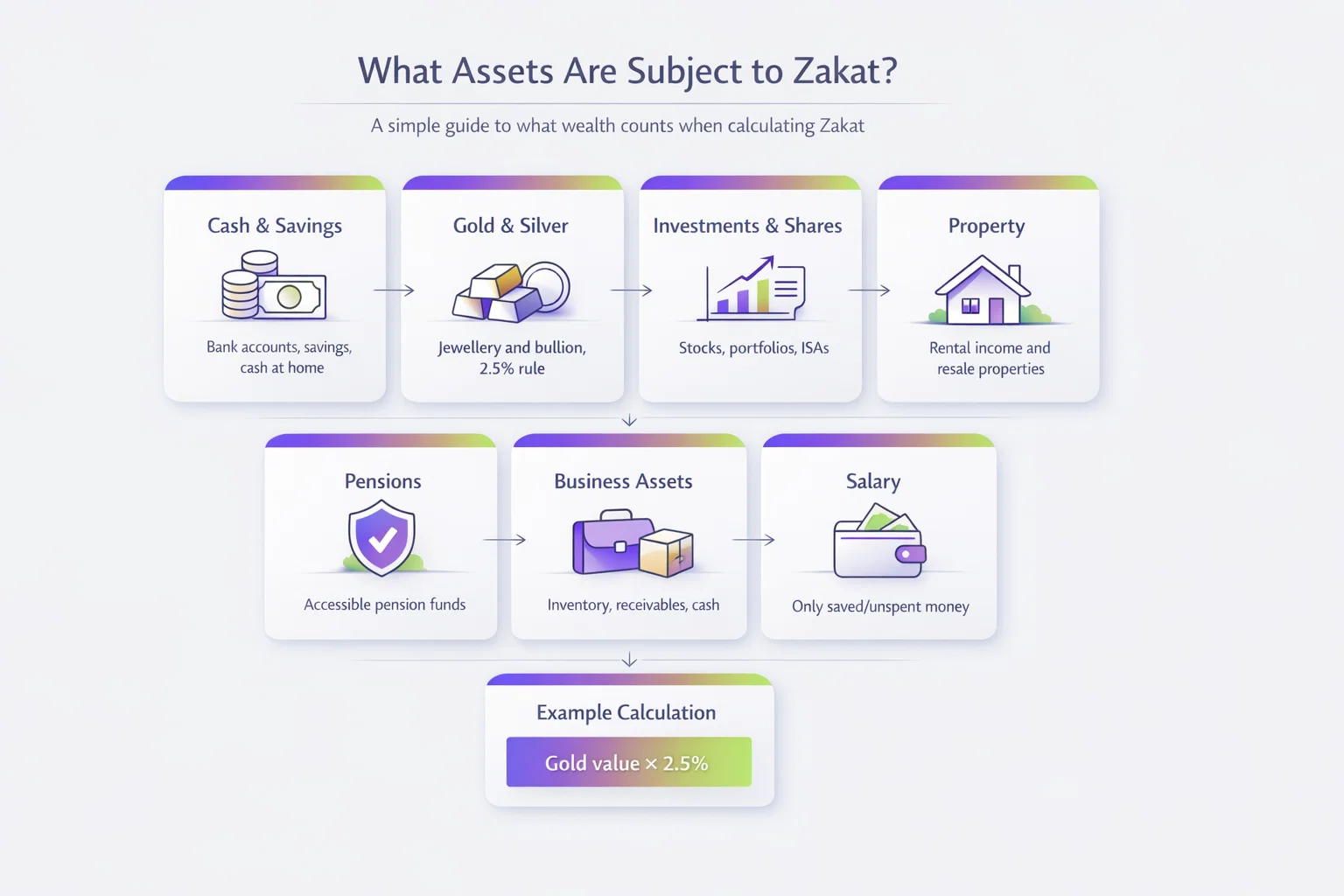
Understanding which assets are subject to Zakat is crucial for accurate calculation. When you calculate Zakat, you need to consider various categories of wealth. Let us break down each category so you can identify what applies to your situation.
Cash and Savings
When learning how to calculate zakat on cash, the process is straightforward. All cash in your possession is subject to Zakat. This includes money in your current accounts, savings accounts, fixed deposits, and any cash you have at home. For UK Muslims, this also includes ISAs (Individual Savings Accounts), even though they are tax-free in the UK. Zakat is calculated on the total amount, not just the profit.
Gold and Silver
Many people ask: how do you calculate zakat on gold? The answer depends on how you use it. Gold and silver jewellery that you wear regularly has different rulings among scholars. Some scholars hold that jewellery worn for adornment is not subject to Zakat, while others maintain that all gold and silver is taxable regardless of use. To be safe, many UK Muslims include the value of their gold and silver jewellery in their Zakat calculation.
For a zakat calculator for gold working, simply determine the weight of your gold in grams and multiply by the current market price. Then apply 2.5% to the total value. For example, if you have 100 grams of gold and the market price is £60 per gram, the value is £6,000. Your Zakat would be £150.
Investments and Shares
Stocks, shares, and investment portfolios require careful consideration. If you hold shares for investment purposes, you pay Zakat on their current market value. If the companies you invest in hold non-Zakatable assets like property or machinery, some scholars recommend calculating the Zakatable portion only. For UK Muslims with stocks and shares ISAs, the current value of your investments should be included in your calculation.
Property and Real Estate
The family home you live in is not subject to Zakat. However, investment properties, land held for resale, and rental income are Zakatable. If you own a buy-to-let property in the UK, you should include the rental income received during the year and any profit you expect from selling the property.
Pensions
Calculating zakat on pension funds is a common concern for UK Muslims. The ruling depends on the type of pension and when you can access it. For defined contribution pensions (like most workplace pensions in the UK), you should calculate Zakat on the current value of your pension pot if you are able to withdraw it, even with penalties. If withdrawal is not possible, some scholars advise waiting until you can access the funds.
For defined benefit pensions (common in the public sector), the calculation is more complex. Many scholars recommend estimating the Zakatable portion based on your contributions. If you are unsure about your specific situation, consult with a scholar who understands UK pension systems.
Business Assets
If you run a business in the UK, you need to include your business assets in your Zakat calculation. This includes inventory, cash held by the business, and receivables. Equipment, machinery, and premises used for business operations are not subject to Zakat, as they are considered tools of your trade rather than wealth.
Salary and Income
Many employed Muslims ask how to calculate zakat on salary. Your salary itself is not taxed as income. Instead, you calculate Zakat on whatever portion of your salary remains in your possession at your Zakat date. Money you have already spent on living expenses, bills, and other needs is not included. Only count what you have saved or hold in accounts.
Step-by-Step Guide: How to Calculate Zakat
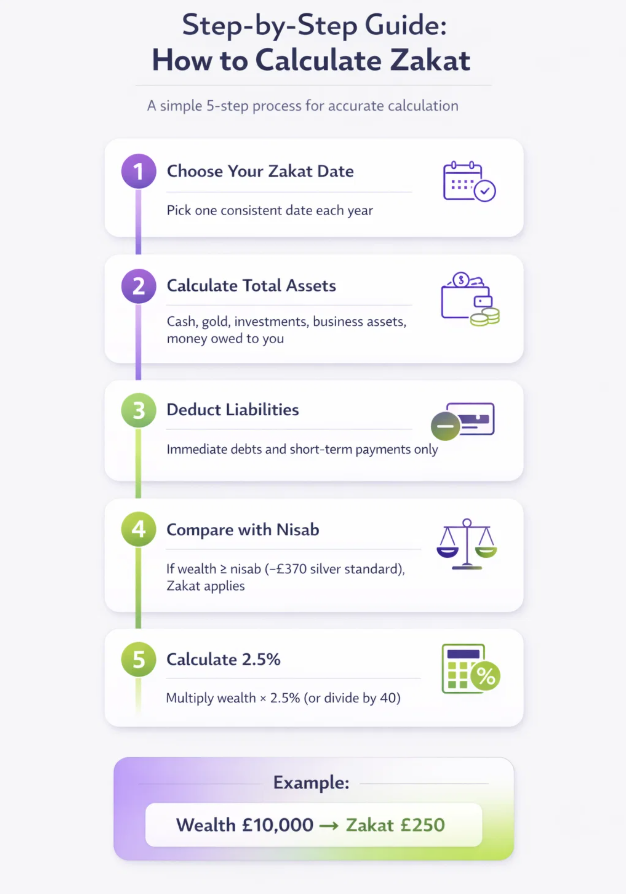
Now that you understand what assets are subject to Zakat, let us walk through the actual calculation process. Learning how to calculate zakat in Islam is straightforward once you break it down into steps. Follow this simple five-step process to determine your Zakat amount accurately.
Step 1: Choose Your Zakat Date
Select a specific date each year for your Zakat calculation. Many UK Muslims choose a date during Ramadan because of the increased blessings. Others choose the Islamic date when they first possessed wealth above the nisab. Whatever date you choose, maintain consistency year after year. This date marks the end of your Zakat year and the beginning of the next.
Step 2: Calculate Your Total Assets
On your chosen date, list all your Zakatable assets with their current values. Be thorough and honest in this assessment. Include cash in all accounts, the value of gold and silver, investments, business assets, and money owed to you. This comprehensive approach ensures you fulfil your obligation correctly.
Step 3: Deduct Your Liabilities
Subtract any immediate debts you owe from your total assets. This includes your mortgage, personal loans, credit card balances, and any other debts that are due. Long-term debts should be considered differently than immediate ones. For mortgages, include only the portion due within the next year. For student loans, opinions vary, so consult a scholar if you are unsure.
Step 4: Compare with Nisab
After deducting your liabilities, compare your net wealth with the nisab. If your remaining wealth equals or exceeds the nisab (approximately £370 using the silver standard), you are liable to pay Zakat. If it falls below nisab, you are not obligated to pay Zakat this year.
Step 5: Calculate 2.5%
If your wealth exceeds the nisab, multiply your total Zakatable wealth by 2.5% (or divide by 40). This gives you the amount you must pay. For example, if your net Zakatable wealth is £10,000, your Zakat would be £250.
Practical Example: Zakat Calculation for a UK Muslim
Let us look at a practical example to illustrate the calculation process. Ahmed lives in London and wants to calculate his Zakat for 2026. Here is a breakdown of his financial situation:
| Asset / Liability | Amount (£) | Notes |
|---|---|---|
| Current account | 3,500 | Full amount |
| Savings account | 8,000 | Full amount |
| Stocks & Shares ISA | 12,000 | Current value |
| Gold jewellery (50g at £60/g) | 3,000 | Market value |
| Workplace pension | 25,000 | Current pot value |
| Total Assets | 51,500 | |
| Less: Credit card balance | (1,500) | Outstanding |
| Net Zakatable Wealth | 50,000 | |
| Zakat Payable (2.5%) | 1,250 | Due amount |
Table 2: Example Zakat Calculation
In this example, Ahmed’s net Zakatable wealth is £50,000, which far exceeds the nisab threshold. His Zakat obligation is therefore £1,250. This simple calculation demonstrates how straightforward the process can be when you have all the necessary information organized.
UK-Specific Considerations for Zakat
Living in the UK presents some unique considerations when calculating Zakat. The financial instruments available, tax treatments, and regulatory environment differ from many Muslim-majority countries. Here are some important points for UK Muslims to keep in mind.
Gift Aid and Your Zakat
When you pay Zakat to a UK-registered charity like Your Impact Foundation, the charity can claim Gift Aid on your donation if you are a UK taxpayer. This adds an extra 25% to your donation at no additional cost to you. However, since Zakat is a precise obligation, the Gift Aid portion should be treated as voluntary charity (Sadaqah), not as part of your Zakat payment. This ensures you fulfil your obligation exactly while providing additional benefit to those in need.
Student Loans
UK student loans have unique characteristics that affect Zakat calculation. Since repayment is income-contingent and the loan is written off after a certain period, some scholars consider it different from conventional debt. The prevailing view among UK scholars is that you should deduct only the amount you expect to repay within the next 12 months, not the total loan balance. Consult with a scholar familiar with the UK system for personalised guidance.
Help to Buy ISAs and Lifetime ISAs
These government savings schemes are popular among UK Muslims saving for their first home. The money in these accounts is Zakatable, including any government bonuses received. Calculate Zakat on the total balance on your Zakat date, just as you would with any other savings account.
Tax Considerations
Zakat is calculated on your gross wealth before tax, not your net wealth after tax. However, any taxes you owe to HMRC at the time of calculation should be deducted as liabilities. This ensures your Zakat calculation reflects your true financial position. For self-employed individuals, this includes any pending tax bills.
Where Should You Pay Your Zakat?
Once you have calculated your Zakat using this guide or a zakat calculator uk tool, the next question is where to pay it. The Quran specifies eight categories of eligible recipients: the poor, the needy, those who administer Zakat, those whose hearts need reconciliation, those in bondage, those in debt, in the cause of Allah, and the wayfarer.
When you pay your Zakat through Your Impact Foundation, you can be confident that your contribution reaches those who qualify. As a UK-registered charity (Number 1192710), we operate with full transparency and ensure that 100% of your Zakat goes directly to eligible recipients. Our distribution follows strict Sharia-compliant guidelines, reviewed by qualified Islamic scholars.
Why Choose Your Impact Foundation?
- 100% Zakat Policy: Every penny of your Zakat reaches those in need. Our administrative costs are covered by separate Sadaqah donations and Gift Aid.
- Sharia Compliance: Our distribution methods are reviewed by qualified scholars to ensure they meet Islamic requirements.
- Transparent Reporting: We provide clear updates on how your Zakat is used, with annual reports available for all donors.
- Global Reach: Your Zakat supports communities in need across the world, from Gaza and Yemen to Syria and beyond.
- UK Registered: Fully compliant with UK charity law and regulations, giving you complete peace of mind.
You can pay your Zakat directly through our website. We also offer the option to automate your Ramadan donations, ensuring you never miss giving during the blessed month.
Automating Your Zakat and Charity Payments
Once you understand how to use a Zakat calculator and complete your calculation, consider setting up automated payments. Automation ensures consistency in your giving, which aligns with the Prophet Muhammad’s teaching that the most beloved deeds to Allah are those done consistently, even if they are small.
Your Impact Foundation offers an automated donation system that allows you to schedule your Zakat payments throughout the year or concentrate them during Ramadan. This is particularly beneficial for those who want to give consistently but worry about forgetting. Our platform handles the technical aspects, so you can focus on the spiritual rewards of your giving.
Frequently Asked Questions About Zakat Calculation
What if my wealth drops below nisab during the year?
Zakat is assessed on the wealth you possess on your Zakat date. If your wealth was above nisab on that date but dropped below during the year, you still owe Zakat. Conversely, if your wealth was below nisab on your Zakat date, you do not owe Zakat for that year, regardless of increases during the year.
Can I pay Zakat in advance?
Yes, you can pay Zakat in advance. Many Muslims choose to pay their Zakat during Ramadan to maximise rewards. If you pay in advance, keep track of your payments to ensure you do not underpay when your actual Zakat date arrives.
Do I pay Zakat on money owed to me?
Yes, money owed to you is considered your wealth. However, there are different scholarly opinions on when to pay Zakat on receivables. Some scholars advise paying when you receive the money, while others suggest paying annually even before receipt. Consult a scholar for guidance specific to your situation.
Can I give Zakat to my relatives?
You can give Zakat to relatives who qualify as recipients, provided they are not your dependents. Parents, children, and spouses cannot receive your Zakat because you are already obligated to support them. However, extended family members who are eligible recipients may receive your Zakat.
Is jewellery I wear daily subject to Zakat?
Zakat is the annual 2.5% payment on wealth held above nisab. Zakat al-Fitr (also called Fitrana) is a separate, smaller payment made before Eid prayer at the end of Ramadan. Every Muslim who has food beyond their needs must pay Zakat al-Fitr for themselves and their dependents. In the UK, the recommended amount is approximately £5-10 per person.
Is jewellery I wear daily subject to Zakat?
Scholars have different opinions on this matter. Some say jewellery worn for daily use is exempt, while others maintain that all gold and silver is Zakatable regardless of use. To be cautious, many UK Muslims include their jewellery value in their Zakat calculation. The choice ultimately depends on which scholarly opinion you follow.
Conclusion: Fulfilling Your Zakat Obligation
Calculating and paying Zakat is a fundamental pillar of Islam that purifies your wealth and supports those in need. Whether you use this guide to calculate manually or prefer a Zakat calculator UK tool, the most important thing is to fulfil this obligation with sincerity and accuracy.
Remember these key points as you approach your Zakat calculation: determine your Zakat date, calculate all Zakatable assets, deduct liabilities, compare with nisab, and apply the 2.5% rate. If you have complex financial situations, consult with knowledgeable scholars who understand the UK context.
Your Impact Foundation is here to support you in your journey of giving. We ensure your Zakat reaches those who truly qualify, maintaining the highest standards of Sharia compliance and transparency. Pay your Zakat today and experience the spiritual fulfilment that comes from fulfilling this blessed obligation.
Ready to calculate and pay your Zakat?
About Your Impact Foundation
Your Impact Foundation is a UK-registered charity (Number 1192710) dedicated to providing life-saving emergency aid, sustainable development, and faith-based humanitarian relief to communities affected by poverty, war, and disaster. Founded on the principles of compassion, equality, and justice, we ensure that every donation is spent responsibly and in accordance with Islamic charitable principles.
Our 100% Zakat policy guarantees that every penny of your obligatory charity reaches those in need. Administrative costs are covered separately, ensuring complete transparency and trust. We work directly with communities in Gaza, Yemen, Syria, and other regions facing humanitarian crises, providing food, water, healthcare, and sustainable livelihood support.
For more information about our work or to verify our charity registration, visit the Charity Commission website or contact us directly. Your trust is important to us, and we are committed to maintaining the highest standards of governance and accountability.