
Fasting during Ramadan is one of the most cherished acts of worship in Islam, bringing spiritual growth, self-discipline, and closeness to Allah. However, life circumstances—such as chronic illness, old age, pregnancy, breastfeeding, or travel—can sometimes prevent a person from completing every fast. In these cases, Islam provides compassionate alternatives: fidya and kaffarah.
For many Muslims in the UK, understanding fidya meaning in Islam and kaffarah meaning is essential to fulfilling religious obligations correctly while ensuring their compensation reaches those truly in need. Whether you’re calculating fidya for missed fasts, wondering how much is fidya or how much is kaffarah in 2026, or looking for reliable ways to pay fidya and pay kaffarah in the UK, this guide is designed to help.
Fidya serves as compensation for those who cannot make up missed fasts due to permanent valid reasons, while kaffarah is the atonement required for deliberately breaking an obligatory fast without a valid excuse. Both are powerful acts of charity that not only purify intentions but also support vulnerable communities—orphans, widows, refugees, and families facing hardship across the world.
In the UK, where meal costs and living expenses continue to rise, accurate fidya calculation and kaffarah payment matter more than ever. Choosing a trustworthy, Sharia-compliant UK charity with transparency (such as a 100% donation policy) ensures your contribution delivers maximum impact and brings barakah to your giving.
In this complete 2026 guide, we’ll explain:
- What fidya and kaffarah truly mean in Islam
- Who must pay each one and when
- Step-by-step calculation for the UK (including current rates)
- How and where to donate safely and securely
- Trusted UK charities that handle fidya and kaffarah with full accountability
Whether you’re searching for fidya uk options, exploring feed 60 people for kaffarah, or simply want clarity on fidya and kaffarah, this article will give you everything you need to act with confidence and sincerity.
Along with your Fidya, if you are eligible for Zakat in UK 2026, calculate it and donate to a eligible charity.
Ready to fulfil your obligation? Let’s begin by understanding the meanings and rules clearly.
What is Fidya in Islam?
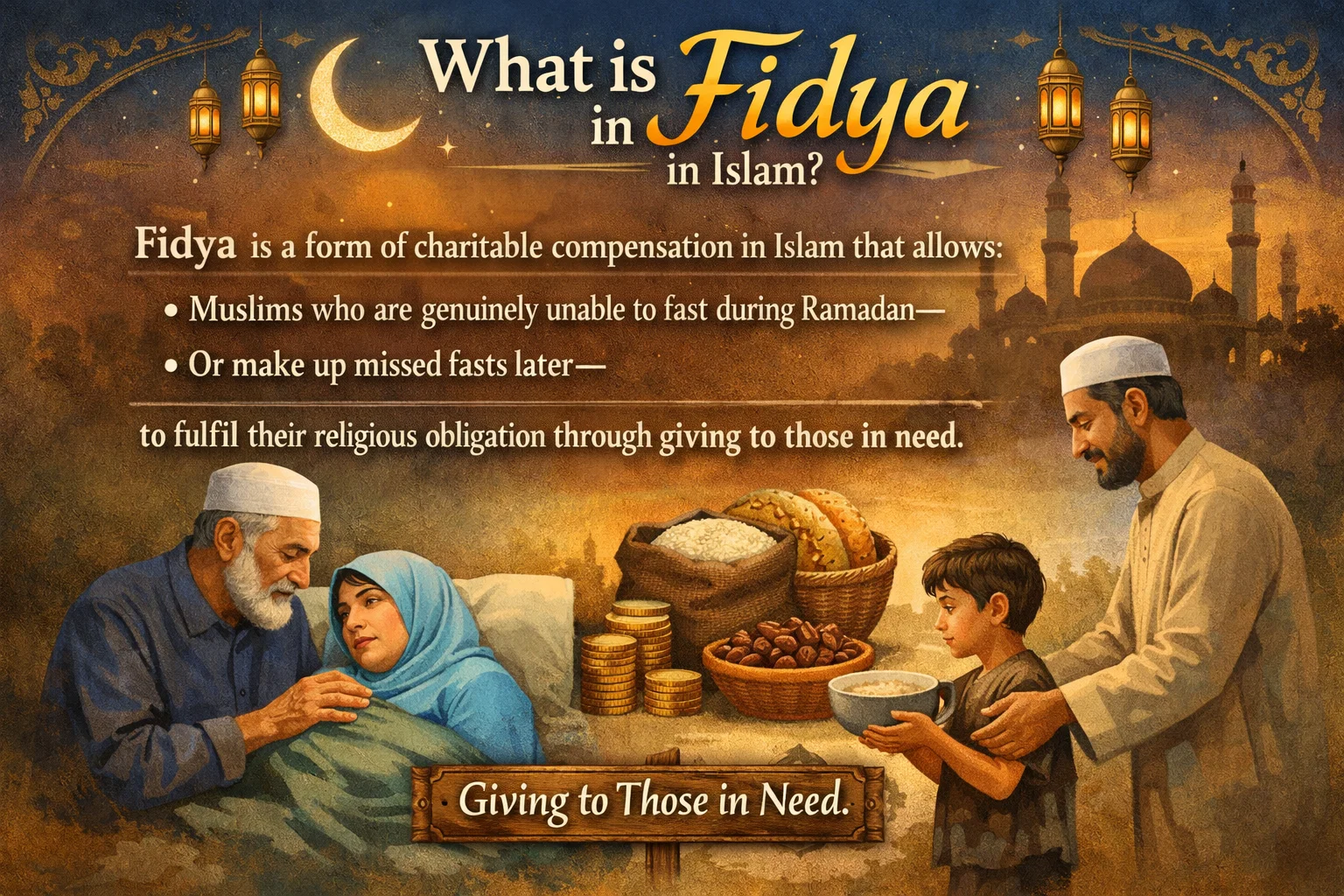
Fidya is a form of charitable compensation in Islam that allows Muslims who are genuinely unable to fast during Ramadan—or make up missed fasts later—to fulfil their religious obligation through giving to those in need.
Fidya Meaning and Fidya Meaning in Islam
The word fidya (also spelled fidyah) comes from the Arabic root meaning “ransom” or “compensation.” In Islamic terminology, fidya meaning in Islam refers to a specific expiation for those who miss obligatory fasts due to a permanent, valid reason and cannot make them up at a later time.
The primary basis for fidya is found in the Quran:
“And as for those who can fast [only] with difficulty, they have [the option of] fidya—feeding a poor person [for each day missed].”
(Surah Al-Baqarah 2:184)
Scholars from the major schools of thought (Hanafi, Maliki, Shafi’i, Hanbali) agree that fidya is a legitimate and merciful alternative for individuals facing ongoing hardship. It is not a punishment but an act of ease and charity that maintains the spirit of Ramadan while helping the less fortunate.
What is Fidya? Who Must Pay It?
What is fidya in practical terms? It is paid by Muslims who:
- Are permanently unable to fast or make up missed fasts due to old age, chronic illness, or severe medical conditions.
- Were exempt from fasting in Ramadan for a valid reason (e.g., pregnancy, breastfeeding, serious illness) but are now unable to perform qada (make-up) fasts later in the year.
Common examples in the UK include:
- Elderly Muslims over 70–80 years old with frailty or health issues.
- People with long-term conditions such as diabetes complications, heart disease, or mobility limitations that make fasting unsafe or impossible.
- In rare cases, women whose pregnancies or breastfeeding periods overlap multiple Ramadans and prevent catch-up fasting.
Fidya is not required for temporary excuses where qada is still possible (e.g., short-term travel or recoverable illness).
Fidya for Missed Fasts
Fidya for missed fasts applies specifically when the individual knows they will never be able to make up the fasts. For each missed day of Ramadan fasting, the person must feed one poor person (or, according to some opinions, two poor people) with a meal equivalent to the average daily food consumption in their locality.
In the UK context, this typically means providing a nutritious meal (or its monetary value) to someone in need. Many scholars recommend giving the fidya amount directly to a trusted charity that distributes food or cash to eligible recipients in line with Sharia.
Importantly:
- Fidya can be paid at any time of the year—not just during Ramadan.
- It can cover missed fasts from previous years if they were not compensated earlier.
- The obligation is per person and per missed day.
By paying fidya, Muslims in the UK can continue to honour the pillar of fasting while supporting vulnerable communities—whether locally or in regions facing poverty, conflict, or displacement.
What is Kaffarah?
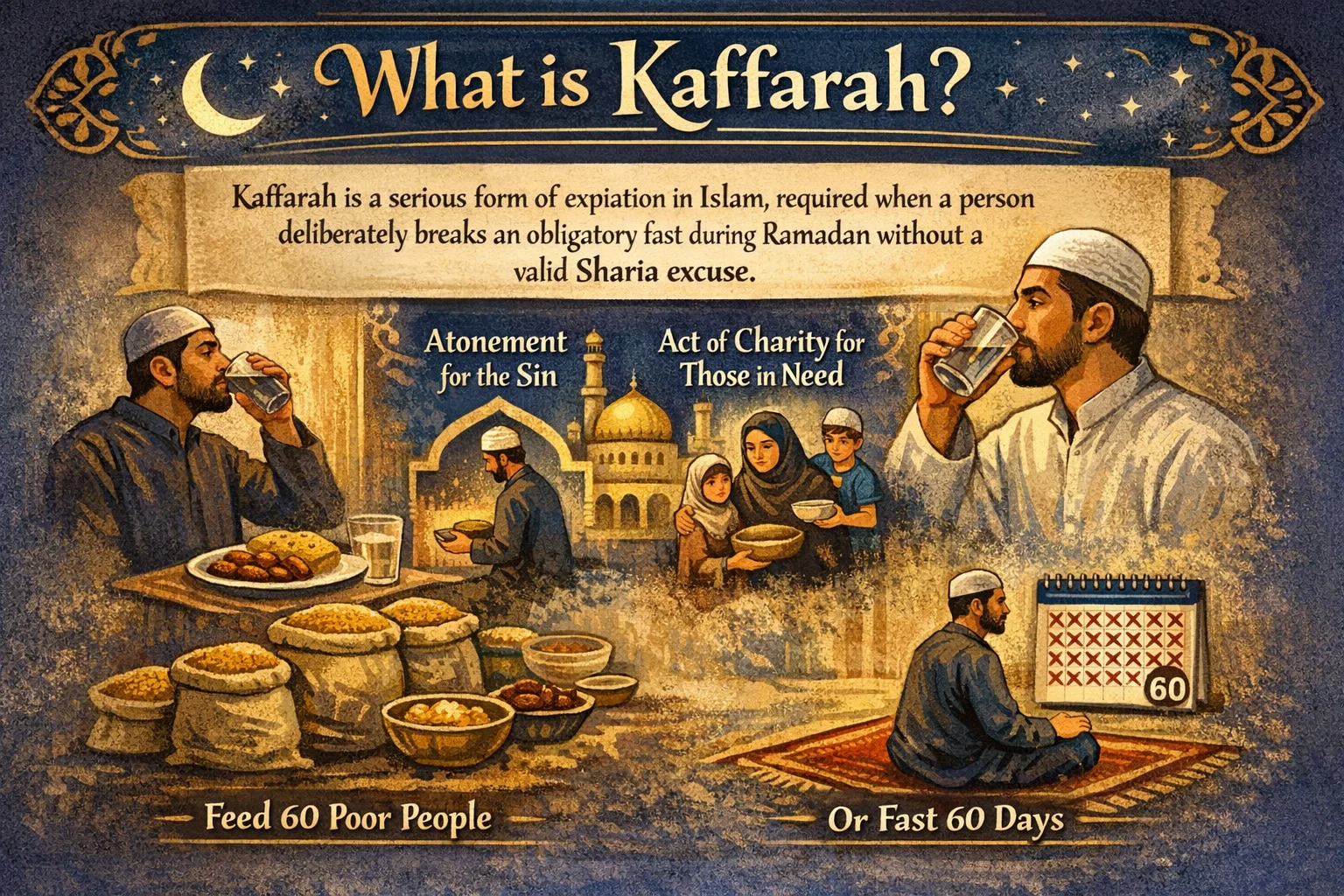
Kaffarah is a serious form of expiation in Islam, required when a person deliberately breaks an obligatory fast during Ramadan without a valid Sharia excuse. It serves both as atonement for the sin and as an act of charity that benefits those in need.
Kaffarah Meaning
The term kaffarah (also spelled kaffara) comes from the Arabic root meaning “to cover” or “to atone.” In Islamic jurisprudence, kaffarah meaning refers to a prescribed act of worship and charity that covers or expiates a specific violation of religious duty—in this context, intentionally breaking the fast of Ramadan.
The ruling is based on authentic Hadith and scholarly consensus across the major schools of thought. The Prophet Muhammad (peace be upon him) said:
“Whoever breaks the fast in Ramadan deliberately, without a valid excuse such as illness or travel, there is no expiation for him except to fast one day for that day—or to feed sixty poor people.”
(Narrated in various forms, including by Abu Dawud and Ibn Majah)
This makes kaffarah one of the most significant forms of expiation in Islam, highlighting the gravity of intentionally violating the fast while also providing a path to repentance through charity.
What is Kaffarah in Islam?
What is kaffarah in practical terms? It becomes obligatory when a person:
- Intentionally eats, drinks, or engages in marital relations during the daylight hours of Ramadan while knowing the fast is obligatory.
- Does so without a valid Sharia excuse (e.g., not due to illness, pregnancy, travel, or extreme hardship).
Kaffarah is not required for:
- Accidental breaking of the fast (e.g., forgetting and eating).
- Breaking the fast due to a genuine valid reason (in which case only qada/make-up fasting is needed).
- Non-obligatory fasts (e.g., voluntary or make-up fasts outside Ramadan).
The expiation options, in order of preference according to most scholars, are:
- Freeing a slave (not applicable in modern times).
- Fasting 60 consecutive days without interruption.
- If unable to fast 60 days consecutively (due to health, age, or other valid reasons), feeding 60 poor people (one meal each or its equivalent value).
In the UK today, the vast majority of people opt for the charitable route—feeding 60 people—as it is more practical and directly supports those in poverty.
Feed 60 People: The Charitable Option
Feed 60 people is the most common way UK Muslims fulfil kaffarah. This means providing a full meal (or its monetary value) to 60 poor or needy individuals. The meal should be equivalent to what an average person eats in a day in the local context.
In the UK, charities typically calculate this based on the average cost of a nutritious meal (around £5 per person in 2026, making the total kaffarah approximately £300). The funds are used to provide food, cash assistance, or essential support to eligible recipients—often orphans, widows, refugees, or families in crisis zones.
Key points for UK donors:
- Kaffarah should be paid as soon as possible after the incident to complete the repentance process.
- It must be given to those who qualify as poor or needy according to Sharia (not to family members you are financially responsible for).
- Many scholars allow giving kaffarah to international projects if the need is greater and distribution is verified.
Paying kaffarah through a trusted, transparent UK charity ensures your expiation is fulfilled correctly while bringing real relief to those suffering from hunger, displacement, or hardship.
Why Fidya and Kaffarah Rates Have Changed in 2026?
In 2026, the global economy has seen a significant shift in food prices. As a UK-based charity, we are often asked why the fidya calculation varies from year to year. The Sharia requirement is to provide a “full meal” or its equivalent value to the poor.
In the UK, with the rising cost of living and global supply chain shifts, the price of a nutritious, staple-based meal (consisting of items like flour, rice, and pulses) has settled between £5.00 and £7.00. When you pay your fidya uk dues, we use these current rates to ensure that the beneficiary is truly receiving a meal that sustains them, rather than just the bare minimum. Choosing a charity that updates these rates annually is a sign of Sharia-compliance and financial transparency.
Key Differences Between Fidya and Kaffarah
| Aspect | Fidya | Kaffarah |
| Reason / Trigger | Valid permanent excuse for missing fasts (e.g., old age, chronic illness) where makeup fasts (qada) are impossible | Deliberate/intentional breaking of an obligatory Ramadan fast without any valid Sharia excuse (e.g., eating or drinking knowingly) |
| Nature | Compensation / ransom for unavoidable inability to fast | Expiation / atonement for a serious, intentional violation of the fast |
| Who Must Pay | Elderly, chronically ill, or those with permanent conditions preventing fasting or makeup | Anyone who breaks the fast deliberately and has no valid reason (requires sincere repentance) |
| Compensation Options | Feed one (or in some opinions two) poor person per missed fast day | 1. Fast 60 consecutive days without break2. If unable, feed 60 poor people (most common in UK) |
| 2026 UK Amount (approx.) | £5–£7 per missed day (based on average meal cost) | £300 total (£5 per person × 60 people) |
| Feeding Requirement | Feed 1–2 people per day missed | Feed 60 people (or equivalent value) |
| Timing / Urgency | Can be paid anytime; no strict deadline | Should be paid as soon as possible after the incident to complete repentance |
| Consequence if Ignored | Ongoing obligation until paid | Serious sin requiring atonement; fasting alternative may not be feasible for many |
| Common UK Practice | Paid annually or in lump sum for past/present missed fasts | Almost always fulfilled via charity donation due to difficulty of 60 consecutive fasts |
While the table above provides a general overview, many donors in the UK face specific life circumstances that require a deeper understanding of fidya and kaffarah. Below, we address the “gray areas” where most questions arise.
Do You Pay Fidya for Pregnancy or Menstruation?
One of the most common points of confusion for sisters in the UK is whether temporary physiological conditions require a fidya calculation.
- Menstruation: There is no Fidya for fasts missed due to menstruation. These days are considered a temporary suspension of fasting. The requirement is solely to perform Qada (make-up fasts) at any time before the next Ramadan begins.
- Pregnancy and Breastfeeding: This depends on the individual’s long-term health. If a mother misses fasts because she fears for her health or the baby’s health, the primary obligation is to make up the fasts later. However, if she has back-to-back pregnancies or health complications that make it physically impossible to ever catch up on those fasts over several years, many scholars allow her to pay fidya online as a valid expiation.
Expert Tip: If you are unsure, consult with your local Imam or our Sharia-advisory team. Generally, if the inability to fast is temporary, you make it up; if it is permanent, you pay Fidya.
Kaffarah for Broken Oaths vs. Fasting
When people search for kaffarah meaning in Islam, they are usually referring to a broken fast, but it is important to distinguish this from Kaffarat al-Yamin (expiation for a broken oath).
- Kaffarah for Fasting: This is the “Major Kaffarah.” It is required for intentionally violating a Ramadan fast. The penalty is feeding 60 poor people, which in 2026 UK rates totals approximately £360.
- Kaffarah for Broken Oaths: If you made a solemn promise in the name of Allah and were unable to keep it, the expiation is “Minor Kaffarah.” This requires feeding 10 poor people. In 2026, this is a £60 kaffarah payment.
Understanding this distinction ensures you don’t overpay or underpay your religious dues. At Your Impact Foundation, we provide separate options for both types of kaffarah charity to ensure your intention (niyyah) matches your action.
Most Muslims in the UK choose the charitable route for both—donating the monetary equivalent to trusted charities that distribute food, cash assistance, or essential aid to the poor and needy. This not only fulfills the religious requirement but also brings tangible relief to vulnerable communities, whether in the UK or abroad.
How to Calculate Fidya and Kaffarah in the UK (2026 Rates)
Calculating fidya and kaffarah correctly is straightforward in the UK. Use the average cost of a nutritious meal (based on current food prices and guidance from major UK Muslim charities). In 2026, most reputable organisations recommend £5–£7 per meal as a fair benchmark.
Fidya Calculation – Step-by-Step
- Count the total number of Ramadan fasts you missed and cannot make up (due to permanent valid reasons like old age or chronic illness).
- Multiply that number by the fidya rate per day: £5–£7 (most common range in the UK in 2026).
- Use £5 for a conservative/minimum amount
- Use £6–£7 if following higher-guidance charities (e.g., reflecting London/South East costs)
- Result = Total fidya amount due.
Example
- Missed 15 fasts permanently
- Using £6 per day → 15 × £6 = £90
- Using £7 per day → 15 × £7 = £105
You can pay this amount in one go or spread it over time.
Kaffarah Calculation – Step-by-Step
- Confirm the violation was intentional and without valid excuse (requires sincere tawbah/repentance alongside expiation).
- Choose the charitable option (most practical in the UK): feed 60 poor people.
- Multiply 60 by the per-person meal rate: £5–£7 per person (same UK benchmark as fidya).
- £5 × 60 = £300
- £6 × 60 = £360
- £7 × 60 = £420
Standard 2026 UK amount
Most donors and charities settle on £300–£360 for kaffarah. £300 is widely accepted as the baseline.
Quick Reference Table (2026 UK)
| Obligation | Basis | Rate per unit | Typical Total (2026) |
| Fidya | Per missed fast | £5–£7 | £5–£7 × days missed |
| Kaffarah | Feed 60 people | £5–£7 | £300–£420 |
Tips for Accuracy
- Check the latest rate on your chosen UK charity’s website (rates are reviewed annually).
- If in doubt, use the higher end (£6–£7) to be cautious and generous.
- Many charities (including Your Impact Foundation) offer simple online calculators or instant quotes when donating.
Once calculated, proceed to donate securely through a trusted, Sharia-compliant UK charity to ensure the funds reach eligible recipients.
Fidya and Kaffarah in Action: 2026 Real-World Scenarios
Theology is straightforward, but life in the UK is often complex. To help you determine your exact obligation for the 2026 season, we have analyzed the most frequent inquiries sent to our support team. Here is how to handle the most common “Gray Areas.”
Scenario A: The Chronic Condition vs. The Recoverable Surgery
- The Situation: “I had a major operation in early 2026 and missed 15 days of Ramadan. I am now healthy and back to work.”
- The Verdict: You do not pay Fidya. Because your illness was temporary and you have recovered, you are required to perform Qada (make-up fasts).
- The Rule: Fidya is reserved exclusively for those whose inability to fast is permanent (e.g., chronic kidney disease, advanced age, or terminal illness). If you can eventually make up the days, you must do so.
Scenario B: The “Forgotten” Years
- The Situation: “I realized I missed 5 days of fasting three years ago and never atoned for them. Should I pay the rate from three years ago or today’s rate?”
- The Verdict: Obligations to the poor are considered a “debt” to Allah. Scholars recommend paying at the current 2026 UK rate.
- The Reasoning: The goal of fidya for missed fasts is to provide a full meal to a hungry person today. Since £4 might have bought a meal three years ago but won’t cover a nutritious meal in 2026, paying the current rate of £6 ensures your religious duty is fully and generously discharged.
Scenario C: Financial Hardship & Large Kaffarah
- The Situation: “I intentionally broke a fast and need to pay Kaffarah, but I cannot afford £360 all at once due to the current cost of living in the UK.”
- The Verdict: Islam does not place a burden on you that you cannot bear. You should seek sincere repentance (Tawbah) and begin paying your kaffarah charity in installments.
- The Solution: You can pay kaffarah online through Your Impact Foundation by setting up a monthly donation until the full 60-person requirement is met. The intention to pay is the first step toward expiation.
Scenario D: The Elderly Relative
- The Situation: “My elderly father can no longer fast, but he is not tech-savvy. Can I pay fidyah online on his behalf?”
- The Verdict: Yes. You may pay the Fidya for a relative or a deceased loved one. As long as the Niyyah (intention) is made that the payment is for them, the obligation is considered fulfilled.
Case Study: How Your £360 Kaffarah Impacts a Community
To visualize the kaffarah meaning in a real-world context, consider our 2026 distribution in Gaza and Yemen. When a single donor in the UK makes a kaffarah payment of £360:
- Bulk Purchasing: Our teams procure local staples like rice, flour, and oil at wholesale prices.
- The 60-Person Rule: We identify 60 individuals (often across 10–12 families) who are living below the poverty line.
- Nutrition: Each person receives a hot, nutrient-dense meal or a food pack containing enough calories for a full day.
- The Result: Your expiation for one missed fast literally provides the caloric intake for an entire small community for a day. This is the power of a 100% donation policy—your penalty becomes their survival.
How to Pay Fidya and Kaffarah in the UK
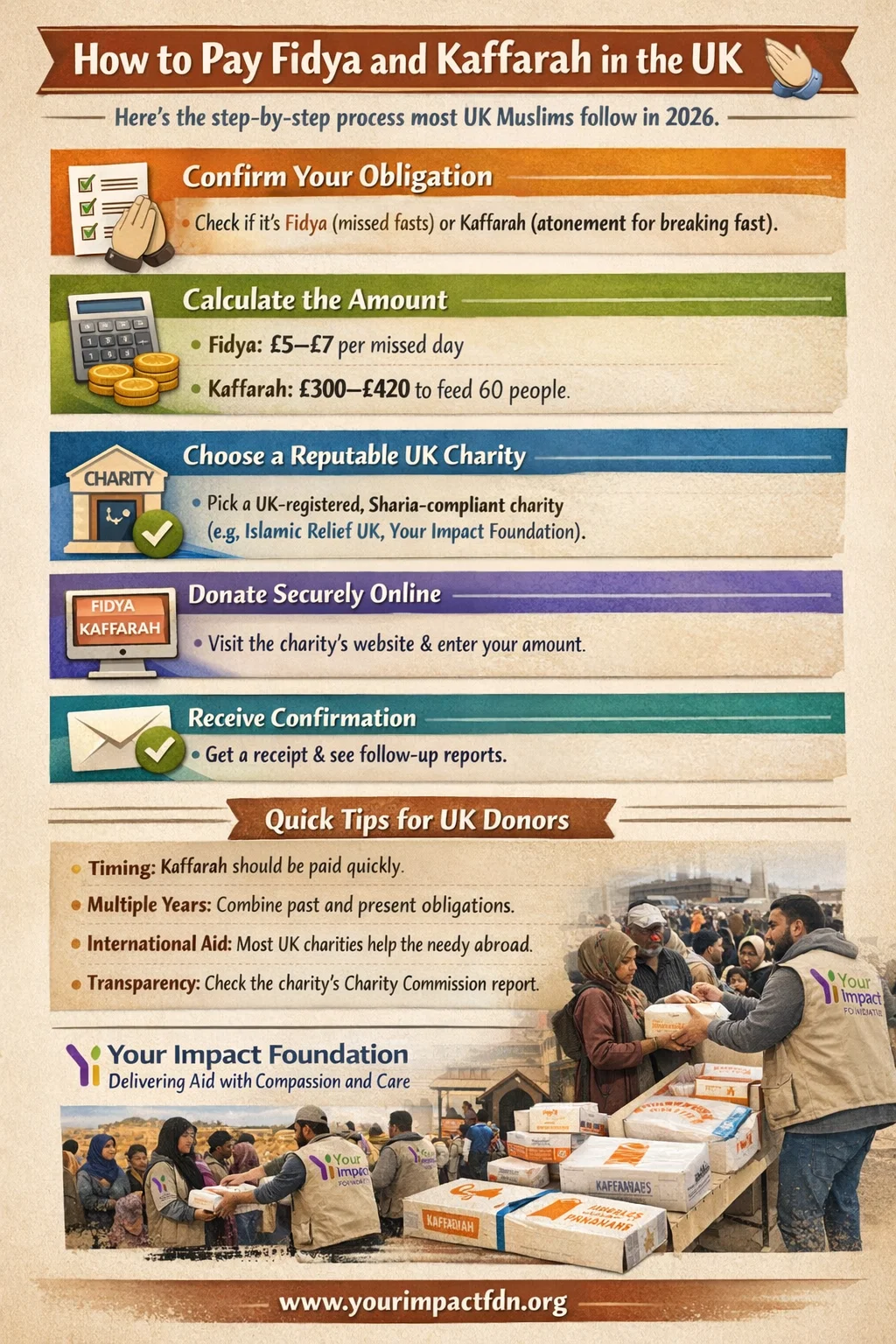
Once you’ve calculated your fidya or kaffarah amount, donating through a trusted, UK-registered charity is the simplest, most secure, and Sharia-compliant way to fulfil your obligation. Here’s the step-by-step process most UK Muslims follow in 2026.
Step-by-Step Guide to Paying Fidya or Kaffarah
- Confirm Your Obligation
Double-check whether it’s fidya (permanent inability to fast/make up) or kaffarah (intentional break requiring atonement). Ensure sincere tawbah (repentance) if kaffarah applies.
- Calculate the Exact Amount
Use the 2026 UK rates:
- Fidya: £5–£7 per missed day
- Kaffarah: £300–£420 (usually £300–£360) to feed 60 people Many charities provide instant calculators on their websites.
- Choose a Reputable UK Charity
Select a UK-registered charity (Charity Commission number visible) with:
- Sharia-compliant distribution
- Clear fidya/kaffarah policy
- 100% donation policy (preferred by many donors)
- Transparent impact reporting Examples: Your Impact Foundation (Charity No. 1192710), Islamic Relief UK, Human Appeal, One Ummah.
- Donate Securely Online
- Visit the charity’s official website (e.g., yourimpactfdn.org/donate).
- Select “Fidya” or “Kaffarah” from the donation options.
- Enter your calculated amount (or let the tool suggest based on days missed).
- Choose one-time payment (card, bank transfer, PayPal).
- Add a note if paying for multiple years or specific appeals (e.g., orphans, Gaza relief).
- Complete Gift Aid if eligible (boosts your donation by 25% at no extra cost).
- Receive Confirmation & Track Impact
- Get an instant digital receipt/confirmation email.
- Many charities send follow-up reports showing how your fidya or kaffarah helped (e.g., food parcels distributed, families supported).
- Keep records for your peace of mind and religious accountability.
Quick Tips for UK Donors
- Timing: Fidya can be paid anytime; kaffarah should be completed as soon as possible after the incident.
- Multiple years: Combine past and current obligations in one donation.
- International aid: Most UK charities distribute to high-need areas (refugees, orphans, famine zones) while ensuring Sharia compliance.
- Transparency: Always verify the charity’s latest annual report on the Charity Commission website.
By donating through a trusted organisation like Your Impact Foundation, your fidya or kaffarah reaches those who truly need it—delivering meals, cash support, or essential aid directly to beneficiaries.
Trusted UK Charities for Fidya and Kaffarah Donations
In the UK, donating fidya or kaffarah through a registered, Sharia-compliant charity is the most reliable way to ensure your payment reaches eligible recipients according to Islamic guidelines. All listed charities below are registered with the Charity Commission for England and Wales, publish clear fidya/kaffarah policies, and distribute funds transparently.
Here are some of the most trusted options in 2026:
- Your Impact Foundation (Charity No. 1192710)
A UK-based Muslim charity with a strict 100% donation policy—no admin or marketing costs are deducted from fidya or kaffarah funds. They focus on orphans, refugees, widows, emergency relief, and poverty alleviation (including Gaza and other crisis areas). Highly regarded for transparency, project updates, and direct impact. Ideal for donors seeking full confidence that every pound helps those in need.
- Islamic Relief UK
One of the largest and longest-established UK Muslim charities. They have a dedicated fidya and kaffarah policy, verified by scholars, and deliver food, cash assistance, and livelihood support globally. While admin is covered separately, their scale and audited reports make them a go-to for many.
- Human Appeal
Offers a 100% Zakat/fidya/kaffarah fund policy (admin covered from other sources). They specialise in emergency food aid, healthcare, water projects, and orphan support across 27+ countries. Clear reporting and scholar verification add strong trust.
- One Ummah
Strict 100% donation policy with segregated admin costs. They provide direct aid in high-need regions (Palestine, Yemen, Syria, Rohingya communities) and accept fidya, kaffarah, and general donations. Known for transparency and quick distribution.
- Ummah Welfare Trust
Operates a 100% donations policy for charitable projects (including fidya and kaffarah). Focuses on water wells, food security, healthcare, and orphan care in crisis zones. Regularly publishes impact stories and financial accountability.
Quick Comparison Table (2026 UK)
| Charity | 100% Donation Policy for Fidya/Kaffarah? | Typical Fidya Rate (per day) | Kaffarah Amount (60 people) | Key Strengths |
| Your Impact Foundation | Yes (strict) | £5–£7 | £300–£420 | Maximum transparency, orphan/refugee focus |
| Islamic Relief UK | Transparent admin | £5–£7 | £300–£420 | Large scale, global reach |
| Human Appeal | Yes (ring-fenced fund) | £5–£7 | £300–£420 | Sustainable projects, emergencies |
| One Ummah | Yes (strict) | £5–£7 | £300–£420 | Crisis zones, full donor trust |
| Ummah Welfare Trust | Yes | £5–£7 | £300–£420 | Water/food/orphans, accountability |
Recommendation: Always verify the latest rates and policy directly on the charity’s website before donating, as meal costs can vary slightly year to year. Cross-check registration and reports on the Charity Commission website for added peace of mind.
Ready to give? Your Impact Foundation makes it easy to calculate and donate your fidya or kaffarah securely—every contribution goes directly to beneficiaries, bringing real relief and barakah.
Frequently Asked Questions (FAQs)
1. What is the difference between Fidya and Kaffarah?
The main difference lies in the reason for the missed fast. Fidya is compensation for those who cannot fast due to a permanent, valid excuse (like chronic illness or old age). Kaffarah is an atonement for intentionally breaking a fast without a valid Sharia excuse. Think of Fidya as a “ransom” for inability, and Kaffarah as “reparations” for a violation.
2. How much is Fidya and Kaffarah in the UK for 2026?
Due to food inflation in 2026, most UK charities (including Your Impact Foundation) have set the rate at £5.00 – £6.00 per meal.
* Fidya: £5.00 – £6.00 per day missed.
* Kaffarah: £300.00 – £360.00 (to feed 60 people).
3. Can I pay Fidya if I am only temporarily ill?
No. If your illness is temporary (like the flu or recovering from a minor surgery), you do not pay Fidya. Instead, you are required to perform Qada—making up the missed fasts day-for-day once you have recovered. Fidya is only for those whose condition is permanent or long-term.
4. Do I need to pay Fidya for missed fasts due to menstruation?
No. Fasts missed during a period are considered temporary. These days must be made up (Qada) later in the year. Fidya does not apply to menstruation or short-term travel.
5. Can I pay Fidya or Kaffarah on behalf of a deceased relative?
Yes. If a loved one passed away and had unfulfilled fasts that they were unable to make up, you can pay fidya online on their behalf. This is considered a beautiful act of Sadaqah Jariyah that helps settle their religious debts.
6. What if I missed fasts years ago and forgot to pay?
The obligation of Fidya and Kaffarah does not expire. You should calculate the number of days missed and pay based on 2026 rates. This ensures that the poor receive a meal that is equivalent to today’s cost of living, fulfilling the spirit of the command.
7. Why should I choose a charity with a 100% donation policy?
When you pay kaffarah online, you are fulfilling a religious duty. A 100% donation policy ensures that every penny of your expiation goes directly to buying food for the needy. We do not take administrative or marketing fees from these sacred funds, ensuring your duty is discharged with maximum impact.
8. Is it permissible to pay Kaffarah in installments?
Yes. If you are unable to pay the full £300–£360 Kaffarah at once due to financial hardship, you can seek sincere repentance and pay in manageable amounts. Allah (SWT) looks at your intention and your effort to make amends.
Final Thoughts: Turning Obligations into Barakah
Fidya and Kaffarah are more than just “religious penalties” or “calculations”—they are a profound manifestation of Allah’s (SWT) mercy. They ensure that even when we are unable to fast, or when we stumble in our worship, the most vulnerable members of our global Ummah are not forgotten.
In 2026, as families in places like Gaza, Yemen, and Syria face unprecedented hunger, your expiation takes on a life-saving dimension. By choosing to pay kaffarah online or settle your Fidya today, you are transforming a missed day of fasting into a day of dignity for a brother or sister in need.
Why Settle Your Dues Today?
- Peace of Mind: Clear your record and enter your next prayer with the tranquility of knowing your religious debts are settled.
- Immediate Impact: Our 100% donation policy means your funds are converted into food aid almost immediately.
- Ease of Access: Our secure UK portal is designed for simplicity, allowing you to fulfill your duty in under 60 seconds.
“Charity extinguishes sin as water extinguishes fire.” (Prophet Muhammad ﷺ)
Don’t let your unfulfilled fasts weigh on your heart. Whether you are paying for this year, a previous year, or on behalf of a loved one, let your charity be the light that eases someone else’s hardship.
Ready to Fulfill Your Obligation?
Use our secure, Sharia-compliant tools below to calculate and complete your payment:
- Automate Your Last 10 Night Donations – For those who does not want to miss the power nights.
- Make a Kaffarah Payment – Expiation for broken fasts or oaths.
- Learn More About Our 100% Policy – See how we ensure every penny reaches the poor.
May Allah (SWT) accept your intentions, multiply your rewards, and bring barakah to your wealth and your household. Ameen.